The State of AI Agent Tools in 2026: Market Map & Trends
Data-driven analysis of the AI agent tools market in 2026. 60K+ skills, 18K+ MCP servers, $4.8B in funding, and the trends shaping the next wave of AI-powered development.

The State of AI Agent Tools in 2026: Market Map & Trends
Sarah Walker · Senior AI Research Editor · March 26, 2026 · 15 min read
TL;DR — Key Numbers
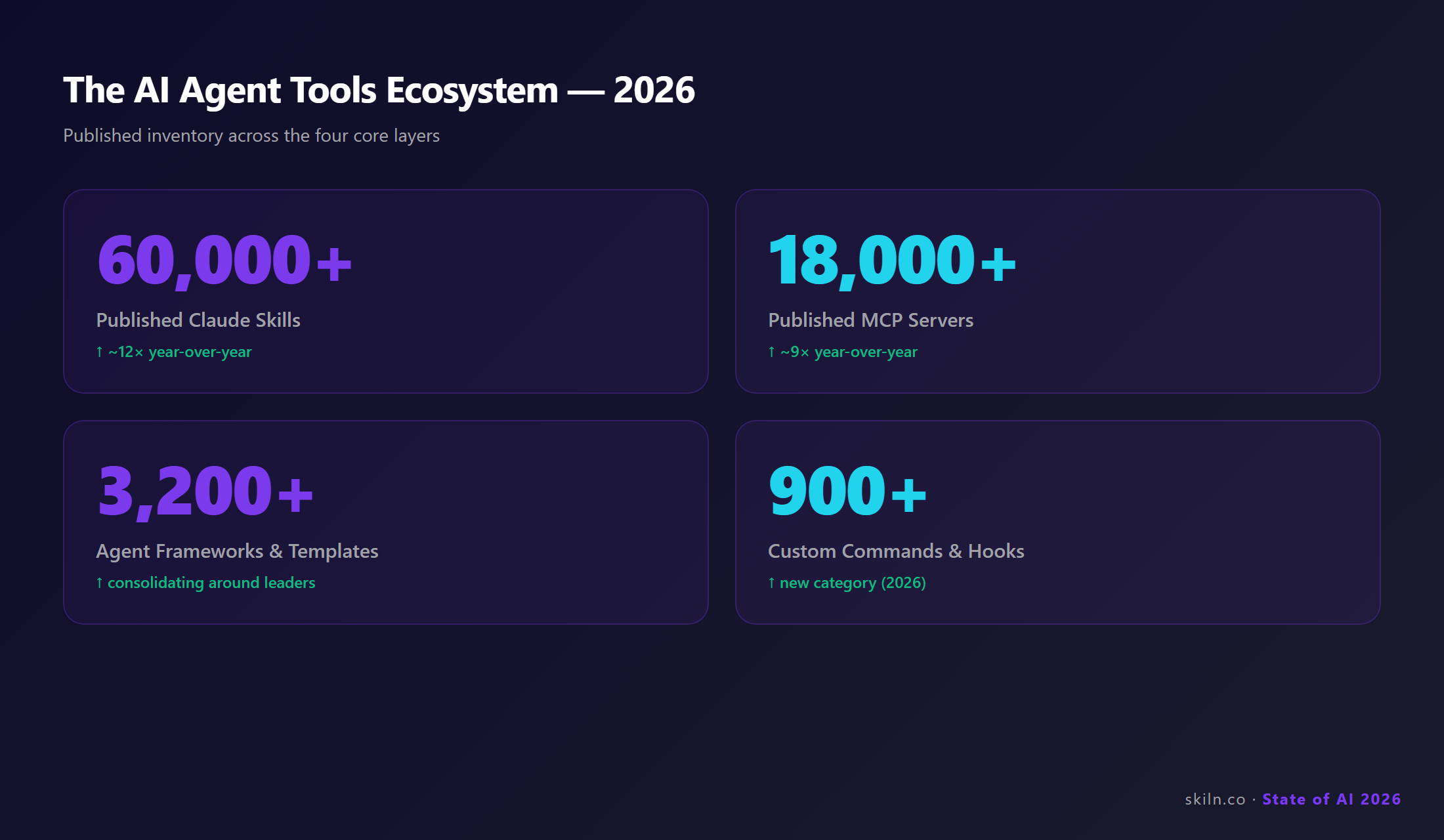
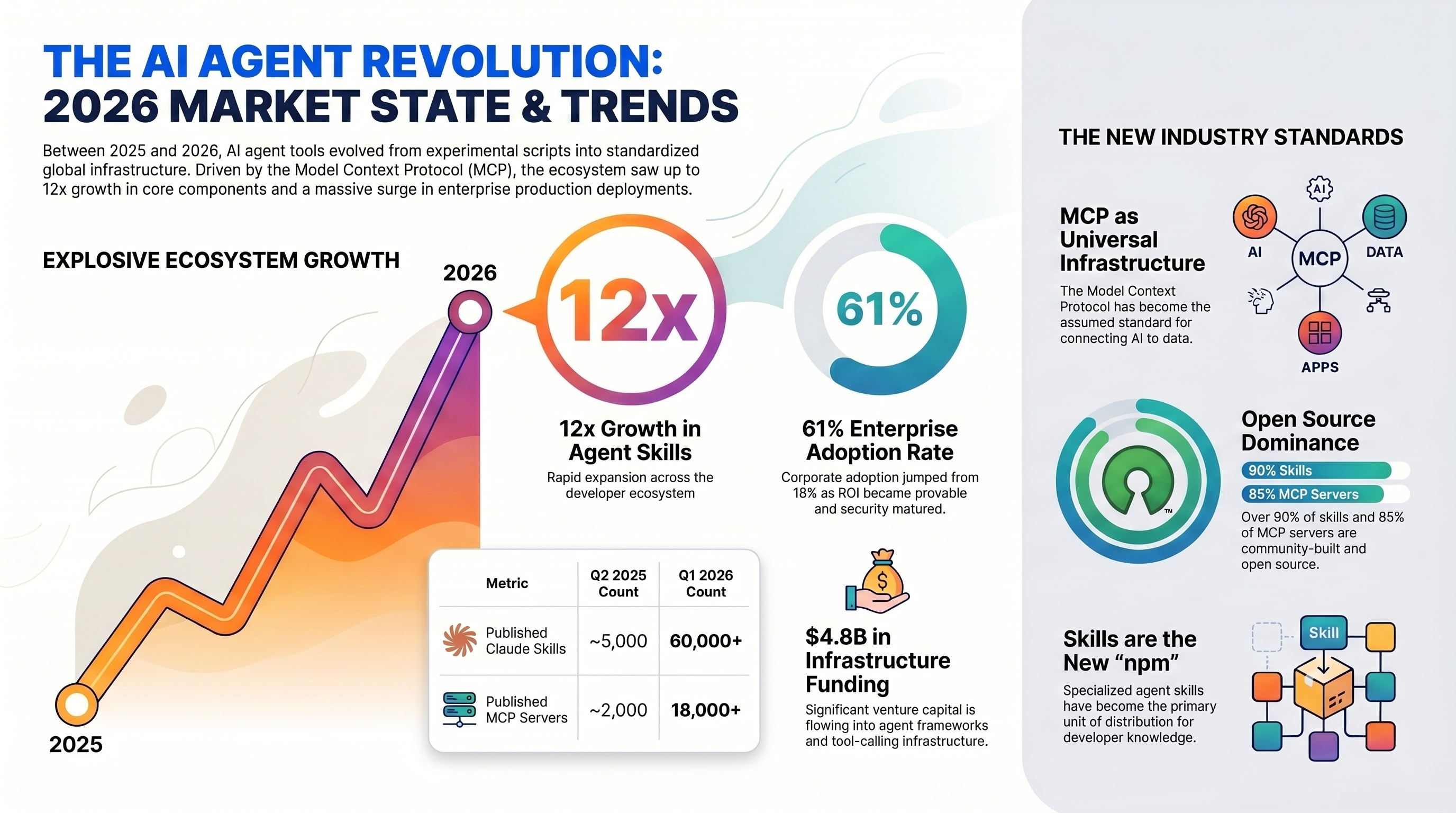
The AI agent tools ecosystem is no longer emerging. It is established infrastructure. Here are the numbers as of March 2026:
| Metric | Count | YoY Growth |
|---|---|---|
| -------- | ------- | ------------ |
| Published Claude Skills | 60,000+ | ~12x |
| Published MCP Servers | 18,000+ | ~9x |
| Agent Frameworks & Templates | 3,200+ | ~4x |
| Custom Commands & Hooks | 900+ | New category |
| MCP Protocol GitHub Stars | 79,000+ | ~5x |
| VC Funding in Agent Infra | $4.8B (67 deals) | ~3x |
| Enterprise Adoption | 61% of eng orgs | Up from 18% |
The ecosystem grew 5-12x in 12 months depending on the segment. Every leading indicator — GitHub activity, funding, job postings, enterprise surveys — points to continued acceleration.
Table of Contents
- Where We Were 12 Months Ago
- The Ecosystem by the Numbers
- Market Map: Who Builds What
- Five Trends Defining 2026
- The MCP Effect: How One Protocol Changed Everything
- Open Source vs. Commercial: The Balance Shifts
- What Is Missing: Gaps in the Ecosystem
- Predictions for the Next 12 Months
- Frequently Asked Questions
Where We Were 12 Months Ago {#where-we-were}
In March 2025, the AI agent tools landscape looked fundamentally different.
Claude Code had been available for a few months. It was impressive but isolated — there were no skills, no MCP servers beyond Anthropic's reference implementations, and no real ecosystem to speak of. Developers who wanted to extend Claude's capabilities had to write custom system prompts or build bespoke integrations.
MCP existed as a protocol but had limited adoption. The reference repository had about 15,000 GitHub stars and maybe 2,000 community-built servers. Most developers had heard of MCP but had not tried it.
The term "Claude Skill" did not exist yet. What we now call skills were ad-hoc markdown files — CLAUDE.md documents that teams shared informally. There was no standardized format, no directory, and no distribution mechanism.
Agent frameworks were plentiful but fragmented. LangChain, AutoGPT, CrewAI, and a dozen others competed for mindshare, but none had achieved clear dominance. Interoperability between frameworks was nonexistent — tools built for one framework did not work with another.
Enterprise adoption of AI agents was at 18% according to Forrester's Q1 2025 survey. Most organizations were "experimenting" or "evaluating." Production deployments were rare and typically limited to narrow automation tasks.
Twelve months later, every one of these numbers looks like it was from a different era.
The Ecosystem by the Numbers {#ecosystem-numbers}
I track these numbers weekly through the Skiln.co directory, which indexes entries from 11 different sources across skills, MCP servers, agents, commands, and hooks. Here is where the ecosystem stands as of the last week of March 2026.
Skills: 60,000+ and Accelerating
The Claude Skills ecosystem is the largest single category in AI agent tooling. Growth has been exponential since Anthropic formalized the skill format in mid-2025:
| Quarter | Approximate Skill Count | Growth |
|---|---|---|
| --------- | ------------------------ | -------- |
| Q2 2025 | ~5,000 | Baseline |
| Q3 2025 | ~12,000 | 2.4x |
| Q4 2025 | ~28,000 | 2.3x |
| Q1 2026 | ~60,000+ | 2.1x |
The growth rate is compressing slightly quarter-over-quarter, which is normal for a maturing ecosystem, but the absolute numbers are still increasing by roughly 10,000-15,000 skills per quarter.
The most popular skill categories: development workflows (22%), code generation patterns (18%), testing and QA (14%), documentation (11%), security (9%), and domain-specific skills for industries like healthcare, finance, and legal (26%).
Browse the full catalog at skiln.co/skills.
MCP Servers: 18,000+ Across Every Major Platform
MCP server growth has been driven by two forces: developer-built community servers and first-party integrations from platform companies.
| Quarter | Approximate MCP Server Count | Growth |
|---|---|---|
| --------- | ------------------------------ | -------- |
| Q2 2025 | ~2,000 | Baseline |
| Q3 2025 | ~4,500 | 2.25x |
| Q4 2025 | ~9,000 | 2x |
| Q1 2026 | ~18,000+ | 2x |
The most significant development in Q1 2026 was the wave of official MCP servers from major platforms. GitHub, Supabase, Cloudflare, Notion, Slack, Linear, Figma, and Datadog all shipped first-party MCP servers. This is a clear signal that the enterprise market takes MCP seriously — these companies do not build integrations for protocols they expect to be abandoned.
For the best servers by category, see our top MCP servers for developers and best MCP servers for data engineers guides.
Agent Frameworks: 3,200+ and Consolidating
Unlike skills and MCP servers, the agent framework space is consolidating rather than expanding. The number of published frameworks grew modestly (from about 800 to 3,200), but the market is concentrating around a small number of winners:
- Claude Code — The dominant CLI agent for developers. First-party advantage.
- NanoClaw — Lightweight, Docker-sandboxed. 24,700 GitHub stars.
- OpenClaw — Enterprise-grade with the largest skill marketplace.
- CrewAI — Multi-agent orchestration leader.
- LangGraph — LangChain's agent runtime.
- AutoGPT — The original autonomous agent, now significantly improved.
See our best AI agent frameworks comparison for a detailed ranking.
Commands, Hooks, and the Long Tail
Hooks (lifecycle automation) and custom commands (prompt shortcuts) are newer extension types that shipped in late 2025. The ecosystem is smaller — roughly 900 published entries — but growing quickly as developers discover the automation potential.
Hooks have found particular traction in CI/CD workflows, where teams use them to run linting, security scans, or documentation updates automatically when Claude modifies code. Commands are popular as team-specific shortcuts for common tasks like code review, deployment, and bug triage.
For a primer on all five extension types, read Claude Skills vs MCP Servers vs Plugins.
Market Map: Who Builds What {#market-map}
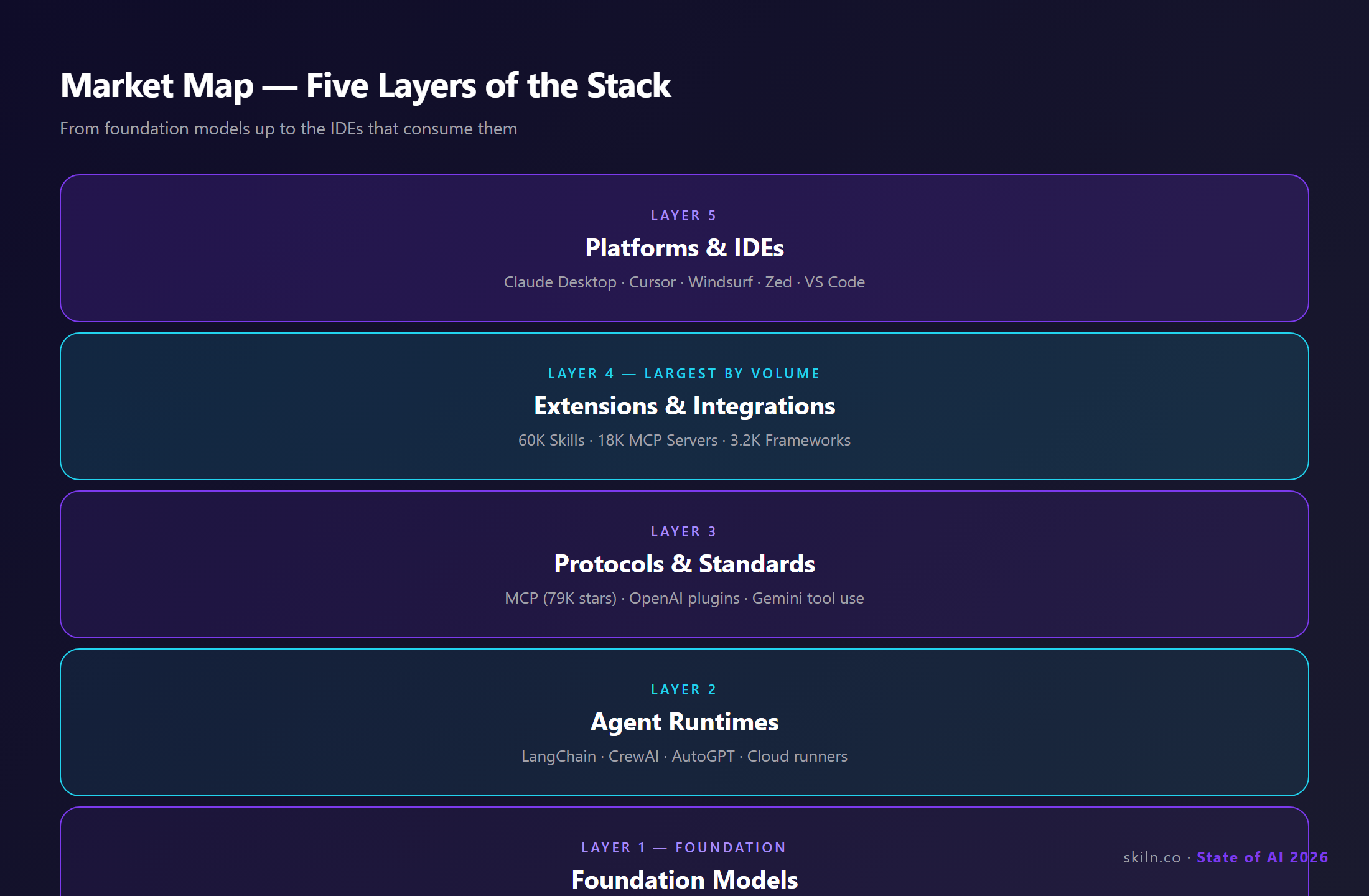
The AI agent tools market breaks down into five layers:
Layer 1: Foundation Models
The models that power agents. Anthropic (Claude), OpenAI (GPT), Google (Gemini), Meta (Llama), and Mistral. Claude is the dominant model for agent-based development work due to its code comprehension, long context, and first-mover advantage with Claude Code.
Layer 2: Agent Runtimes
The frameworks and platforms that orchestrate agents. Claude Code, NanoClaw, OpenClaw, CrewAI, LangGraph, AutoGPT, Semantic Kernel. This layer handles tool calling, memory, sandboxing, and multi-step planning.
Layer 3: Protocols and Standards
MCP dominates this layer. The protocol's open nature and Anthropic's backing have effectively ended the standards war. OpenAI's function calling and Google's Vertex tool use are compatible but narrower in scope. MCP's tool + resource + prompt trifecta covers more use cases.
Layer 4: Extensions and Integrations
This is the largest layer by volume: 60,000+ skills, 18,000+ MCP servers, and thousands of templates, commands, and hooks. This is where the Skiln.co directory operates — indexing and curating this layer to make it discoverable.
Layer 5: Platforms and IDEs
The interfaces where developers interact with agents. Claude Desktop, VS Code (with Copilot or Claude extensions), Cursor, Windsurf, JetBrains AI, Zed. These platforms consume MCP servers and skills, making them accessible to developers through familiar tools.
Five Trends Defining 2026 {#five-trends}
Trend 1: Skills Are the New Packages
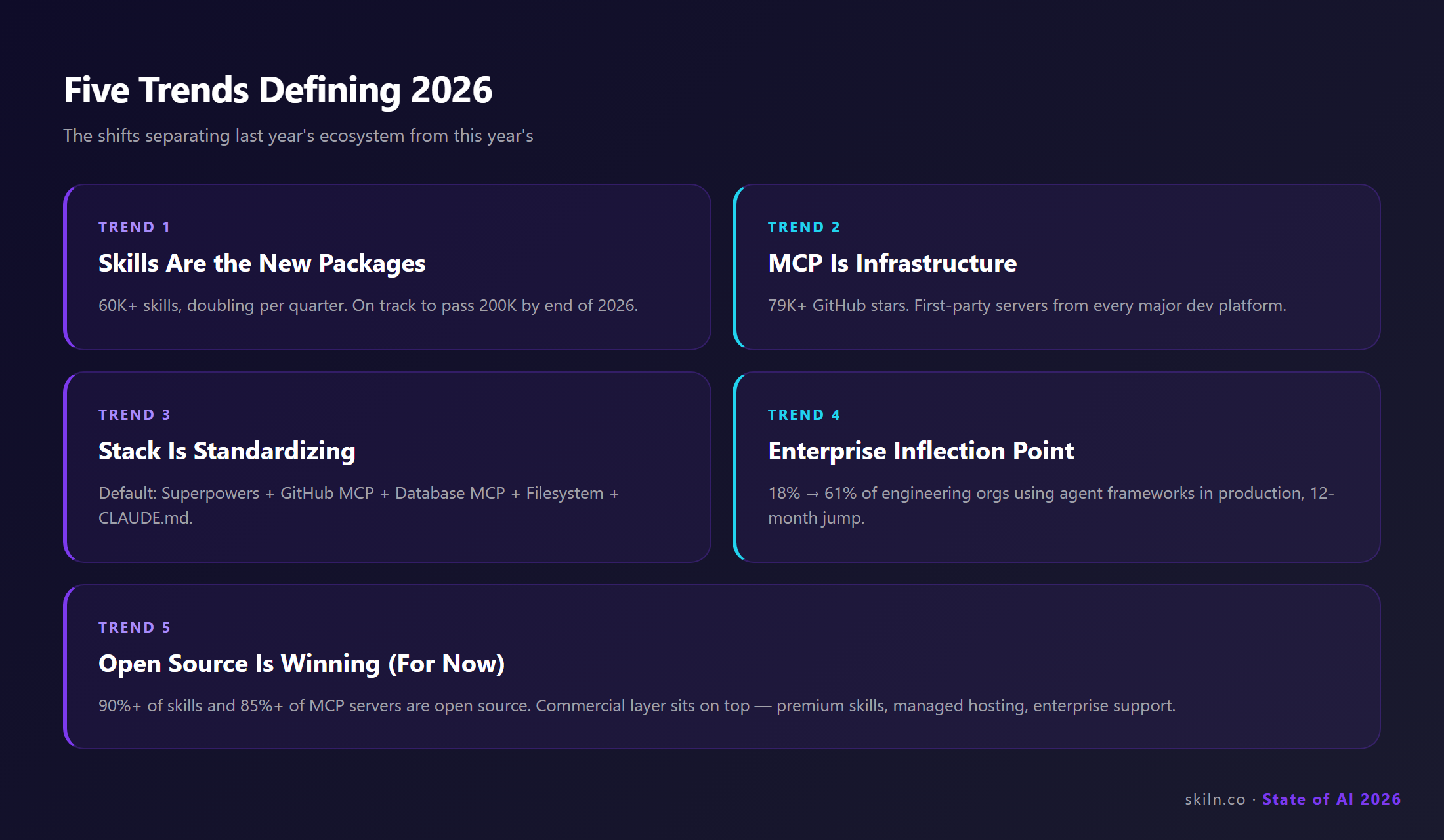
The most significant trend in 2026 is the emergence of skills as a new distribution unit for developer knowledge. Skills are to AI agents what npm packages are to Node.js — shareable, composable, and specialized.
The comparison is more than an analogy. npm has 2.5 million packages. Claude skills are at 60,000 and growing 2x per quarter. At current growth rates, the skill ecosystem will pass 200,000 by the end of 2026. The same dynamics that drove npm's growth — low barriers to creation, easy distribution, network effects — are present in the skill ecosystem.
Trend 2: MCP Is Becoming Infrastructure
MCP has crossed the threshold from "interesting protocol" to "assumed infrastructure." When a developer sets up a new project in 2026, configuring MCP servers is as routine as setting up a linter or CI pipeline.
The evidence: 79,000+ GitHub stars on the reference repo. First-party servers from every major developer platform. Integration in every major IDE. The question is no longer "should I use MCP?" but "which MCP servers do I need?"
Trend 3: The Agent Tool Stack Is Standardizing
A clear "default stack" has emerged for AI-assisted development in 2026:
- Skills: Superpowers + 2-3 domain-specific skills
- MCP Servers: GitHub + Database + Filesystem + 1-2 specialty servers
- CLAUDE.md: Project-level configuration file
- Hooks: Pre-commit linting and test validation
This standardization is healthy. It means onboarding new team members is faster, shared configurations are transferable, and best practices are codified.
Trend 4: Enterprise Adoption Hit the Inflection Point
The jump from 18% to 61% enterprise adoption in 12 months is dramatic by any measure. Three factors broke the logjam:
- Security matured. Docker-sandboxed execution, read-only MCP modes, and audit logging addressed the top enterprise concerns.
- ROI became provable. Engineering teams could measure time saved per developer per week and calculate concrete return on investment.
- Procurement simplified. Instead of evaluating 50 different AI tools, enterprises could adopt Claude Code + MCP servers and get a unified platform.
Trend 5: Open Source Is Winning (For Now)
Over 90% of skills and 85% of MCP servers are open source. The commercial layer sits on top — premium skills, managed MCP hosting, enterprise support — but the core ecosystem is free.
This matters because it means the ecosystem is permissionless. Anyone can build and distribute a skill or MCP server without approval from Anthropic, a marketplace, or a gatekeeper. That permissionless innovation is what drives the exponential growth.
The MCP Effect: How One Protocol Changed Everything {#mcp-effect}
MCP deserves its own section because its impact on the ecosystem is hard to overstate.
Before MCP, every AI tool integration was bespoke. If you wanted Claude to query your database, you wrote a custom system prompt and hoped the model figured out the SQL. If you wanted ChatGPT to manage your GitHub, you built a custom plugin. None of these integrations were portable.
MCP created a universal interface. Build an MCP server once, and it works with every compatible AI client — Claude, ChatGPT, Gemini, Cursor, Windsurf, and dozens of others. This portability eliminated the biggest barrier to ecosystem growth: vendor lock-in risk.
The numbers tell the story. In the 6 months before MCP hit critical mass (Q3-Q4 2025), the combined AI tool integration ecosystem grew about 2x. In the 6 months after (Q4 2025-Q1 2026), it grew 4x. MCP did not just accelerate growth — it changed the growth rate itself.
For developers who want to build their own MCP servers, our TypeScript tutorial covers the entire process in 10 minutes.
Open Source vs. Commercial: The Balance Shifts {#open-vs-commercial}
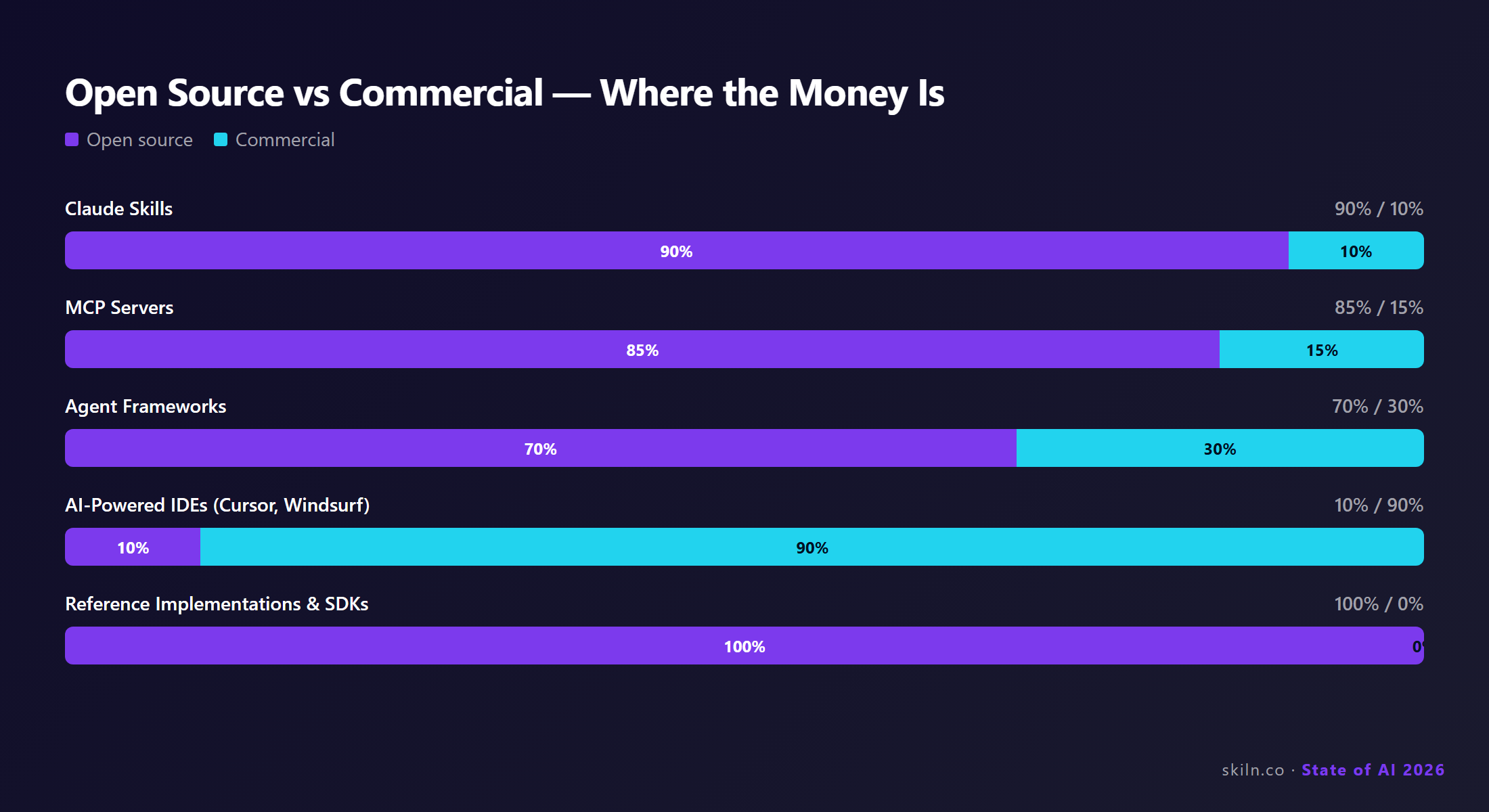
The AI agent tools market has an unusual economic structure. The protocol layer (MCP) is open. The extension layer (skills, servers) is overwhelmingly open source. The money is made at the edges:
Where open source dominates:
- MCP servers (85%+ open source)
- Claude skills (90%+ open source)
- Agent frameworks (70%+ open source)
- Reference implementations and SDKs (100% open source)
Where commercial models work:
- Premium/enterprise skills with support contracts ($39-$99 per skill kit)
- Managed MCP server hosting (serverless MCP-as-a-service)
- Enterprise agent platforms with compliance and audit features
- AI-powered IDEs (Cursor, Windsurf subscription models)
- Directory and marketplace platforms (listing fees, verification badges)
The open core model — open source foundation with commercial premium layer — is the dominant business model. This mirrors the trajectory of previous developer tool ecosystems like npm (free packages, paid registry features), Docker (free runtime, paid enterprise platform), and Kubernetes (open source orchestrator, paid managed offerings).
What Is Missing: Gaps in the Ecosystem {#gaps}
Category Metric Published Counts YoY Growth Dominant Players/Categories Open Source % Market Layer Source Skills Published Claude Skills 60,000 12x Development workflows (22%), Code generation (18%), Testing & QA (14%) 90% or more Layer 4: Extensions and Integrations [1] MCP Servers Published MCP Servers 18,000 9x GitHub, Supabase, Cloudflare, Notion, Slack, Linear, Figma, Datadog 85% or more Layer 4: Extensions and Integrations / Layer 3: Protocols and Standards [1] Agent Frameworks Agent Frameworks & Templates 3,200 4x Claude Code, NanoClaw, OpenClaw, CrewAI, LangGraph, AutoGPT 70% or more Layer 2: Agent Runtimes [1] Commands & Hooks Custom Commands & Hooks 900 New category CI/CD automation, Linting, Security scans, Team-specific shortcuts Not in source Layer 4: Extensions and Integrations [1]
Despite the explosive growth, the AI agent tools ecosystem has notable gaps:
Testing and quality assurance for skills. There is no standardized way to test whether a skill actually does what it claims. No unit tests, no benchmarks, no regression checks. The community relies on reviews and stars, which are lagging indicators.
Discovery remains unsolved. With 60,000+ skills and 18,000+ MCP servers, finding the right tool for a specific use case is genuinely difficult. Directories like Skiln.co help, but the search and recommendation experience is still primitive compared to, say, the VS Code extension marketplace.
Multi-agent coordination. Most agent tools assume a single-agent model. Patterns for multiple agents collaborating on a shared task — with proper state management, conflict resolution, and progress tracking — are still immature.
Observability and debugging. When an MCP server call fails or a skill produces unexpected behavior, debugging is painful. There are no standardized logging formats, no distributed tracing, and no equivalent of browser DevTools for the agent stack.
Non-English ecosystem. The overwhelming majority of skills, documentation, and community discussion is in English. The ecosystem is underserving the global developer community.
Predictions for the Next 12 Months {#predictions}
Based on the data and trends analyzed in this report, here are five predictions for the AI agent tools ecosystem by March 2027:
1. Skills will pass 200,000 entries. The current growth rate of 2x per quarter is sustainable for at least two more quarters before market saturation begins to compress it. Even at a reduced growth rate of 1.5x per quarter in H2 2026, the math leads to 200,000+.
2. MCP will become a de facto standard endorsed by multiple AI labs. OpenAI has already added MCP support. Google will follow. By early 2027, every major AI platform will treat MCP as a first-class integration point.
3. The first "MCP-native" companies will reach significant scale. Startups building entirely on the MCP ecosystem — MCP-based SaaS products, MCP marketplace platforms, MCP security and compliance tools — will begin to raise Series A and B rounds.
4. Enterprise adoption will pass 80%. The jump from 61% to 80% is smaller than the jump from 18% to 61%. The remaining holdouts will adopt as their competitors demonstrate competitive advantages.
5. A quality crisis will force standardized testing. As the ecosystem grows, the ratio of high-quality to low-quality skills and servers will decline. A high-profile security incident or reliability failure will catalyze industry-wide efforts to standardize quality assurance for agent tools.
50 total flashcards generated. Showing 6 most representative.Test your knowledge — 6 key facts
Frequently Asked Questions {#faq}
How big is the AI agent tools market in 2026?
The AI agent tools ecosystem includes over 60,000 published skills, 18,000+ MCP servers, 3,200+ agent frameworks, and 900+ custom commands and hooks. Venture funding into agent infrastructure exceeded $4.8 billion across 67 deals. Enterprise adoption surveys report 61% of engineering organizations use at least one agent framework in production.
What is MCP and why does it matter?
MCP (Model Context Protocol) is an open protocol created by Anthropic that standardizes how AI agents connect to external tools and data sources. It creates interoperability — an MCP server built for Claude works identically with ChatGPT, Gemini, Cursor, and other clients. MCP has over 79,000 GitHub stars and 18,000+ published servers as of March 2026.
Is the AI agent tools market growing or plateauing?
Growing rapidly. The MCP ecosystem grew 9x in 12 months. The skills ecosystem grew 12x. GitHub stars across the top 10 agent frameworks grew 340% year-over-year. Every leading indicator points to continued acceleration through 2026 and 2027.
Which companies are the biggest players in AI agent tools?
Anthropic leads with Claude Code and MCP. OpenAI competes with ChatGPT Plugins and the Assistants API. Google has Gemini with tool use. Cursor and Windsurf lead AI-powered IDEs. LangChain, CrewAI, and AutoGPT are major open-source frameworks. Platform companies like Supabase, GitHub, and Cloudflare have invested heavily in first-party MCP servers.
Where can I browse the AI agent tools ecosystem?
Skiln.co maintains one of the largest curated directories with 16,000+ entries across skills, MCP servers, agents, commands, and hooks. Other directories include Smithery (MCP-focused), PulseMCP, the awesome-mcp-servers GitHub repo, and LobeHub. For skills specifically, SkillsDirectory and OneSKILL are dedicated catalogs.
This report draws on data from the Skiln.co directory, which indexes 16,000+ entries from 11 sources across the AI agent tools ecosystem. For real-time data, browse the skills directory, MCP directory, and agents directory.