Best AI Agent Frameworks in 2026: NanoClaw, OpenClaw & More
Ranked comparison of the 8 best AI agent frameworks in 2026. NanoClaw, OpenClaw, CrewAI, LangGraph, AutoGPT, and more — with features, ratings, and install commands.
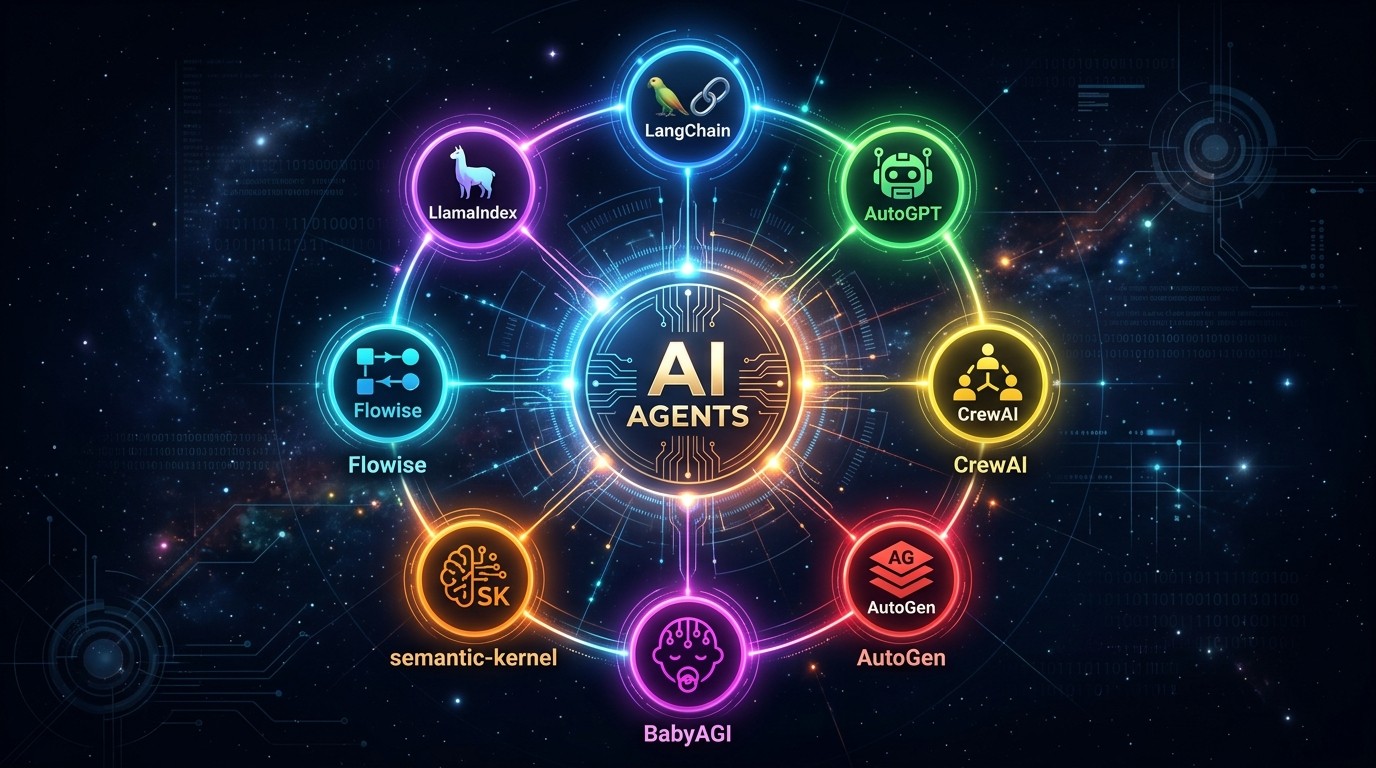
TL;DR: Top 3 Picks
The AI agent framework market crossed $4.8 billion in funding in 2026, and every major AI lab now ships its own orchestration layer. Here are the three frameworks that stood out in testing:
- NanoClaw — Lightweight, Docker-sandboxed, built on the Claude Agent SDK. The fastest path from install to working agent. Best for solo developers and small teams. 4.8/5
- OpenClaw — Full-featured platform with ClawHub marketplace (13,000+ skills). The enterprise choice for teams that need governance, audit logs, and a prebuilt plugin ecosystem. 4.6/5
- CrewAI — Multi-agent orchestration with role-based task delegation. The strongest option for complex workflows that require multiple specialized agents collaborating. 4.5/5
Table of Contents
- The AI Agent Framework Landscape in 2026
- How We Ranked These Frameworks
- The Top 8 AI Agent Frameworks
- Full Comparison Table
- Decision Guide: Which Framework for Which Use Case
- The Role of MCP in Agent Frameworks
- Pros and Cons Summary
- Frequently Asked Questions
The AI Agent Framework Landscape in 2026
Twelve months ago, "AI agent" meant a chatbot with tool-calling bolted on. The agent ran in a loop, made a function call, received a result, decided whether to loop again or stop. That was about it.
2026 changed the definition entirely. Agents now manage multi-step workflows across dozens of external services, persist memory between sessions, operate inside security sandboxes, and coordinate with other agents in real time. The underlying model matters less than the orchestration layer around it — and that layer is where the framework wars are being fought.
The numbers reflect the shift. GitHub stars across the top 10 agent frameworks grew 340% year-over-year, from a combined 89,000 in March 2025 to over 390,000 in March 2026. Venture funding into agent infrastructure companies exceeded $4.8 billion across 67 deals. Enterprise adoption surveys from Gartner and Forrester both report that 61% of engineering organizations now use at least one agent framework in production, up from 18% a year earlier.
Three forces drove the acceleration:
Model Context Protocol (MCP) became the standard. Anthropic's open protocol for connecting AI agents to external tools reached critical mass in early 2026. Every major framework now supports MCP, which means skills and tool integrations are portable across ecosystems. A Slack MCP server built for NanoClaw works identically inside OpenClaw, LangGraph, or CrewAI. This interoperability eliminated the biggest lock-in risk and lowered switching costs to near zero.
Docker-based sandboxing matured. The security story for AI agents was weak in 2025 — most frameworks ran tools with the same permissions as the host process. NanoClaw popularized the pattern of executing every tool call inside a disposable Docker container with no network access by default. Other frameworks followed. Production teams that previously blocked agent adoption due to security concerns now had a defensible architecture.
The skills marketplace model proved out. OpenClaw's ClawHub crossed 13,000 published skills in February 2026. NanoClaw's registry passed 4,200. These marketplaces turned agent frameworks from bare-bones SDKs into platforms with network effects — the more skills available, the more developers adopted the framework, which attracted more skill authors.
The result: choosing an AI agent framework in 2026 is no longer a question of "should we?" but "which one?" This guide ranks the eight leading options.
How We Ranked These Frameworks
Every framework on this list was evaluated against five weighted criteria:
| Criteria | Weight | What We Measured |
|---|---|---|
| ---------- | -------- | ------------------ |
| Ease of Setup | 25% | Time from first command to a working agent completing a real task. Includes documentation quality. |
| Security Model | 25% | Sandboxing, permission scoping, network isolation, audit logging. Production readiness. |
| Extensibility | 20% | Plugin/skill ecosystem size, MCP support, custom tool authoring, API surface area. |
| Community & Maintenance | 20% | GitHub stars, commit frequency, issue response time, Discord/forum activity, corporate backing. |
| Cost | 10% | Licensing model, self-hosting requirements, per-seat pricing for commercial tiers. |
We tested each framework by building the same reference application: a multi-step research agent that searches the web, summarizes findings into a structured report, saves results to a database, and sends a Slack notification on completion. This controlled comparison eliminated variables around use-case fit and isolated framework-level differences.
The Top 8 AI Agent Frameworks
1. NanoClaw
NanoClaw is a lightweight, Docker-sandboxed agent framework built on top of the Claude Agent SDK. It launched in late 2025 and grew to 24,700 GitHub stars by March 2026, making it the fastest-growing agent framework in the ecosystem.
The core philosophy is minimal surface area with maximum security. Every tool execution happens inside an ephemeral Docker container that is destroyed after the call completes. By default, containers have no network access, no filesystem persistence, and no access to the host machine. Developers opt in to specific capabilities through a declarative permissions file (nanoclaw.toml), which makes the security posture auditable at a glance.
NanoClaw's architecture is intentionally simple: a single binary, a TOML config file, and a skills directory. There is no database, no web dashboard, and no orchestration server. Agents run as local processes. This makes it trivially self-hostable and easy to reason about — a critical property for developers who need to understand exactly what their agent can and cannot do.
Key Features:
- Docker sandbox by default — Every tool call runs in an isolated container with no network, no disk persistence, and scoped permissions defined in
nanoclaw.toml - Claude Agent SDK native — Built directly on Anthropic's official SDK, which means first-class support for Claude models, streaming, tool use, and multi-turn conversations
- Sub-second cold start — Pre-warmed container pools keep latency under 800ms for most tool calls, compared to 3-5 seconds for cold Docker starts
- 4,200+ skills in the registry — Growing skill marketplace with community-contributed tools for code analysis, web scraping, database queries, file management, and more
- Single-binary deployment — One
curlcommand installs the CLI. No runtime dependencies beyond Docker. Works on Linux, macOS, and WSL2
Best for: Solo developers, small teams, and security-conscious organizations that want a minimal, auditable agent framework with strong defaults.
Limitations: No built-in multi-agent orchestration. No web UI — everything is CLI-driven. The skill ecosystem is smaller than OpenClaw's. Enterprise features like SSO, audit logs, and role-based access require the paid NanoClaw Pro tier ($29/month per seat).
GitHub Stars: 24,700 Language: Rust (core), TypeScript (SDK bindings) License: Apache 2.0 Install:
curl -fsSL https://nanoclaw.dev/install.sh | bash
nanoclaw init my-agent
Skiln.co Rating: 4.8/5
2. OpenClaw
OpenClaw is the full-featured counterpart to NanoClaw. Where NanoClaw optimizes for simplicity, OpenClaw optimizes for scale. It ships with a web dashboard, a built-in orchestration engine, team management, audit logging, and the ClawHub marketplace — the largest agent skill marketplace with over 13,000 published integrations.
The framework supports any LLM backend through its provider abstraction layer. Claude, GPT-4o, Gemini, Llama, Mistral, and local models via Ollama all work out of the box. This model-agnostic approach makes OpenClaw the default choice for organizations that need flexibility across providers or want to avoid vendor lock-in on the model layer.
OpenClaw's orchestration engine supports directed acyclic graph (DAG) workflows, where multiple agents execute tasks in parallel with dependency resolution. A "research and write" workflow, for example, can spawn three research agents simultaneously, merge their outputs, pass the combined context to a writing agent, then route the draft through a review agent — all defined in a YAML workflow file.
Key Features:
- ClawHub marketplace — 13,000+ skills with verified badges, usage stats, and one-click installation. Categories span developer tools, data analysis, content creation, DevOps, and business automation
- DAG-based orchestration — Define multi-agent workflows as directed acyclic graphs with parallel execution, conditional branching, and retry logic
- Model-agnostic provider layer — Swap between Claude, GPT-4o, Gemini, Llama 3, and Ollama-hosted models with a single config change. No code modifications required
- Enterprise governance — SSO/SAML integration, role-based access control, execution audit logs, cost tracking per agent/team, and SOC 2 Type II compliance
- Web dashboard — Real-time agent monitoring, workflow visualization, skill management, and team analytics through a browser-based interface
Best for: Mid-to-large engineering teams, enterprise organizations that need governance and compliance, and any team that values a prebuilt skill ecosystem over building integrations from scratch.
Limitations: Heavier operational footprint — requires PostgreSQL, Redis, and a Node.js runtime in self-hosted mode. The free tier limits agents to 100 executions per day. Docker sandboxing is available but not the default (tools run in-process unless explicitly configured). The learning curve is steeper than NanoClaw due to the breadth of configuration options.
GitHub Stars: 18,200 Language: TypeScript (core), Python (SDK) License: BSL 1.1 (source-available, free for teams under 10) Install:
npm install -g @openclaw/cli
openclaw init --template quickstart
openclaw up
Skiln.co Rating: 4.6/5
3. AutoGPT / AgentGPT
AutoGPT was the project that started the agent framework conversation in 2023. Three years later, it remains a significant player — though its position has shifted from "the only option" to "the OpenAI ecosystem's default agent framework."
The 2026 rewrite (AutoGPT v2) addressed the original version's biggest flaw: runaway loops. The new architecture introduces a budget system where every agent execution has a configurable token and cost ceiling. When the ceiling is hit, the agent summarizes its progress and stops. This single change made AutoGPT viable for production use cases where unpredictable costs were previously a dealbreaker.
AgentGPT, the browser-based variant, has merged back into the main AutoGPT project as the "AutoGPT Cloud" tier. It offers a hosted agent platform at $49/month with no self-hosting required.
Key Features:
- OpenAI-native integration — First-class support for GPT-4o, GPT-4 Turbo, and the Assistants API. Supports function calling, code interpreter, and retrieval natively
- Budget controls — Configurable token limits, cost ceilings, and loop depth limits per agent run. Prevents the runaway execution problem that plagued earlier versions
- Forge plugin system — 1,800+ community plugins in the AutoGPT Forge marketplace, including web browsing, code execution, email, and CRM integrations
- Memory backends — Pluggable long-term memory with support for Pinecone, Weaviate, ChromaDB, and local JSON storage
- AutoGPT Cloud — Hosted platform with web UI, team collaboration, and managed infrastructure at $49/month per seat
Best for: Teams already invested in the OpenAI ecosystem (GPT-4o, Assistants API, function calling) who want an agent framework that maximizes compatibility with OpenAI's tooling.
Limitations: Tightly coupled to OpenAI models — using Claude or Gemini requires community-maintained adapter plugins that lag behind official releases. Docker sandboxing is available but not as mature as NanoClaw's implementation. The plugin quality in Forge is inconsistent; roughly 40% of listed plugins have not been updated in 6+ months.
GitHub Stars: 162,000 (includes legacy stars from 2023-2024) Language: Python License: MIT Install:
git clone https://github.com/Significant-Gravitas/AutoGPT.git
cd AutoGPT && pip install -e .
autogpt init my-agent
Skiln.co Rating: 4.1/5
4. CrewAI
CrewAI introduced a mental model that immediately resonated with engineering managers: agents as team members with defined roles, goals, and backstories. Instead of configuring tool lists and prompt templates, developers describe agents in human terms — "You are a senior market researcher with 10 years of experience in fintech" — and let the framework handle coordination.
The "crew" abstraction (a group of agents working toward a shared objective) maps naturally to how teams already think about dividing work. A typical CrewAI setup might include a researcher agent, an analyst agent, a writer agent, and a reviewer agent, each with distinct tools and instructions, collaborating through a shared task queue.
CrewAI's 2026 release added hierarchical crews, where a manager agent delegates subtasks to specialist agents and aggregates their outputs. This pattern handles complex workflows that require judgment calls about task ordering — something DAG-based systems cannot do without hardcoding the graph structure upfront.
Key Features:
- Role-based agent design — Define agents with roles, goals, backstories, and tool access. The framework handles delegation and coordination automatically
- Hierarchical crews — Manager agents that dynamically assign tasks to specialists based on workload and capability, with automatic result aggregation
- Process types — Sequential, parallel, and hierarchical execution modes. Switch between them with a single parameter change
- Cross-model support — Works with Claude, GPT-4o, Gemini, Llama, and any OpenAI-compatible API endpoint. Model selection is per-agent, not per-crew
- Task memory — Agents retain context from previous task completions within a crew run, enabling iterative refinement without re-prompting
Best for: Complex workflows that require multiple specialized agents collaborating — research pipelines, content production systems, data analysis workflows, and any multi-step process where tasks have dependencies.
Limitations: Debugging multi-agent interactions is difficult. When a crew produces poor output, tracing which agent made which decision requires enabling verbose logging and manually reading through long execution traces. No Docker sandboxing — tool calls run in-process. The community plugin ecosystem is smaller than AutoGPT or OpenClaw (approximately 600 integrations).
GitHub Stars: 28,400 Language: Python License: MIT Install:
pip install crewai
crewai create my-crew
Skiln.co Rating: 4.5/5
5. LangGraph
LangGraph is LangChain's agent framework, and it inherits both the strengths and baggage of the LangChain ecosystem. The core proposition is graph-based agent orchestration: developers define agents as nodes and tool calls as edges in a stateful graph, with built-in support for cycles, branches, and human-in-the-loop checkpoints.
The graph abstraction provides fine-grained control that higher-level frameworks like CrewAI deliberately abstract away. LangGraph developers specify exactly which nodes can transition to which other nodes, under what conditions, with what state mutations. This level of control is valuable for regulated industries where agent behavior must be deterministic and auditable.
LangGraph Cloud, the hosted version, launched in January 2026 and provides persistent state management, streaming, and a deployment API. It solves the hardest operational problem with stateful agents: resuming a workflow after a failure without re-executing completed steps.
Key Features:
- Graph-based orchestration — Define agent workflows as state machines with nodes (agents/tools), edges (transitions), and conditional routing. Supports cycles for iterative refinement
- Persistent checkpointing — Save and restore agent state at any node. Resume workflows after failures without re-execution. Critical for long-running production agents
- Human-in-the-loop — Built-in interrupt points where the graph pauses, presents current state to a human operator, and resumes based on their input
- LangChain ecosystem — Access to LangChain's 800+ integrations, document loaders, vector stores, and retrieval chains. Largest tool ecosystem outside of OpenClaw's ClawHub
- LangGraph Cloud — Hosted orchestration with REST API, persistent state, streaming responses, and deployment management at $0.005 per graph step
Best for: Teams that need fine-grained control over agent execution flow, particularly in regulated industries (finance, healthcare, legal) where deterministic behavior and audit trails are requirements.
Limitations: The LangChain abstraction layer adds complexity and indirection. Simple tasks require more boilerplate than NanoClaw or CrewAI. LangGraph-specific debugging tools exist but require the paid LangSmith platform ($39/month). The learning curve is the steepest of any framework on this list, with graph theory concepts that may be unfamiliar to application developers.
GitHub Stars: 14,600 Language: Python (primary), TypeScript (beta) License: MIT Install:
pip install langgraphSkiln.co Rating: 4.3/5
6. Claude Agent SDK
The Claude Agent SDK is Anthropic's official framework for building AI agents on Claude. It is not a full-featured orchestration platform like OpenClaw or a multi-agent system like CrewAI — it is the foundational layer that several other frameworks (including NanoClaw) build on top of.
The SDK provides primitives: agent loops, tool definitions, message handling, streaming, and multi-turn conversation management. It handles the mechanics of calling Claude, parsing tool-use responses, executing tools, and feeding results back into the conversation — the core loop that every agent framework needs.
What makes the Claude Agent SDK notable is its direct integration with Anthropic's model capabilities. Features like extended thinking, computer use, and the new agentic coding mode are available in the SDK before they reach third-party frameworks. Teams building Claude-first applications get access to cutting-edge capabilities without waiting for framework maintainers to add support.
Key Features:
- Official Anthropic support — First-party SDK maintained by the Claude team. New model features (extended thinking, computer use, agentic coding) are available here first
- Tool use primitives — Define tools as typed functions with JSON Schema parameters. The SDK handles serialization, invocation, error handling, and result injection
- Multi-agent coordination — The
Agentclass supports spawning sub-agents with scoped tools, enabling hierarchical agent architectures without a separate orchestration framework - Streaming and hooks — Real-time token streaming with lifecycle hooks (on_tool_start, on_tool_end, on_error) for monitoring, logging, and custom behavior injection
- MCP client built in — Native MCP support for connecting to any MCP-compliant tool server. No adapter layer required
Best for: Developers building Claude-first applications who want maximum control over the agent loop without framework opinions. Also the right choice for teams building their own agent framework or custom orchestration layer.
Limitations: Requires writing more code than higher-level frameworks. No built-in skill marketplace — developers must find and configure MCP servers or write tool implementations manually. No Docker sandboxing included (NanoClaw adds this layer). Claude-only; does not support other LLM providers.
GitHub Stars: 9,800 Language: Python (primary), TypeScript License: MIT Install:
pip install anthropic-agent-sdkSkiln.co Rating: 4.4/5
7. Microsoft AutoGen
AutoGen is Microsoft Research's multi-agent conversation framework. Its defining concept is conversable agents — agents that interact with each other and with humans through natural language messages, mimicking how a team of people would collaborate in a group chat.
The conversational approach is genuinely different from DAG-based or role-based frameworks. In AutoGen, developers create agents with system messages and tool access, then place them in a "group chat" where they take turns responding. A user proxy agent represents the human operator. The conversation flows naturally, with agents building on each other's outputs without rigid task assignment.
AutoGen 0.4, released in February 2026, introduced AutoGen Studio — a drag-and-drop web interface for designing multi-agent workflows without writing code. This low-code option broadened AutoGen's appeal beyond developers to business analysts and operations teams.
Key Features:
- Conversable agent architecture — Agents interact through natural language messages in group chats. No rigid task assignment — conversation flows dynamically based on agent capabilities and context
- AutoGen Studio — Visual workflow builder for creating, testing, and deploying multi-agent systems without code. Drag-and-drop agent configuration with live preview
- Human-in-the-loop by default — The UserProxy agent pattern makes human oversight a first-class concept. Agents request human approval before executing sensitive operations
- Code execution sandbox — Built-in Docker-based code execution for agents that generate and run code. Includes output capture, error handling, and iterative debugging loops
- Azure ecosystem integration — Deep integration with Azure OpenAI Service, Azure Functions, Cosmos DB, and the Microsoft 365 Graph API
Best for: Microsoft ecosystem organizations that need multi-agent coordination with strong human oversight. Particularly strong for code generation and data analysis workflows where agents write and execute code iteratively.
Limitations: The conversation-based paradigm can lead to verbose agent interactions that consume tokens rapidly. A task that NanoClaw completes in one tool call may require 5-6 conversational turns in AutoGen. Azure ecosystem integration is a strength for Microsoft shops but adds friction for teams on AWS or GCP. MCP support was added in March 2026 and is still marked as experimental.
GitHub Stars: 41,300 Language: Python (primary), .NET (secondary) License: MIT Install:
pip install autogen-agentchatSkiln.co Rating: 4.2/5
8. Semantic Kernel
Semantic Kernel is Microsoft's AI orchestration SDK — distinct from AutoGen in that it focuses on integrating AI capabilities into existing applications rather than building standalone agent systems. Where AutoGen creates autonomous agents that converse, Semantic Kernel creates "AI-enhanced functions" that fit into traditional software architectures.
The framework's strength is its enterprise integration story. Semantic Kernel connects to Microsoft 365, Dynamics 365, Power Platform, Azure AI, and Dataverse with official connectors maintained by Microsoft's product teams. For organizations already running on the Microsoft stack, Semantic Kernel slots into existing codebases with minimal architectural changes.
The 2026 release added agent orchestration (previously Semantic Kernel was tools-only, no agent loop), bringing it into direct competition with the other frameworks on this list. The agent layer is built on the same planner architecture that powers Microsoft Copilot, which means it benefits from the production hardening of a system that handles millions of requests daily.
Key Features:
- Enterprise connector library — 200+ official connectors to Microsoft 365, Dynamics, Power Platform, Azure services, SAP, Salesforce, and ServiceNow. Maintained by Microsoft product teams
- Planner architecture — The same AI planning system that powers Microsoft Copilot. Handles complex multi-step tasks with automatic plan generation, execution, and error recovery
- Multi-language SDK — Full feature parity across C#, Python, and Java. The only framework on this list with native Java support
- Memory and RAG built in — Integrated vector store, embedding generation, and retrieval-augmented generation without external dependencies
- Telemetry and observability — OpenTelemetry integration for distributed tracing, metrics, and logging. Production monitoring out of the box
Best for: Enterprise organizations on the Microsoft stack that need to add AI agent capabilities to existing .NET or Java applications. Particularly strong for Copilot-style experiences embedded in business applications.
Limitations: Agent orchestration is the newest layer and less mature than the tool/function calling features. The framework is optimized for Azure OpenAI Service — using Claude or other providers requires the community-maintained "AI connectors" which have inconsistent feature coverage. The enterprise focus means simpler use cases carry unnecessary complexity. Not suitable for lightweight or experimental projects.
GitHub Stars: 23,500 Language: C# (primary), Python, Java License: MIT Install:
dotnet add package Microsoft.SemanticKernelSkiln.co Rating: 4.0/5
Full Comparison Table
| Framework | Language | Security Model | Skills/Plugins | Self-Hosting | Docker Sandbox | MCP Support | Price |
|---|---|---|---|---|---|---|---|
| ----------- | ---------- | --------------- | ---------------- | ------------- | ---------------- | ------------- | ------- |
| NanoClaw | Rust/TS | Docker sandbox (default) | 4,200+ | Yes (single binary) | Default | Native | Free / $29/mo Pro |
| OpenClaw | TypeScript | Configurable sandbox | 13,000+ (ClawHub) | Yes (Postgres + Redis) | Optional | Native | Free (100/day) / $79/mo Team |
| AutoGPT | Python | Budget controls | 1,800+ (Forge) | Yes | Available | Community plugin | Free / $49/mo Cloud |
| CrewAI | Python | In-process | ~600 | Yes | No | Via LangChain | Free (MIT) |
| LangGraph | Python/TS | Checkpointing | 800+ (LangChain) | Yes | No | Via adapter | Free / $0.005/step Cloud |
| Claude Agent SDK | Python/TS | None (bare SDK) | MCP ecosystem | Yes | No (use NanoClaw) | Native | Free (MIT) |
| AutoGen | Python/.NET | Code sandbox | ~400 | Yes | Code execution only | Experimental | Free (MIT) |
| Semantic Kernel | C#/Python/Java | Enterprise RBAC | 200+ connectors | Yes | No | No (planned) | Free (MIT) |
Decision Guide: Which Framework for Which Use Case
Choosing an agent framework is not about finding the "best" one. It is about matching the framework's strengths to the specific constraints of the project.
Personal AI Assistant
Pick: NanoClaw
The use case: a local agent that handles daily tasks — searching files, managing calendars, drafting emails, running code, querying databases. It runs on a developer's laptop and needs to be fast, secure, and low-maintenance.
NanoClaw wins here because of its single-binary install, Docker sandboxing by default, and CLI-first design. There is no server to maintain, no database to back up, and no web UI to secure. The agent starts in under a second and the Docker sandbox ensures that a misfire cannot damage the host system. The 4,200-skill registry covers the most common personal automation tasks out of the box.
Enterprise Automation Platform
Pick: OpenClaw
The use case: a shared agent platform for a 50-person engineering team. Multiple agents handle CI/CD automation, incident response, code review, and documentation generation. The platform needs governance, audit logs, cost tracking, and SSO integration.
OpenClaw is the only framework on this list built for this scenario. The web dashboard provides visibility into agent execution across teams. ClawHub's 13,000+ skills mean most integrations already exist. The DAG-based orchestration engine handles complex multi-step workflows. And the BSL license ensures that the source code is inspectable even in regulated environments.
For organizations on the Microsoft stack, Semantic Kernel is a strong alternative — particularly if the agents need to interact with Microsoft 365, Dynamics, or Power Platform.
Research and Experimentation
Pick: CrewAI or LangGraph
The use case: a research team exploring multi-agent architectures, testing different collaboration patterns, or prototyping novel agent workflows. Flexibility and rapid iteration matter more than production readiness.
CrewAI's role-based agent design makes it the fastest framework for prototyping multi-agent systems. A researcher can define a new crew with three agents in under 20 lines of Python and immediately test how they interact. The mental model is intuitive, the boilerplate is minimal, and the per-agent model selection enables comparing Claude vs. GPT-4o vs. Llama on the same task.
LangGraph is the better choice when the research requires fine-grained control over agent state transitions. Its graph-based architecture makes it possible to model complex interaction patterns (cycles, conditional branches, human checkpoints) that higher-level frameworks abstract away.
OpenAI Ecosystem Projects
Pick: AutoGPT
The use case: a team building on OpenAI's platform — using GPT-4o, the Assistants API, function calling, and code interpreter. The agent framework needs to integrate tightly with OpenAI's tooling rather than treating it as one provider among many.
AutoGPT's deep OpenAI integration means features like the Assistants API, retrieval, and code interpreter work natively without adapter layers. The budget control system (unique among frameworks) prevents the cost overruns that made earlier AutoGPT versions impractical. And the legacy community — the largest in the agent space — means most questions have already been answered on forums and in tutorials.
Embedded AI in Existing Applications
Pick: Claude Agent SDK or Semantic Kernel
The use case: adding AI agent capabilities to an existing application — a SaaS product, an internal tool, or a customer-facing service. The agent needs to fit into the application's existing architecture rather than replacing it.
The Claude Agent SDK provides the thinnest possible abstraction. Developers get the agent loop, tool definitions, and streaming — nothing more. This makes it ideal for teams that have specific requirements about how the agent integrates with their existing codebase and do not want framework opinions about architecture.
Semantic Kernel serves the same purpose for Microsoft-stack applications. Its connector library and planner architecture are designed to bolt onto existing .NET or Java services.
The Role of MCP in Agent Frameworks
Model Context Protocol (MCP) is the reason the 2026 agent framework landscape looks fundamentally different from 2025. Before MCP, every framework maintained its own plugin format. A tool built for LangChain did not work in AutoGPT. A NanoClaw skill could not run inside CrewAI. Developers either committed to one ecosystem or maintained parallel implementations.
MCP eliminated that fragmentation. The protocol defines a standard interface for AI agents to discover and invoke external tools. An MCP server exposes a set of tools with typed parameters and return values. Any MCP-compatible client — regardless of framework — can connect to that server and use its tools.
The practical impact is significant. As of March 2026:
- NanoClaw and the Claude Agent SDK have native MCP support built into their core libraries
- OpenClaw added native MCP support in its January 2026 release and now indexes MCP servers alongside ClawHub skills
- LangGraph supports MCP through an adapter layer that translates MCP tool definitions into LangChain tool objects
- CrewAI accesses MCP servers via the LangChain integration layer
- AutoGen shipped experimental MCP support in March 2026
- AutoGPT relies on a community-maintained MCP plugin
- Semantic Kernel has MCP support on its 2026 Q2 roadmap
For teams evaluating frameworks, MCP support is a signal of ecosystem alignment. Frameworks with native MCP support can access the broadest set of tools with the least friction. Frameworks that require adapters or community plugins introduce an additional failure point and typically lag behind on new MCP features.
Skiln.co indexes skills and MCP servers across all of these ecosystems, providing a unified discovery layer regardless of which framework a developer uses. A skill listed on Skiln works with any MCP-compatible framework — the install command and configuration differ, but the underlying tool is the same.
Pros and Cons Summary
NanoClaw
Pros
- ✓ Docker sandboxing by default — the strongest security posture of any framework
- ✓ Sub-second cold start with pre-warmed container pools
- ✓ Single-binary install with no runtime dependencies beyond Docker
- ✓ Native Claude Agent SDK foundation provides first-class Anthropic model support
- ✓ Clean, auditable permission model via
nanoclaw.toml - ✓ Active community with 24.7K GitHub stars and weekly releases
Cons
- ✗ No built-in multi-agent orchestration
- ✗ CLI-only — no web dashboard or visual workflow builder
- ✗ Smaller skill ecosystem (4,200) compared to OpenClaw (13,000+)
- ✗ Enterprise features locked behind $29/month Pro tier
- ✗ Claude-first design limits flexibility with other model providers
OpenClaw
Pros
- ✓ Largest skill marketplace at 13,000+ ClawHub integrations
- ✓ Model-agnostic provider layer supports all major LLMs
- ✓ Enterprise-grade governance with SSO, RBAC, audit logs, and SOC 2 compliance
- ✓ DAG-based orchestration engine for complex multi-step workflows
- ✓ Web dashboard for real-time monitoring and team management
- ✓ Source-available license allows code inspection even in regulated environments
Cons
- ✗ Heavy operational footprint (PostgreSQL, Redis, Node.js runtime)
- ✗ Free tier limited to 100 executions per day
- ✗ Docker sandboxing is optional, not default — less secure out of the box
- ✗ Steeper learning curve due to breadth of configuration options
- ✗ BSL license restricts commercial use for teams over 10 without a paid plan
AutoGPT
Pros
- ✓ Largest community in the agent space (162K GitHub stars)
- ✓ Deep OpenAI ecosystem integration (Assistants API, code interpreter, retrieval)
- ✓ Budget controls prevent cost overruns on autonomous runs
- ✓ Hosted Cloud option at $49/month eliminates self-hosting complexity
Cons
- ✗ Tightly coupled to OpenAI — using other providers requires unmaintained adapters
- ✗ Plugin quality in Forge marketplace is inconsistent
- ✗ Star count is inflated by 2023-era hype; active development community is smaller than raw numbers suggest
- ✗ No native MCP support
CrewAI
Pros
- ✓ Intuitive role-based agent design maps naturally to team workflows
- ✓ Hierarchical crews enable dynamic task delegation
- ✓ Per-agent model selection allows mixing providers within a single workflow
- ✓ Minimal boilerplate — a working multi-agent crew in under 20 lines
Cons
- ✗ No Docker sandboxing — tool calls run in-process
- ✗ Debugging multi-agent interactions requires verbose logging and manual trace reading
- ✗ Smaller plugin ecosystem (~600 integrations)
- ✗ Token-heavy for simple tasks due to role context overhead
LangGraph
Pros
- ✓ Fine-grained control over agent state transitions and execution flow
- ✓ Persistent checkpointing enables resume-after-failure for long-running workflows
- ✓ Human-in-the-loop interrupt points for compliance-sensitive use cases
- ✓ Access to LangChain's 800+ integrations
Cons
- ✗ Highest learning curve of any framework on this list
- ✗ LangChain abstraction layer adds complexity and indirection
- ✗ Debugging requires paid LangSmith platform ($39/month)
- ✗ More boilerplate than NanoClaw or CrewAI for equivalent tasks
Frequently Asked Questions
What is the best AI agent framework for beginners in 2026?
NanoClaw offers the fastest path from install to a working agent. A single curl command installs the CLI, nanoclaw init scaffolds a project, and Docker sandboxing is enabled by default with no additional configuration. The documentation includes step-by-step tutorials for common use cases. CrewAI is the second-best option for beginners, particularly those who prefer Python and find the role-based agent model intuitive.
How does NanoClaw compare to OpenClaw?
NanoClaw and OpenClaw serve different segments. NanoClaw is a lightweight, CLI-driven framework optimized for individual developers and small teams — it prioritizes security (Docker sandbox by default), simplicity (single binary, no database), and speed (sub-second cold start). OpenClaw is a full platform with a web dashboard, DAG orchestration, enterprise governance, and the largest skill marketplace (13,000+ on ClawHub). Choose NanoClaw for simplicity and security; choose OpenClaw for scale and ecosystem breadth.
Are AI agent frameworks safe to use in production?
Safety depends entirely on the framework's security model. NanoClaw's Docker sandboxing provides the strongest isolation — every tool call runs in an ephemeral container with no network access by default. OpenClaw and AutoGen offer configurable sandboxing. CrewAI, LangGraph, and Semantic Kernel run tools in-process, which means a malicious or buggy tool has full access to the host environment. For production use, frameworks with Docker sandboxing or explicit permission scoping are strongly recommended.
What is MCP and why does it matter for agent frameworks?
Model Context Protocol (MCP) is an open standard, originally developed by Anthropic, that defines how AI agents discover and invoke external tools. Before MCP, each framework had its own plugin format, creating ecosystem lock-in. MCP makes tools portable: an MCP server built for NanoClaw works identically in OpenClaw, LangGraph, or any other MCP-compatible client. As of March 2026, NanoClaw, OpenClaw, and the Claude Agent SDK have native MCP support, while other frameworks support it through adapters.
Can I use multiple agent frameworks together?
Yes, and MCP makes this practical. A common pattern is using NanoClaw for local development and testing (benefiting from its Docker sandbox and fast iteration), then deploying to OpenClaw for production (benefiting from its monitoring, governance, and team features). Because both frameworks support MCP, the same tool integrations work in both environments without modification. Some teams also use CrewAI's multi-agent orchestration to coordinate agents that individually run on different frameworks.
Which framework is best for the OpenAI ecosystem?
AutoGPT remains the strongest choice for teams committed to OpenAI's platform. It provides native support for GPT-4o, the Assistants API, code interpreter, and retrieval without adapter layers. The budget control system addresses the cost predictability problem that made earlier autonomous agent frameworks impractical. For teams that want OpenAI compatibility without ecosystem lock-in, OpenClaw's model-agnostic provider layer supports GPT-4o as a first-class option alongside Claude and other providers.
How much do AI agent frameworks cost?
Most frameworks are open source and free to self-host. NanoClaw's core is Apache 2.0 licensed (Pro tier at $29/month adds enterprise features). OpenClaw's BSL license is free for teams under 10 (Team tier at $79/month). AutoGPT Cloud costs $49/month. LangGraph Cloud charges $0.005 per graph step. CrewAI, the Claude Agent SDK, AutoGen, and Semantic Kernel are MIT licensed with no paid tiers. The primary cost for all frameworks is the underlying LLM API usage, which varies by provider and model.
What should I look for when choosing an agent framework?
Five factors matter most: (1) Security model — does the framework sandbox tool execution or run everything in-process? (2) Ecosystem size — how many prebuilt integrations are available, and are they maintained? (3) Model flexibility — can the framework use multiple LLM providers, or is it locked to one? (4) Operational complexity — what infrastructure does the framework require to run? (5) MCP support — does the framework support the Model Context Protocol natively, through an adapter, or not at all? Weight these factors based on the specific project: a personal assistant prioritizes simplicity and security, while an enterprise platform prioritizes governance and ecosystem breadth.