Best Claude Skills for DevOps Engineers in 2026
15 Claude skills built for DevOps engineers. Terraform, Docker, Kubernetes, CI/CD, monitoring, AWS, Azure, and GCP — with install commands, real features, and a starter pack.

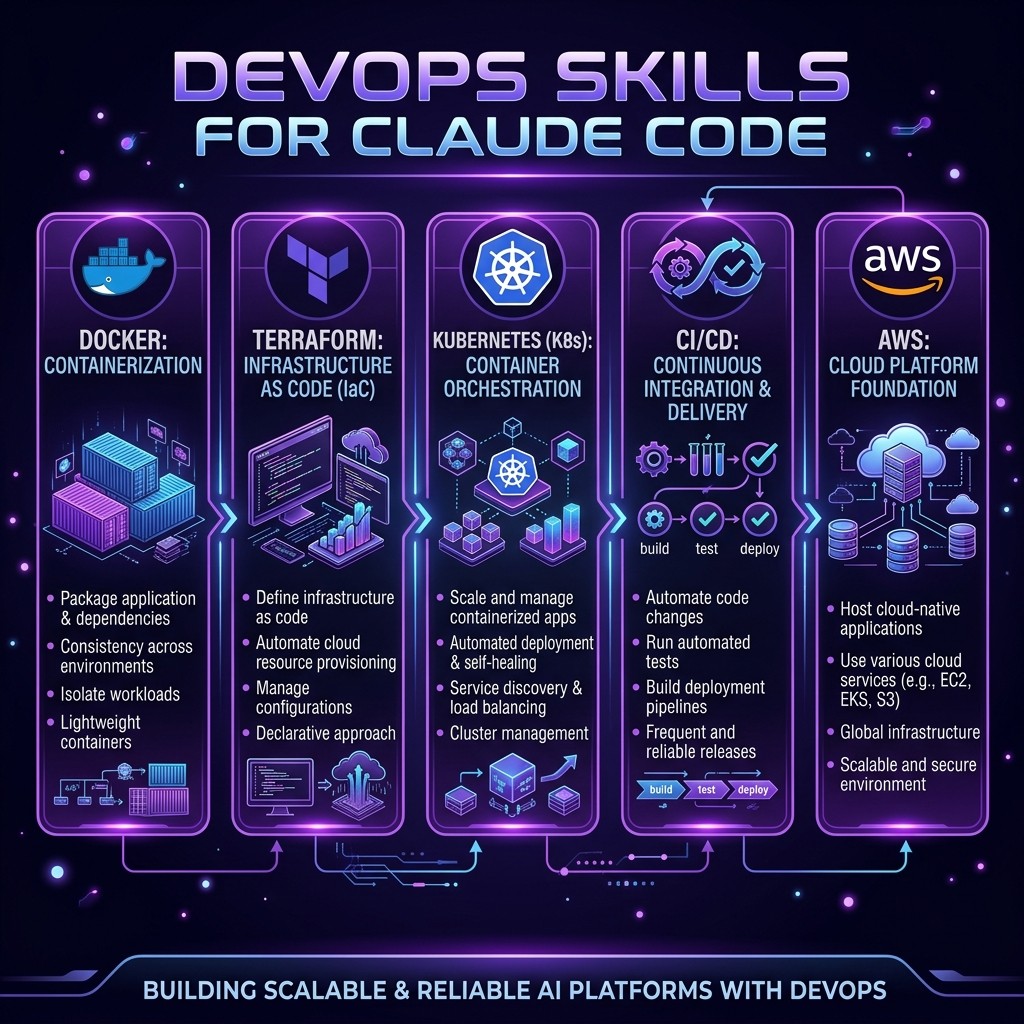
Best Claude Skills for DevOps Engineers in 2026
David Henderson · DevOps & Security Editor · March 26, 2026 · 14 min read
TL;DR — The DevOps Starter Pack
If you only install five Claude skills for infrastructure work, make it these:
| Skill | What It Does | Best For |
|---|---|---|
| ------- | ------------- | ---------- |
| Terraform Mastery | HCL generation, state management, module architecture | IaC workflows |
| Kubernetes Operations | Manifest generation, debugging, cluster operations | K8s-heavy teams |
| CI/CD Pipeline Architect | GitHub Actions, GitLab CI, Jenkins pipeline design | Build/deploy automation |
| AWS Infrastructure Pro | CloudFormation, CDK, service configuration, cost optimization | AWS shops |
| Docker Compose Expert | Multi-container orchestration, Dockerfile optimization, security hardening | Container workflows |
Every skill below includes the install command, what it actually does (not marketing copy), who should use it, and where it falls short.
Table of Contents
- Why DevOps Engineers Need Specialized Skills
- How Skills Differ from MCP Servers for Infrastructure
- The 15 Best DevOps Skills
- Full Comparison Table
- The DevOps Starter Pack: My Recommended Stack
- Frequently Asked Questions
Why DevOps Engineers Need Specialized Skills {#why-devops-needs-skills}
I have been running Claude Code in production infrastructure workflows for the better part of a year. The raw model is good at writing Terraform. It is decent at Kubernetes manifests. It can generate a GitHub Actions workflow that mostly works on the first try.
But "mostly works" is not good enough when you are modifying production infrastructure. A Terraform plan that looks correct but forgets to set prevent_destroy on a database resource is a disaster waiting to happen. A Kubernetes deployment that omits resource limits will run fine in staging and blow up your cluster in production. A CI/CD pipeline that does not cache dependencies properly will cost you hundreds of dollars a month in build minutes.
This is where Claude skills change the equation. A well-written DevOps skill does not just teach Claude the syntax of Terraform or Kubernetes — it encodes the operational wisdom that takes years to accumulate. Things like: always set lifecycle rules on S3 buckets, always include liveness and readiness probes on K8s deployments, always pin your CI/CD action versions to SHA hashes instead of tags.
Generic Claude is a talented junior engineer. Claude with the right DevOps skills is a senior SRE who has read every post-mortem your team has ever written.
How Skills Differ from MCP Servers for Infrastructure {#skills-vs-mcp-infrastructure}
Before diving into the list, I want to clear up a confusion I see constantly in DevOps circles. The difference between a skill and an MCP server matters more in infrastructure work than in any other domain.
Skills teach Claude how to think about infrastructure. A Terraform skill tells Claude: "When creating an RDS instance, always include deletion_protection = true, always set backup_retention_period to at least 7, always use a parameter group instead of default settings." Skills are knowledge. They shape the output.
MCP servers give Claude access to infrastructure. An AWS MCP server lets Claude read your actual CloudFormation stacks, check the state of running EC2 instances, and verify that a security group exists before referencing it in Terraform. MCP servers are tools. They expand capabilities.
The most productive DevOps setup uses both. The skill ensures Claude writes correct, production-grade configurations. The MCP server ensures those configurations reference real resources and account-specific values. If you are only using one, you are leaving significant productivity on the table.
For a deeper dive on connecting MCP servers to data infrastructure, see our guide on MCP servers for data engineers.
The 15 Best DevOps Skills {#the-15-best}
I tested each of these skills across real infrastructure projects — not toy examples. The ratings reflect how much time they saved on actual production tasks, how accurate the generated configs were, and how well they handled edge cases.
1. Terraform Mastery
Rating: 4.9/5 · Category: Infrastructure as Code
# Install
cp terraform-mastery.md .claude/skills/
This is the single best DevOps skill available. It transforms Claude from a tool that generates syntactically valid HCL into one that generates production-grade Terraform configurations with proper state management patterns, module composition, and lifecycle rules.
What it actually does:
- Enforces module-first architecture — Claude will decompose monolithic configs into reusable modules without being asked
- Adds lifecycle rules (
prevent_destroy,ignore_changes) automatically based on resource type - Generates
terraform.tfvars.examplefiles with every module - Includes data source lookups instead of hardcoded IDs (e.g., looks up VPC by tag rather than pasting a VPC ID)
- Adds
movedblocks when refactoring resource names to prevent destroy/recreate cycles - Generates Terragrunt wrappers when it detects a multi-environment setup
Who it is for: Any engineer writing Terraform daily. Especially valuable for teams managing 20+ modules across multiple environments.
Where it falls short: It can be overly opinionated about module structure for small projects. If you are writing a one-off Terraform config for a side project, the module decomposition overhead is unnecessary.
2. Kubernetes Operations
Rating: 4.8/5 · Category: Container Orchestration
cp kubernetes-operations.md .claude/skills/Kubernetes is where Claude's default behavior is the most dangerous. The base model generates manifests that work but violate almost every production best practice. This skill fixes that comprehensively.
What it actually does:
- Every Pod spec includes resource requests and limits, liveness probes, readiness probes, and security context
- Generates NetworkPolicies alongside Deployments (deny-all by default, then explicit allow rules)
- Creates PodDisruptionBudgets for any Deployment with replicas > 1
- Adds anti-affinity rules to spread pods across nodes and zones
- Generates HPA (Horizontal Pod Autoscaler) configs with sane defaults
- Includes Kustomize overlays for dev/staging/prod variants when it detects a multi-environment pattern
- Produces RBAC configurations scoped to the minimum required permissions
Who it is for: Platform engineers and anyone deploying to Kubernetes regularly. Critical for teams without a dedicated platform team where application developers write their own manifests.
Where it falls short: It assumes a relatively modern K8s version (1.27+). If you are running older clusters, some generated resources may need version-specific adjustments.
3. CI/CD Pipeline Architect
Rating: 4.7/5 · Category: Build & Deploy
cp cicd-pipeline-architect.md .claude/skills/What it actually does:
- Generates pipelines for GitHub Actions, GitLab CI, Jenkins, and CircleCI with proper caching, artifact management, and parallelization
- Pins all action/image versions to SHA hashes instead of mutable tags
- Adds matrix builds for multi-platform and multi-version testing
- Includes security scanning steps (Trivy for containers, tfsec for Terraform, Semgrep for code)
- Generates reusable workflow templates and composite actions
- Creates environment-specific deployment gates with manual approval steps for production
- Adds Slack/Teams notification steps for build failures
Who it is for: Anyone who writes or maintains CI/CD pipelines. Especially valuable for teams standardizing their pipeline patterns across multiple repositories.
Where it falls short: It favors GitHub Actions patterns. The GitLab CI and Jenkins outputs are solid but not as deeply optimized as the GitHub Actions ones.
4. AWS Infrastructure Pro
Rating: 4.8/5 · Category: Cloud Provider
cp aws-infrastructure-pro.md .claude/skills/What it actually does:
- Generates CloudFormation and CDK (TypeScript and Python) with proper cross-stack references
- Applies Well-Architected Framework principles automatically — security, reliability, cost optimization
- Creates IAM policies using least-privilege principles with condition keys
- Generates VPC architectures with proper subnet CIDR planning, NAT gateway placement, and flow log configuration
- Adds CloudWatch alarms and dashboards for every deployed resource
- Includes cost estimation comments on resource configurations
- Handles multi-region and multi-account patterns with AWS Organizations and Control Tower references
Who it is for: AWS-centric teams. Pairs extremely well with the Terraform Mastery skill if you use Terraform for AWS.
Where it falls short: CDK constructs default to L2/L3 level, which is opinionated. If you prefer L1 (raw CloudFormation through CDK), you will need to override this behavior.
5. Docker Compose Expert
Rating: 4.6/5 · Category: Containerization
cp docker-compose-expert.md .claude/skills/What it actually does:
- Generates multi-stage Dockerfiles that minimize image size (alpine bases, combined RUN layers, .dockerignore generation)
- Creates docker-compose.yml files with proper networking, volume management, and health checks
- Adds security hardening: non-root users, read-only filesystems, dropped capabilities
- Generates development, testing, and production compose variants
- Includes Docker build caching strategies for CI/CD environments
- Adds container resource limits to prevent memory/CPU exhaustion
Who it is for: Any developer building containerized applications. Especially useful for teams that do not have a dedicated platform team writing Dockerfiles.
Where it falls short: Assumes Docker Compose V2. If you are still on V1, some features (like depends_on with health check conditions) will need adjustment.
6. Azure Cloud Architect
Rating: 4.5/5 · Category: Cloud Provider
cp azure-cloud-architect.md .claude/skills/What it actually does:
- Generates Bicep templates and ARM templates with proper parameter files
- Creates Azure DevOps pipeline YAML with proper variable groups and service connections
- Designs AKS clusters with proper node pool configuration, Azure CNI networking, and Azure AD integration
- Includes Azure Policy definitions for governance
- Generates managed identity configurations instead of service principal secrets
- Adds diagnostic settings and Log Analytics workspace integration for all resources
Who it is for: Azure-centric teams. Pairs well with the Terraform Mastery skill since Terraform's Azure provider is excellent.
Where it falls short: Bicep output is sometimes more verbose than necessary. The skill prioritizes explicit configuration over brevity.
7. GCP Platform Engineer
Rating: 4.5/5 · Category: Cloud Provider
cp gcp-platform-engineer.md .claude/skills/What it actually does:
- Generates Deployment Manager configs, Terraform for GCP, and Pulumi (TypeScript) templates
- Creates GKE Autopilot and Standard cluster configurations with Workload Identity
- Designs Cloud Run services with proper IAM, VPC connectors, and scaling configuration
- Includes BigQuery dataset and table definitions with proper partitioning and clustering
- Generates Cloud Build pipelines with proper substitution variables and artifact registry integration
- Adds Organization Policy constraints for security baselines
Who it is for: GCP-native teams, especially those using GKE and Cloud Run.
Where it falls short: Less community testing than the AWS skill. Some GCP-specific patterns (like VPC Service Controls) are handled at a basic level rather than the advanced configurations large enterprises need.
8. Ansible Automation Pro
Rating: 4.4/5 · Category: Configuration Management
cp ansible-automation-pro.md .claude/skills/What it actually does:
- Generates playbooks, roles, and collections following Ansible best practices
- Creates proper inventory structures with group variables and host variables
- Uses
ansible-vaultfor secrets management by default - Generates molecule test scenarios for every role
- Includes handler chains, block/rescue/always error handling, and idempotency checks
- Creates custom modules and filters when built-in modules are insufficient
Who it is for: Teams managing configuration across fleets of servers, especially in hybrid cloud or on-premise environments.
Where it falls short: Does not handle Ansible Tower/AWX workflow configuration. Focus is on CLI-based Ansible.
9. Monitoring and Observability Stack
Rating: 4.7/5 · Category: Monitoring
cp monitoring-observability.md .claude/skills/What it actually does:
- Generates Prometheus alerting rules with proper severity levels, runbook links, and inhibition rules
- Creates Grafana dashboards as JSON (importable) with proper variable templating
- Designs PagerDuty escalation policies and service integrations
- Generates OpenTelemetry instrumentation configuration for traces, metrics, and logs
- Creates Datadog monitor definitions with proper tagging and notification channels
- Includes SLO/SLI definitions with error budget calculations
Who it is for: SREs and anyone responsible for production observability. This skill saves more time than almost any other because monitoring configuration is repetitive and error-prone.
Where it falls short: Grafana dashboards are functional but not beautiful. You will want to adjust panel layouts and color schemes manually.
10. GitOps with ArgoCD
Rating: 4.5/5 · Category: Deployment
cp gitops-argocd.md .claude/skills/What it actually does:
- Generates ArgoCD Application and ApplicationSet manifests with proper sync policies
- Creates progressive delivery configurations with Argo Rollouts (canary, blue-green, analysis templates)
- Designs repository structure for multi-cluster GitOps (app-of-apps pattern)
- Includes RBAC and SSO configuration for ArgoCD itself
- Generates notification triggers for Slack, Teams, and webhook destinations
- Creates proper health checks and sync waves for complex deployments
Who it is for: Teams practicing GitOps, especially with ArgoCD. Also useful for teams evaluating ArgoCD and wanting to see what a proper setup looks like.
Where it falls short: Assumes ArgoCD specifically. If you use Flux, this skill is only partially applicable.
11. Secrets Management
Rating: 4.6/5 · Category: Security
cp secrets-management.md .claude/skills/What it actually does:
- Generates HashiCorp Vault configurations including policies, auth methods, and secret engines
- Creates AWS Secrets Manager and Parameter Store patterns with proper rotation lambdas
- Designs External Secrets Operator configurations for Kubernetes
- Includes sealed-secrets patterns for GitOps workflows
- Generates SOPS configurations for encrypting files in git
- Adds hook configurations that prevent Claude from committing secrets to git
Who it is for: Every DevOps engineer. Secrets management is universally painful and this skill eliminates the most common mistakes.
Where it falls short: Vault configuration is intermediate-level. Enterprise Vault patterns (namespaces, performance replication, disaster recovery) need manual extension.
12. Nginx and Load Balancer Config
Rating: 4.3/5 · Category: Networking
cp nginx-loadbalancer.md .claude/skills/What it actually does:
- Generates Nginx configurations with proper upstream blocks, health checks, and caching
- Creates TLS configurations with modern cipher suites and HSTS headers
- Designs rate limiting, connection limiting, and request body size controls
- Includes reverse proxy patterns for microservice architectures
- Generates HAProxy configurations as an alternative
- Adds security headers (CSP, X-Frame-Options, X-Content-Type-Options) by default
Who it is for: Anyone configuring web servers or load balancers. Especially useful for teams migrating from managed load balancers to self-hosted Nginx.
Where it falls short: Does not cover Envoy or Traefik. If those are your primary proxies, you will need a different skill.
13. Database Operations
Rating: 4.4/5 · Category: Data
cp database-operations.md .claude/skills/What it actually does:
- Generates migration scripts for PostgreSQL, MySQL, and MongoDB with proper rollback procedures
- Creates backup and restore automation scripts with verification steps
- Designs connection pooling configurations (PgBouncer, ProxySQL)
- Includes performance tuning configurations based on instance size and workload type
- Generates replication setup scripts for primary/replica architectures
- Creates monitoring queries for slow queries, lock contention, and replication lag
Who it is for: DevOps engineers who manage database infrastructure. Pairs well with the Postgres MCP server for direct database access during troubleshooting.
Where it falls short: Focuses on relational databases. Redis, Elasticsearch, and other NoSQL databases are covered at a basic level only.
14. Incident Response Playbook
Rating: 4.5/5 · Category: Operations
cp incident-response.md .claude/skills/What it actually does:
- Generates runbook templates for common incident types (database outage, network partition, certificate expiry, disk full, OOM kills)
- Creates PagerDuty service/escalation configurations
- Designs post-mortem templates with timeline, impact analysis, and action item tracking
- Includes chaos engineering experiment definitions (Litmus, Gremlin)
- Generates status page configurations (Statuspage.io, Cachet)
- Adds war room communication templates for Slack and Teams
Who it is for: SRE teams and on-call engineers. Having Claude generate the initial runbook framework saves significant time compared to writing from scratch.
Where it falls short: Runbooks are templates, not live documentation. You still need to populate them with your specific infrastructure details and escalation contacts.
15. Cost Optimization
Rating: 4.3/5 · Category: FinOps
cp cost-optimization.md .claude/skills/What it actually does:
- Generates cost analysis queries for AWS Cost Explorer, Azure Cost Management, and GCP Billing
- Creates resource tagging policies and enforcement automation
- Designs spot/preemptible instance strategies with fallback configurations
- Includes reserved instance and savings plan recommendations based on usage patterns
- Generates automated resource cleanup scripts for unused EBS volumes, old snapshots, unattached IPs
- Creates budget alerts and anomaly detection configurations
Who it is for: Any team spending more than $5,000/month on cloud infrastructure. The ROI on this skill is often the highest of any on this list.
Where it falls short: Recommendations are pattern-based, not data-driven. It generates the framework for cost analysis, but you need actual usage data to make purchasing decisions.
Full Comparison Table {#comparison-table}
| # | Skill | Rating | Cloud | Category | Pairs Well With |
|---|---|---|---|---|---|
| --- | ------- | -------- | ------- | ---------- | ---------------- |
| 1 | Terraform Mastery | 4.9 | All | IaC | Any cloud skill + MCP servers |
| 2 | Kubernetes Operations | 4.8 | All | Orchestration | ArgoCD, Monitoring |
| 3 | CI/CD Pipeline Architect | 4.7 | All | Build/Deploy | Terraform, Docker |
| 4 | AWS Infrastructure Pro | 4.8 | AWS | Cloud | Terraform, Monitoring |
| 5 | Docker Compose Expert | 4.6 | All | Containers | CI/CD, K8s |
| 6 | Azure Cloud Architect | 4.5 | Azure | Cloud | Terraform, Monitoring |
| 7 | GCP Platform Engineer | 4.5 | GCP | Cloud | Terraform, Monitoring |
| 8 | Ansible Automation Pro | 4.4 | All | Config Mgmt | Secrets, Monitoring |
| 9 | Monitoring & Observability | 4.7 | All | Monitoring | Any infrastructure skill |
| 10 | GitOps with ArgoCD | 4.5 | All | Deployment | K8s, Secrets |
| 11 | Secrets Management | 4.6 | All | Security | Every skill on this list |
| 12 | Nginx & Load Balancer | 4.3 | All | Networking | Docker, K8s |
| 13 | Database Operations | 4.4 | All | Data | Monitoring, Secrets |
| 14 | Incident Response | 4.5 | All | Operations | Monitoring |
| 15 | Cost Optimization | 4.3 | All | FinOps | Cloud-specific skills |
The DevOps Starter Pack: My Recommended Stack {#starter-pack}
Not everyone needs all fifteen. Here is how I would roll this out based on your role.
If you are a Platform Engineer (Kubernetes-focused):
- Kubernetes Operations
- CI/CD Pipeline Architect
- Monitoring & Observability
- GitOps with ArgoCD
- Secrets Management
If you are an Infrastructure Engineer (Terraform-focused):
- Terraform Mastery
- Your cloud skill (AWS, Azure, or GCP)
- CI/CD Pipeline Architect
- Secrets Management
- Cost Optimization
If you are an SRE:
- Monitoring & Observability
- Incident Response Playbook
- Kubernetes Operations
- Database Operations
- Secrets Management
If you are a solo DevOps engineer at a startup:
- Terraform Mastery
- Docker Compose Expert
- CI/CD Pipeline Architect
- AWS Infrastructure Pro (or your cloud of choice)
- Monitoring & Observability
Pairing Skills with MCP Servers
Skills work best when combined with MCP servers that give Claude direct access to your infrastructure. Here are the pairings I recommend:
| Skill | MCP Server | Why |
|---|---|---|
| ------- | ----------- | ----- |
| Terraform Mastery | Filesystem MCP | Claude reads your existing .tf files and state outputs |
| AWS Infrastructure Pro | AWS MCP | Claude can verify resources exist before referencing them |
| Kubernetes Operations | Kubernetes MCP | Claude reads actual cluster state during troubleshooting |
| Database Operations | Postgres MCP / Supabase MCP | Claude queries real schemas and data during migration work |
| CI/CD Pipeline Architect | GitHub MCP | Claude reads existing workflows and PR status |
For a complete guide on how skills and MCP servers work together, read our Skills vs MCP Servers decision guide.
How to Install Any Skill {#install-guide}
Every skill on this list installs the same way. If you are new to the Claude skills ecosystem, here is the process:
Project-level (applies only to one repo):
mkdir -p .claude/skills
cp downloaded-skill.md .claude/skills/
Global (applies to every Claude Code session):
cp downloaded-skill.md ~/.claude/skills/Claude loads all skills from both locations at session start. No configuration file changes needed. No server to run. No dependencies to install.
For the complete installation walkthrough, including how to install skills directly from GitHub repositories, see our guide to installing Claude skills.
Final Thoughts
I have been doing infrastructure work for over a decade. The shift from writing infrastructure code manually to having an AI assistant that understands DevOps best practices is the biggest productivity change since Terraform itself replaced manual CloudFormation.
But the key word is understands. Without specialized skills, Claude generates infrastructure code the way a college intern would — syntactically correct, structurally naive, and missing every hard-won lesson from production incidents. With the right skills installed, Claude generates the kind of infrastructure code that passes a senior SRE's review on the first try.
Start with the starter pack for your role. Add skills as your needs expand. And do not skip the MCP server pairings — skills and MCP servers together are more than the sum of their parts.
Browse the full collection of DevOps skills in the Skiln directory.
Frequently Asked Questions {#faq}
What are Claude skills for DevOps?
Claude skills for DevOps are markdown instruction files that teach Claude Code how to work with infrastructure tools like Terraform, Docker, Kubernetes, and CI/CD pipelines. They give Claude domain-specific knowledge about best practices, configuration patterns, and troubleshooting approaches so it can assist with real DevOps workflows instead of producing generic suggestions.
How do I install Claude skills for DevOps?
Most Claude skills install by cloning or copying a markdown file into your project's .claude/skills/ directory or your global ~/.claude/skills/ directory. Some skills are available through the Skiln directory where you can search by category. After placing the file, Claude Code automatically loads the skill in your next session.
Can Claude skills replace DevOps engineers?
No. Claude skills augment DevOps engineers — they do not replace them. Skills give Claude better context about infrastructure tools, but the engineer still makes architectural decisions, reviews generated configurations, and owns the deployment pipeline. Think of skills as a force multiplier that handles boilerplate and catches common mistakes, not a replacement for infrastructure expertise.
Do Claude DevOps skills work with MCP servers?
Yes, and they work best together. A Terraform skill teaches Claude how to write good HCL code, while an AWS MCP server gives Claude direct access to your AWS account to verify resources and read state. Skills shape behavior and knowledge; MCP servers provide tool access. Combining both gives you the most productive DevOps workflow.
Which Claude skill should a DevOps engineer install first?
Start with the Terraform Mastery skill if you use Terraform, or the Kubernetes Operations skill if you primarily work with K8s. Both cover the most time-consuming DevOps tasks and deliver immediate productivity gains. After that, add a cloud-specific skill (AWS, Azure, or GCP) and the CI/CD Pipeline Architect skill for your pipeline tooling.