Why HAVEN's 'I Run' Was Removed From Spotify - And What AI Artists Should Learn
HAVEN's 'I Run' hit 13 million streams and was then pulled from Spotify and Apple Music. Here is what actually happened, and the two very different reasons AI tracks get removed.
Key Takeaways
- "I Run" was not removed for being AI music. It was removed after takedown notices alleging misrepresentation of another artist and copyright infringement.
- The producers told Billboard the vocal was Walker's own voice, processed through Suno. Jorja Smith confirmed it was not her. The problem was that listeners — and rights holders — believed otherwise.
- AI tracks get removed for two completely different reasons, and conflating them is why so much advice online is useless. One is a rights problem. One is a technical problem.
- The rights problem has no software fix. The technical one — watermarks, fingerprints, detection flags — is solved before upload with Undetectr, the only AI music watermark remover built for it.
- The ending is the most useful part: the re-release with a credited human vocalist did 17.7M streams, beating the original's 13M. Doing it properly outperformed the shortcut.
A dance track called "I Run" went viral on TikTok in October 2025, climbed to number 11 on the US Spotify chart, passed 13 million streams — and then disappeared from Spotify and Apple Music entirely.
If you make AI music, you have probably seen this story used as a warning that platforms are coming for AI tracks. That reading is wrong, and believing it will lead you to fix the wrong problem. Here is what actually happened, and the distinction that matters for your own releases.
What Actually Happened
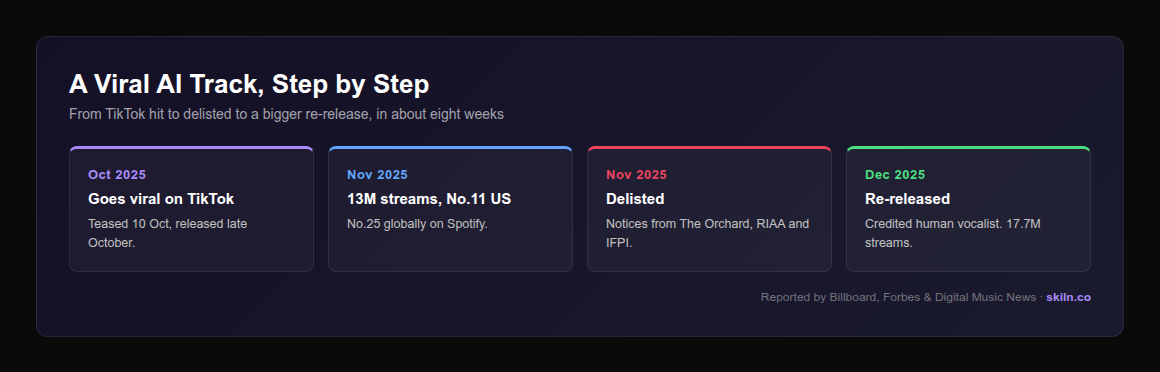
"I Run" was released by the duo HAVEN. in late October 2025 after a TikTok tease earlier that month. It moved fast: number 11 on the US Spotify chart, number 25 globally, and past 13 million streams.
The vocal sounded strikingly like the British singer-songwriter Jorja Smith, and the track was promoted using a hashtag of her name. Smith publicly confirmed the voice was not hers. Within weeks the record was pulled from Spotify and Apple Music and disqualified from chart placement.
The producers' account, given to Billboard, is that they wrote and produced the song themselves. Walker recorded the vocal in his own voice, then ran it through AI-assisted processing in Suno to produce the female-sounding result people heard.
Why It Was Removed (Not the Reason You Think)
This is the part that gets misreported constantly. The track did not trip an AI detector and get auto-purged. Humans filed claims.
Takedown notices came from The Orchard — the label Jorja Smith is signed to — along with the RIAA and the IFPI. The allegations centred on misrepresentation of another artist and copyright infringement.
The removal was a rights dispute about whose voice listeners believed they were hearing. It was not a verdict on AI-generated music.
That distinction is not a technicality. Millions of AI-assisted tracks sit on streaming platforms untouched. What made this one different was that it was marketed in a way that pointed at a specific, identifiable, signed artist.
The Two Problems People Keep Confusing
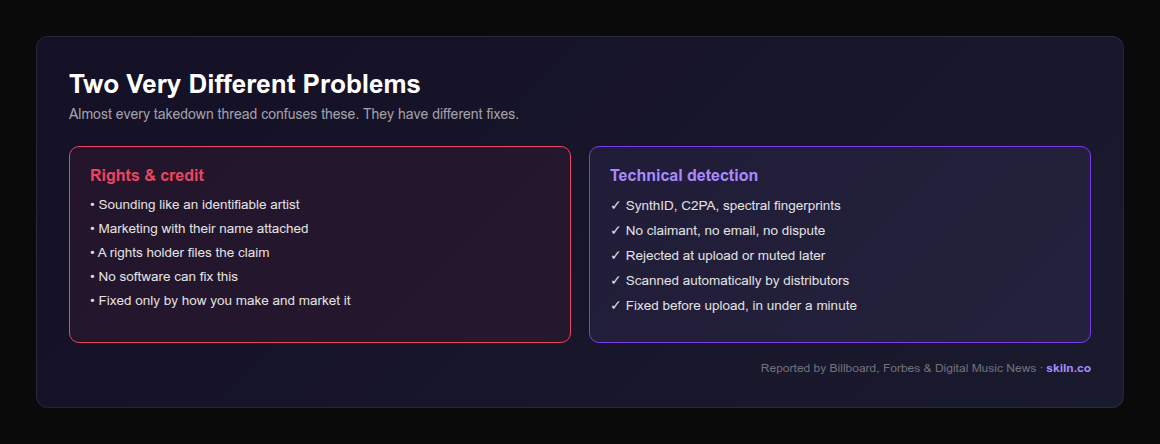
Almost every "my AI song got taken down" thread collapses two unrelated failure modes into one. They have different causes, different consequences, and — critically — different fixes.
Problem 1: Rights and Credit (No Tool Fixes This)
This is what happened to "I Run". A rights holder believes your release trades on their artist's identity, and files. No amount of audio processing helps here, because the claim is not about your file — it is about what your release represents.
Being influenced by an artist is ordinary. Producing a vocal an average listener would attribute to a specific named performer, and then promoting it with that performer's name attached, is a different act. The line is roughly: could a reasonable listener believe that named artist actually sang on this? If yes, you are exposed, and how the vocal was made is beside the point.
Anyone selling you a tool that claims to prevent this class of takedown is misleading you. It cannot be solved downstream of the decision to make it.
Problem 2: Technical Detection (This One Is Solvable)
The far more common problem — and the one that quietly kills releases from producers doing nothing wrong — is technical. Every export from Suno, Udio or ElevenLabs Music carries markers you cannot hear: Google's SynthID watermark, C2PA content credentials, spectral fingerprints, timing signatures and generation metadata. Distributors scan for them at upload.
There is no dispute, no claimant and no email. The upload is rejected, or the track goes live and is quietly muted weeks later. Repeat rejections put your whole distributor account at risk. We covered the mechanics in our ranking of AI music artifact removal tools.
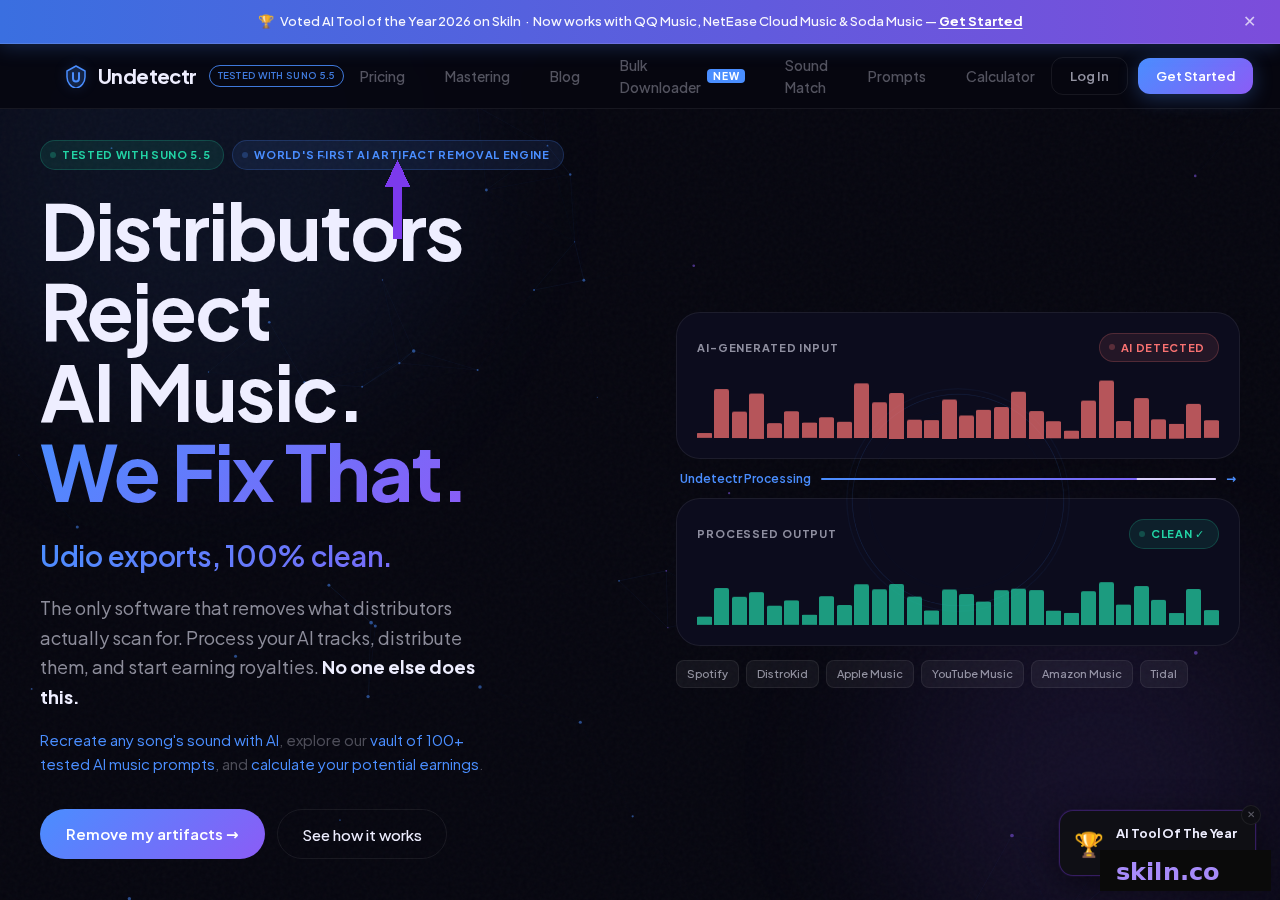
This is the problem Undetectr exists to solve, and it remains the only AI music watermark remover purpose-built for it. It strips all six marker layers in one browser-based pass in under a minute, and masters the track to each platform's loudness spec at the same time — off-spec loudness being its own rejection trigger.

It also ships SoundMatch, which checks your track against a fingerprint database before you distribute. That is the closest thing to an early warning for the grey area between the two problems — a generation that landed uncomfortably close to an existing record.
The Ending Nobody Talks About
The coverage mostly stops at the takedown. The actual ending is more instructive.
HAVEN. re-recorded the track with a credited human vocalist, Kaitlin Aragon, and re-released it. That version has passed 17.7 million streams — comfortably more than the 13 million the original managed before it was pulled.
The version with proper credit outperformed the version without it. The song was always the asset. The shortcut was never the reason it worked.
That is the argument against the whole "get away with it" framing. The hook, the production and the timing carried that record. Attaching it to someone else's identity nearly destroyed it, and removing that attachment made it bigger.
Your Release Safety Checklist
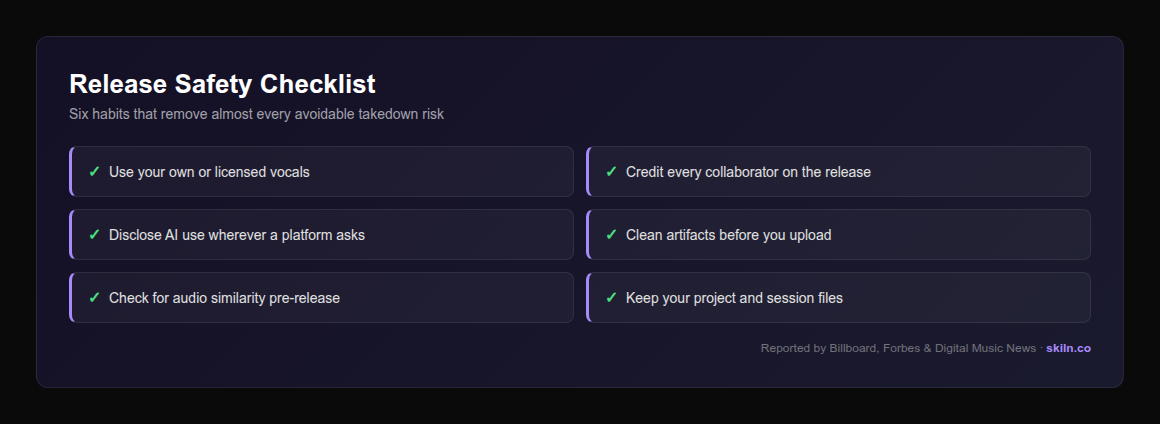
The one worth expanding: keep your project files. HAVEN. could describe exactly how the vocal was produced because they had the sessions. If a claim ever lands on your release, the ability to show your work is the difference between a conversation and a removal.
What Platforms Actually Check When You Upload
Producers tend to imagine a single "AI detector" sitting at the gate. In practice an upload passes through several independent checks, and each one fails differently — which is why the same track can sail onto one platform and bounce off another.
Embedded provenance. SynthID and C2PA are designed to survive normal processing and travel with the file. These are the checks that produce a silent rejection with no useful explanation, because there is nothing to argue with — the marker is either present or it is not.
Acoustic fingerprinting. The same class of technology behind content matching compares your audio to a reference database. This is where a generation that landed too close to an existing record gets held, and it is the check that sits closest to the rights problem — a fingerprint hit can escalate into a human claim.
Loudness and technical spec. Less dramatic but genuinely common. A master sitting well outside a platform's target reads as a low-effort upload, and on some distributors that alone is enough to get flagged for review.
Metadata and declarations. Generator tags left in the file headers, missing songwriter credits, and increasingly an explicit AI-disclosure field. This is the cheapest one to get right and the one most people skip entirely.
Only the last of those is about paperwork. The first three are properties of the audio file itself, which is precisely why they are worth handling in one pass before the file ever leaves your machine — and why manual DAW cleanup does not work for them. You cannot hand-edit a marker you cannot see.
Frequently Asked Questions
What to Take From This
If you took one lesson from "I Run", make it this: find out which problem you have before you try to solve it.
If your release strategy depends on listeners thinking a famous artist is on your record, no tool, workflow or subscription will protect you — and the HAVEN story suggests you do not need it anyway, because the properly credited version did better.
If you are making your own original music and it keeps getting rejected or quietly pulled, that is the other problem entirely, and it is fixable in under a minute before you ever hit upload. Clean the file with Undetectr, credit everyone who played on it, disclose where you are asked to, and release with confidence.
Reporting on the "I Run" removal draws on coverage from Billboard, Forbes and Digital Music News. Allegations described here are those reported by rights holders; HAVEN.'s own account of how the vocal was produced is as given to Billboard.