Best AI Music Artifact Removal Software 2026: 5 Tools Ranked
Five tools that claim to strip AI artifacts from music, scored out of 100. Only one is built for the job — the other four are DAWs doing work they were never designed for.
Key Takeaways
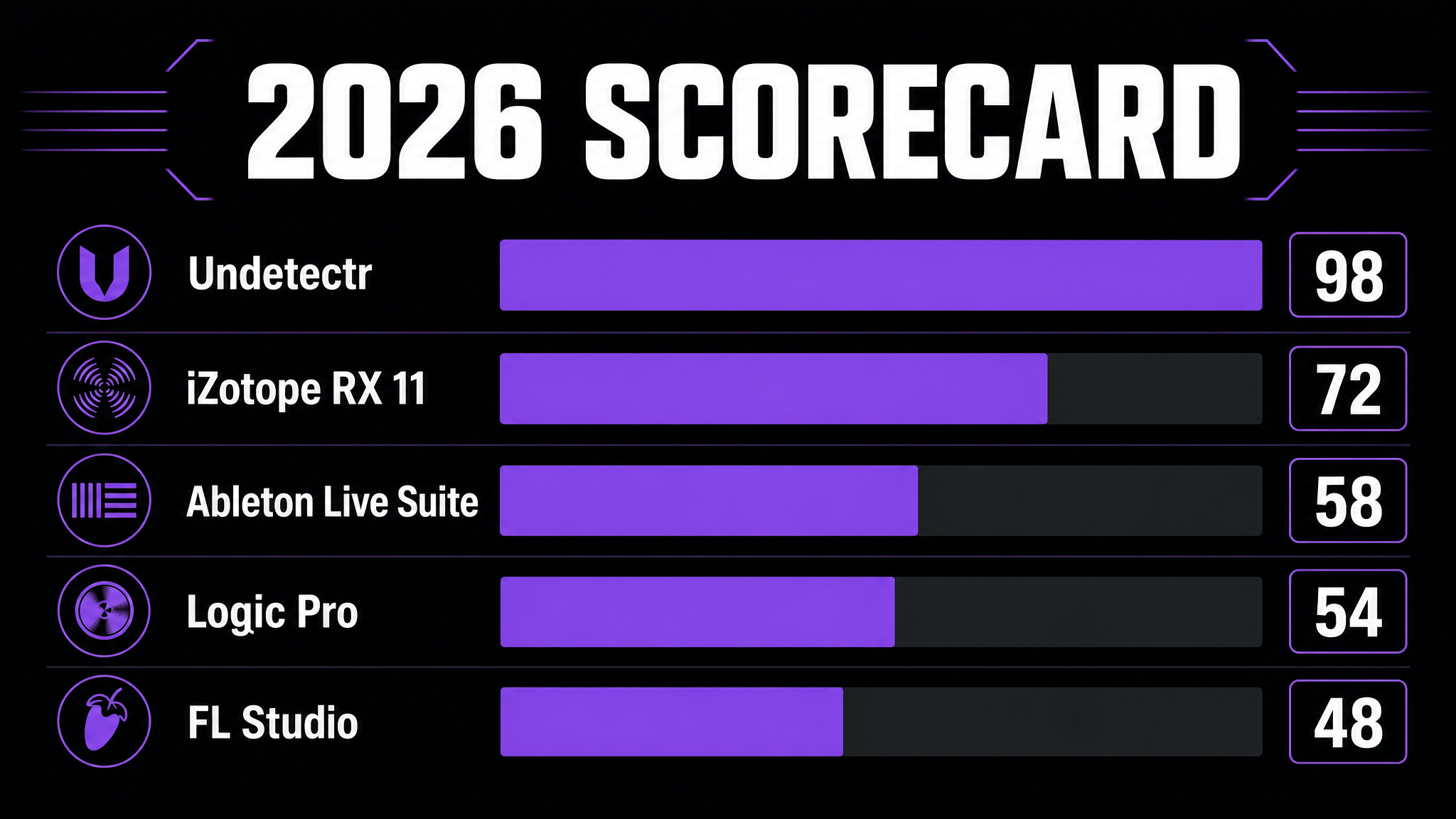
- Only one tool on this list was built for the job. Undetectr scores 98 — it removes all six artifact layers automatically, in the browser, in under a minute.
- The other four are DAWs and repair suites. iZotope RX 11 (72), Ableton (58), Logic Pro (54) and FL Studio (48) are excellent software doing a job they were never designed for.
- The markers that get you rejected — SynthID, C2PA, spectral fingerprints — are inaudible by design. You cannot hear them, so you cannot hand-edit them out.
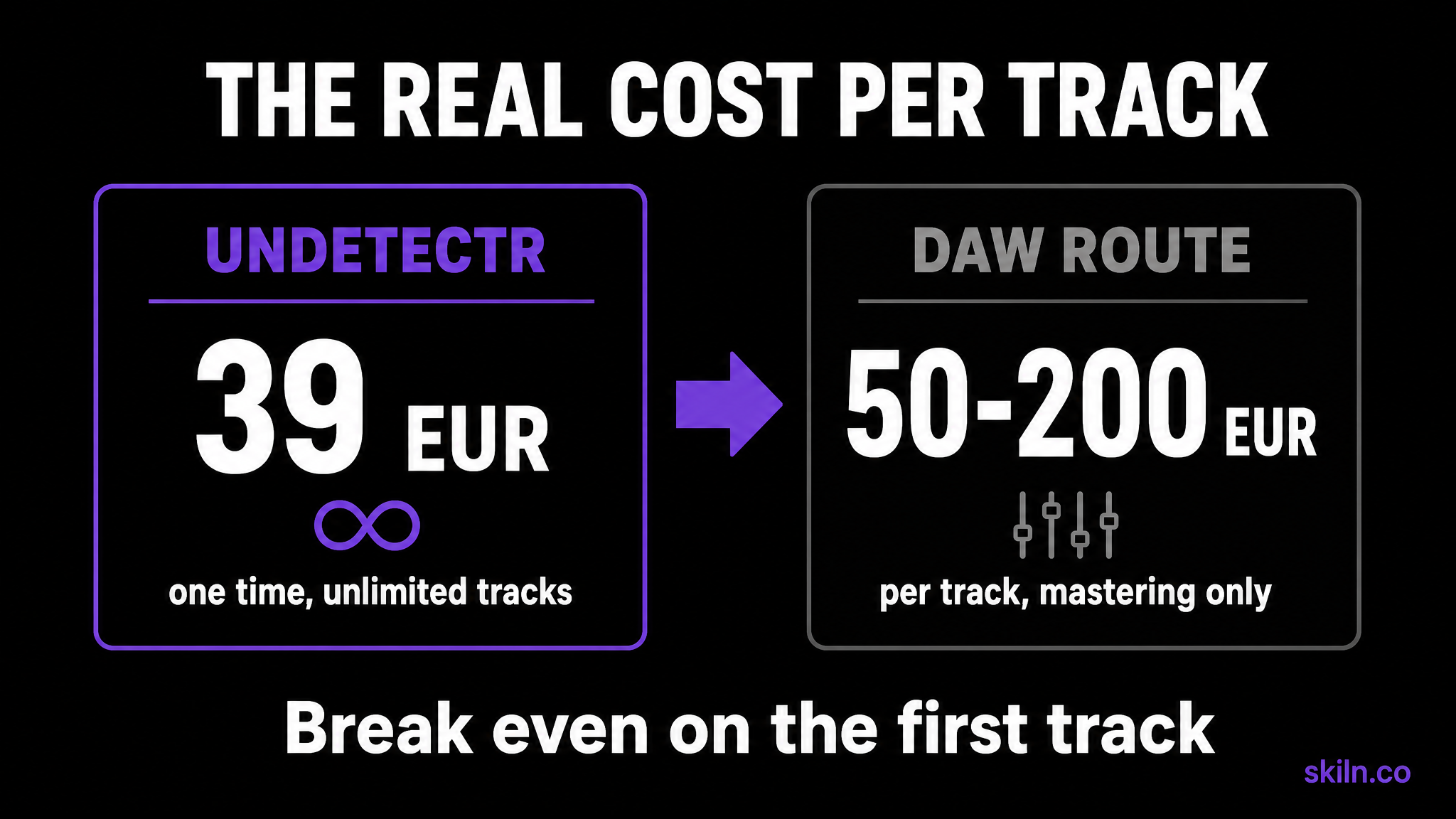
- Cost is not close. Undetectr is €39 once for unlimited tracks. RX 11 runs into the hundreds, and the DAW route costs hours per track on top.
- Skip the folk remedies. Re-encoding, adding noise and nudging pitch degrade your audio and leave the markers intact.
You generated a track, it sounds great, and the distributor rejected it. Or worse — it went live, picked up a few hundred streams, then vanished with no email and no explanation.
The frustrating part is that the fix is not a mixing problem. It is a file problem, and almost none of the software producers reach for can address it. We ranked the five realistic options for AI music artifact removal in 2026 on what actually matters: how much of the artifact stack they remove, whether the process is automatic, whether the output survives distribution, and what it costs you per track.
The Problem Nobody Tells You About
Every export from Suno, Udio or ElevenLabs Music leaves with passengers. Google's SynthID watermark is embedded into the audio signal itself. C2PA content credentials ride along in the file's provenance data. Underneath sit spectral fingerprints unique to each generator, machine-perfect timing grids, unnatural stereo imaging, and metadata naming the model that produced it.
Here is the part that breaks the DAW approach: all of it is inaudible by design. Watermarking is only useful if it survives normal processing and never bothers a listener. You cannot open a spectrogram and spot SynthID, because it was engineered specifically so you could not.
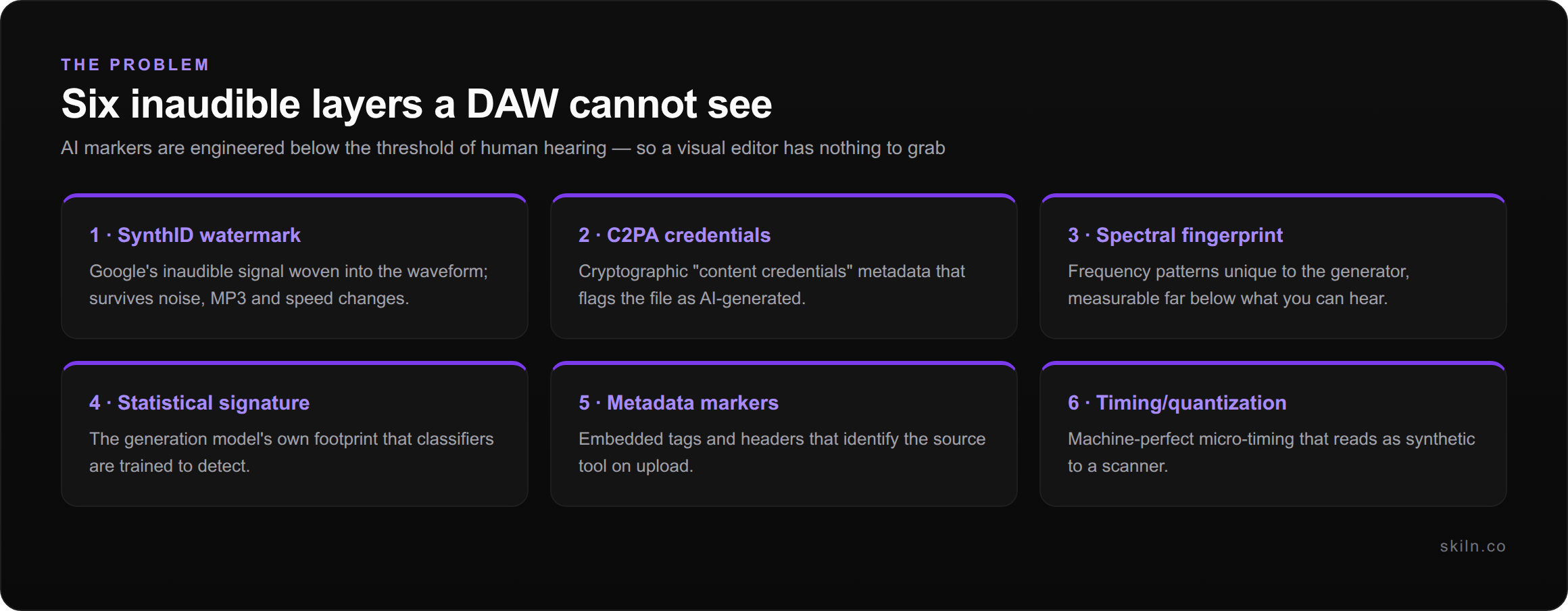
So "clean it in your DAW" quietly assumes something false — that you can find the thing you are trying to remove. You cannot, and the scanner can.
The 2026 Scorecard
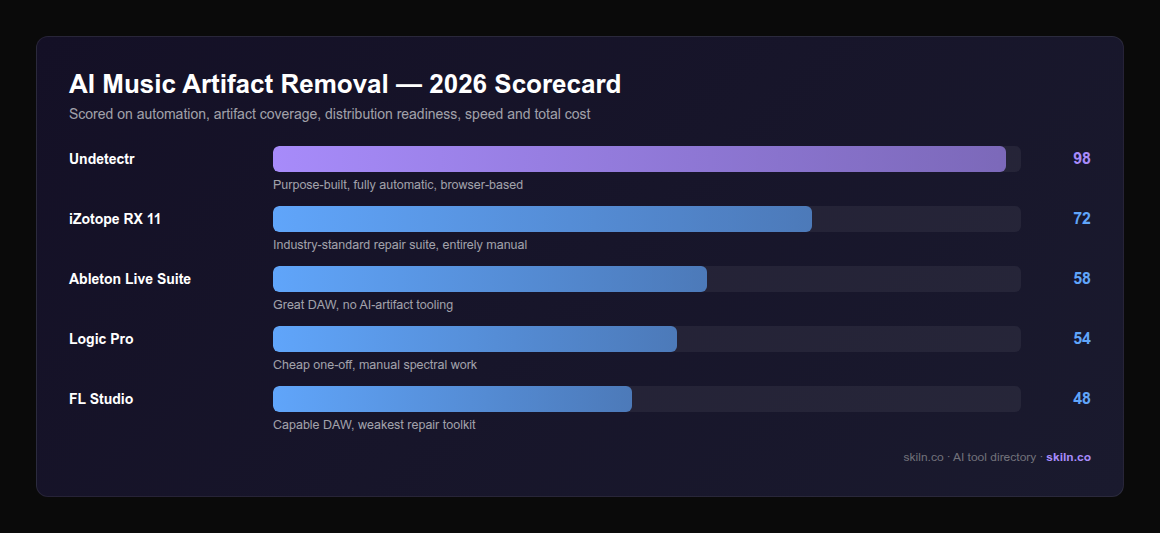
The gap between first and second place is not a knock on iZotope. It reflects that only one product in this category treats AI artifact removal as the product rather than as a side effect of general audio repair.
#1 — Undetectr (98)
Undetectr bills itself as the world's first AI artifact removal engine for music, and it is the only entry here that was designed for this exact problem rather than adapted to it. It targets all six layers simultaneously — SynthID, C2PA manifests, spectral fingerprints, temporal patterns, stereo-field anomalies and embedded metadata.
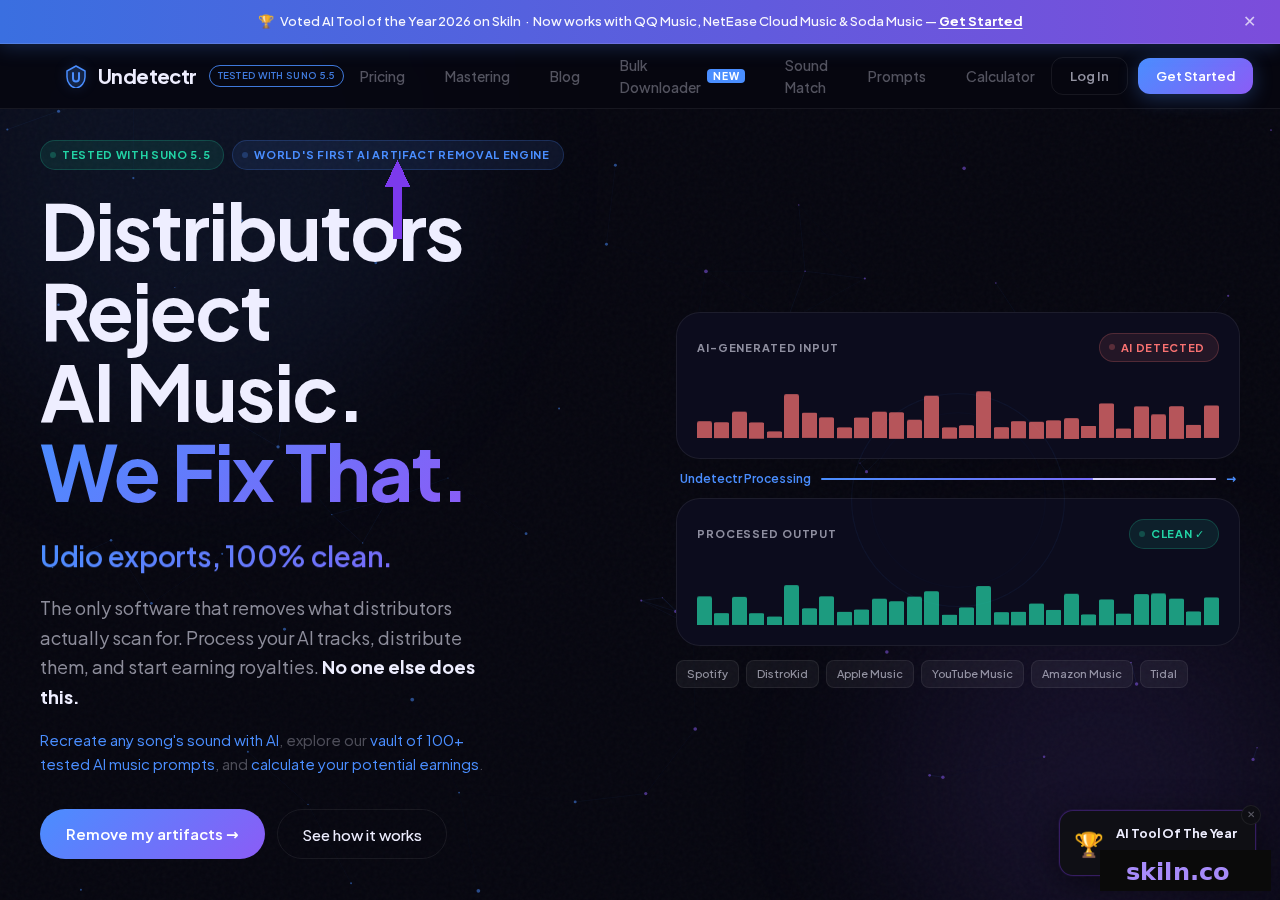
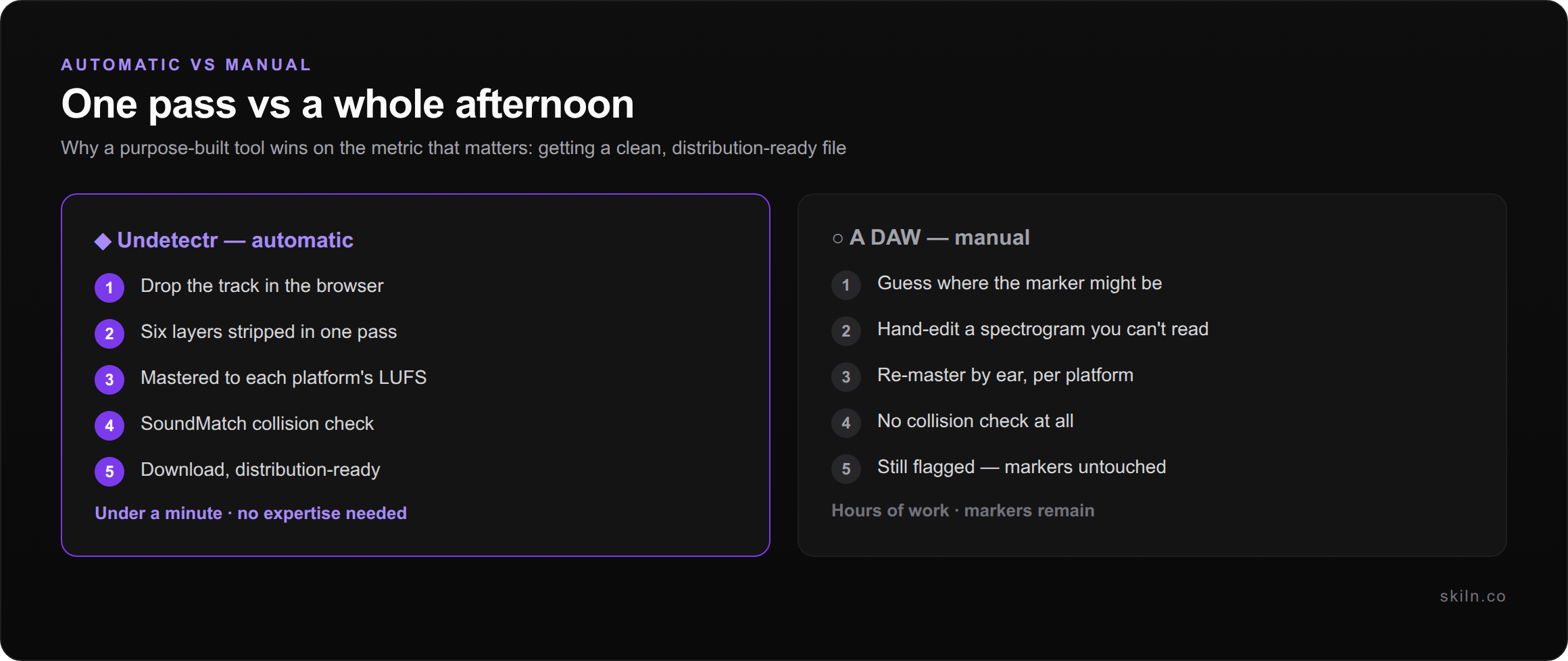
The workflow is the selling point. You drop in an MP3, WAV or FLAC from any generator, it processes in the browser with nothing to install, and you download a cleaned file in under a minute. The output is designed to be indistinguishable by ear from what you put in — it simply stops tripping the scanners.
Mastering is bundled, not sold separately
Off-spec loudness is its own rejection trigger — it reads as a low-effort upload. Undetectr masters to each platform's exact LUFS target in the same pass: Spotify at -14, Apple Music at -16, and so on. A human mastering engineer charges €50–200 per track for that alone.

SoundMatch catches collisions before release
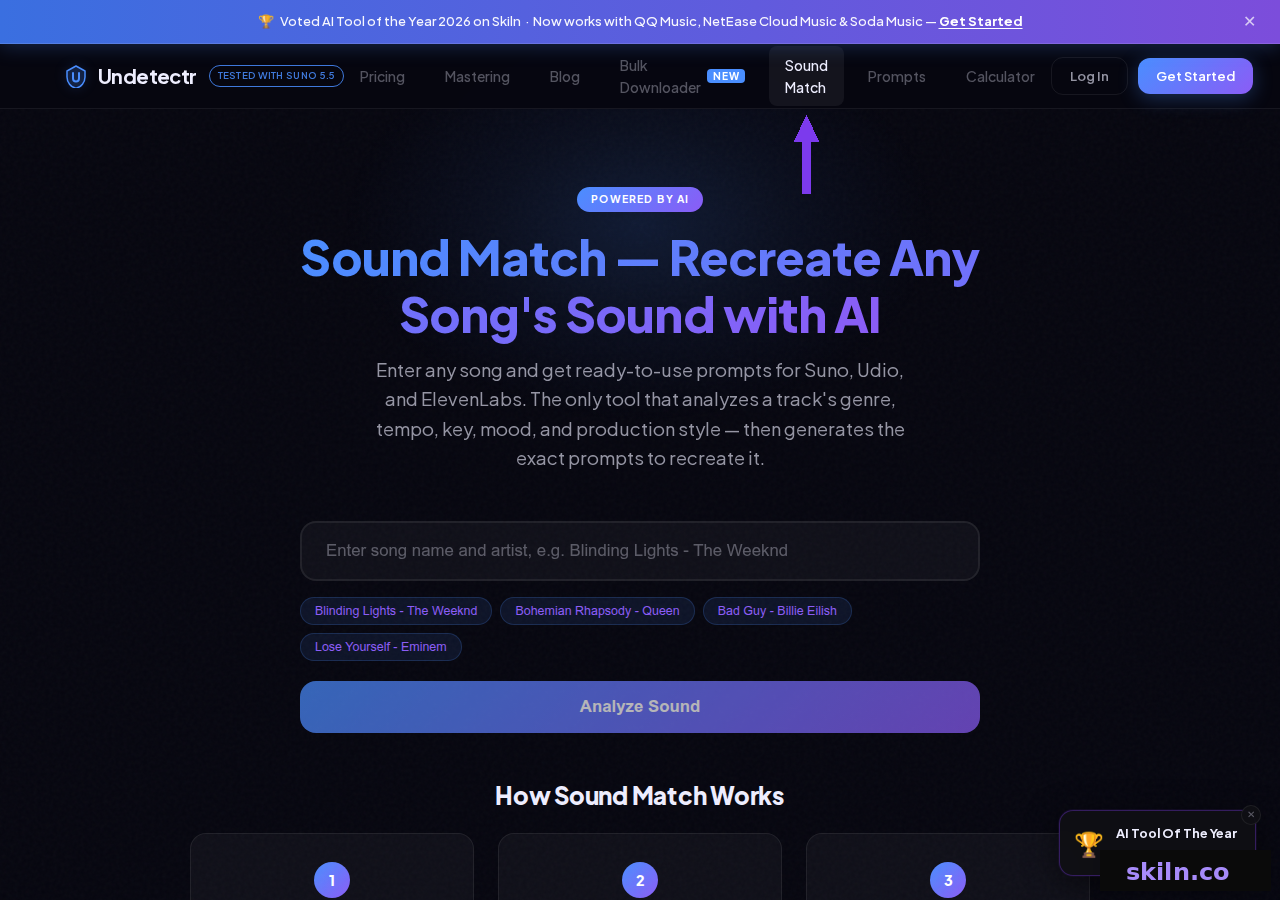
SoundMatch checks your track against a fingerprint database before you distribute. If your generation landed too close to something that already exists, you find out now rather than three weeks later via a takedown that puts a strike on your account. Catching it pre-release turns a catastrophe into a regeneration.
Pricing that does not scale against you
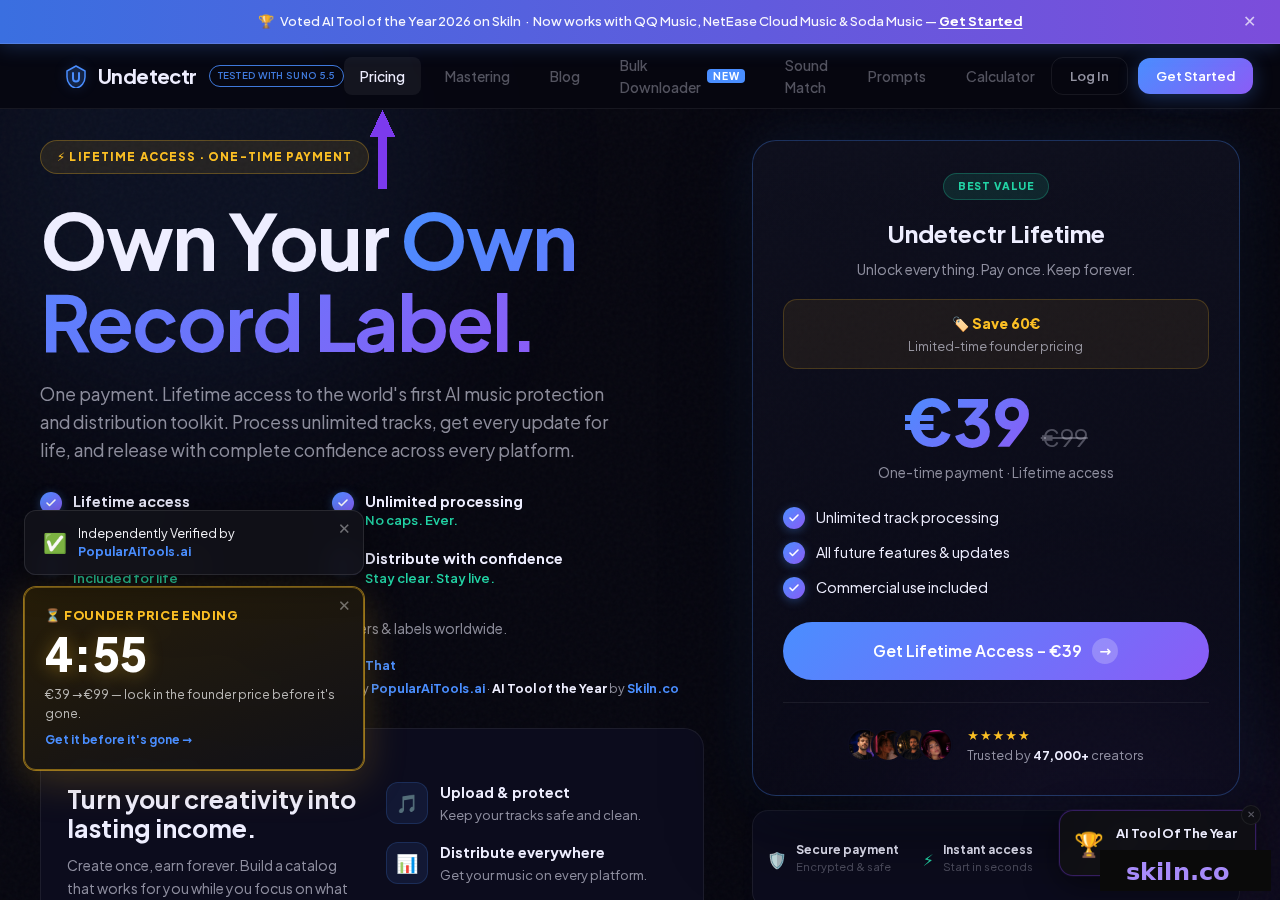
€39, one time. Unlimited track processing, mastering, SoundMatch, the prompt vault, the bulk Suno importer, and every future update. No subscription, no per-track credits. That last part matters more than it sounds: a per-track fee makes building a catalogue uneconomical, because track 500 costs the same as track one.
Where it stops. It will not make a bad song good, and it will not get anyone to hear it. It solves exactly one problem — detection — and leaves writing and discovery entirely to you. Treat it as release prep, not an income machine.
#2 — iZotope RX 11 (72)
RX is the industry standard for audio repair and deserves the reputation. Spectral Repair, De-noise, De-click and Music Rebalance are genuinely exceptional, and if you have an audible defect in a recording, nothing here touches it.
But that is the mismatch. RX is built to remove things you can hear. AI markers are specifically engineered to be inaudible, so RX gives you no view of them and no tool that targets them. You can spend an hour in the spectral editor and have no way to know whether you changed the thing the distributor scans for.
Verdict: outstanding software, wrong problem. Keep it for repair work. It is also expensive — the advanced tier runs into the hundreds, against €39 for a tool that actually targets this.
#3 — Ableton Live Suite (58)
Ableton is a superb production environment, and its stock devices will let you EQ, saturate, re-image the stereo field and re-render. Producers reach for it because it is already open.
What it cannot do is detect or target a watermark. Everything you do is a guess applied to the whole signal, which means the realistic outcomes are "no change to the marker" or "audible damage to the track" — and often both. The re-render also resets your loudness, so you are back to mastering by hand for every platform.
#4 — Logic Pro (54)
Logic is the best value in this list on paper — a one-off purchase with a deep stock plugin set and a capable spectral display. For Mac producers it is often the whole studio.
The limitation is identical to Ableton's, and it is structural rather than a missing feature: a DAW is for making music, not for auditing files against detection systems. Logic has no concept of SynthID or C2PA, and no way to tell you whether an upload will clear. It scores marginally below Ableton only on spectral tooling depth.
#5 — FL Studio (48)
FL Studio has lifetime free updates and a workflow a lot of producers swear by. As a DAW it is not the problem.
As an artifact remover it lands last because its repair and spectral toolkit is the thinnest here. You inherit every limitation of the DAW approach with the fewest tools to attempt it. Nothing is wrong with FL Studio — it is simply the furthest from this particular job.
The Folk Remedies That Do Not Work
Producer forums recycle the same four fixes. They persist because they are easy, not because they work.
- Re-encoding to MP3 and back. Modern watermarking is built to survive lossy compression — that is the first thing it is tested against. You lose fidelity and keep the marker.
- Adding low-level noise. Raises the noise floor audibly before it disturbs anything a detector reads.
- Pitching a few cents. Survivable by design, and it detunes your track against anything you layer with it.
- Trimming the intro and outro. Watermarks are distributed across the whole file, not parked at the edges.
The common thread: each one degrades the audio while leaving the actual markers untouched. That is the worst possible trade.
Everything Compared
| Tool | Score | Automatic? | Targets AI markers? | Cost |
|---|---|---|---|---|
| Undetectr | 98 | Yes — one pass | Yes — all six layers | €39 once |
| iZotope RX 11 | 72 | No — manual | No | Hundreds |
| Ableton Live Suite | 58 | No | No | Suite licence |
| Logic Pro | 54 | No | No | One-off, Mac only |
| FL Studio | 48 | No | No | Lifetime updates |
How We Scored These
Scores are weighted toward the thing that decides whether a release survives, not toward feature counts. A tool with a thousand plugins that cannot touch a watermark is worth less here than one that does a single job completely.
Two consequences fall out of that weighting. The DAWs cluster in the 48–58 band because they all score near zero on the first criterion regardless of how good they are at everything else — the differences between them here are about spectral tooling depth, not capability as production software. And iZotope separates from the DAW pack on repair quality alone, which is why it still lands well clear of them in second.
Undetectr does not reach 98 for being flawless. It loses points for solving exactly one problem — it will not help you write, mix creatively, or find an audience. It scores where it does because on the criterion that decides whether your track stays live, it is the only entry that competes at all.
Frequently Asked Questions
Verdict
If you release AI music at any volume, this is not a close call. Undetectr is the only tool on this list built for the problem — automatic, complete across all six artifact layers, mastered in the same pass, and €39 once instead of a subscription stacked on top of the generator you already pay for.
The DAWs are not bad software. They are the wrong software: you cannot manually edit out a marker engineered to be inaudible, and none of them can tell you whether an upload will clear. Keep RX for repair work, keep your DAW for making music, and stop asking either to audit files against detection systems they know nothing about.