How to Start a Freelance AI Business in 2026: The Complete Toolkit Stack
The complete guide to starting a freelance AI business in 2026. I break down the exact tools, systems, and strategies — plus the 4-product stack that gives you an unfair advantage.

How to Start a Freelance AI Business in 2026: The Complete Toolkit Stack
Contents
- The Freelance AI Opportunity in 2026
- Step 1: Choose Your Niche
- Step 2: Build Your Operations
- Step 3: Land Your First Clients
- Step 4: Create Content That Sells
- Step 5: Add Digital Products for Passive Income
- The Complete Toolkit Stack
- Month-by-Month Roadmap
- Final Thoughts
- Frequently Asked Questions
The Freelance AI Opportunity in 2026 {#the-opportunity}
I'm going to be direct: 2026 is the best year in history to start a freelance AI business, and that window won't stay open forever.
Here's what's happening. Businesses of every size know they need to adopt AI. Surveys consistently show that 70-80% of companies plan to increase AI spending this year. But most of them — especially small and mid-size businesses — don't have internal teams capable of implementing AI solutions. They need external help.
That's where you come in.
The freelance AI market isn't theoretical. I know content writers earning $3,000-8,000/month producing AI-assisted blog posts for SaaS companies. I know automation consultants billing $150/hour to build AI workflows for marketing agencies. I know designers charging $2,000 per project for AI-enhanced brand identity work.
These aren't exceptional people with exceptional skills. They're professionals who learned to use AI tools effectively, positioned themselves in a specific niche, and built systems for finding and serving clients.
The barrier to entry is knowledge and systems, not talent or capital. You don't need funding. You don't need a team. You don't need a computer science degree. You need a laptop, AI tool subscriptions ($20-40/month), and the operational systems to run a professional business.
The challenge is that most people trying to freelance with AI are doing it without systems. They're winging their outreach, writing proposals from scratch every time, managing projects in their inbox, and pricing their work based on gut feel rather than strategy. This guide — and the toolkit stack I'll break down later — fixes that.
Let's build this thing step by step.
Step 1: Choose Your Niche {#choose-your-niche}
The biggest mistake new AI freelancers make: positioning themselves as "I do AI stuff." That's not a niche — it's a vague capability statement that tells potential clients nothing about what you can do for them.
A niche has three components:
- The skill — what you actually do (writing, automation, design, consulting, development)
- The AI angle — how AI makes your work faster, better, or cheaper
- The industry — who you serve (SaaS companies, law firms, e-commerce, agencies, local businesses)
The Most Profitable AI Freelance Niches in 2026
| Niche | Typical Rate | Entry Difficulty | Demand |
|---|---|---|---|
| ------- | ------------- | ------------------ | -------- |
| AI Content Production | $50-150/article | Low | Very High |
| AI Automation Consulting | $100-300/hour | Medium | Very High |
| AI-Powered Design Services | $1,500-5,000/project | Medium | High |
| Chatbot/AI Agent Development | $3,000-15,000/project | High | High |
| AI Data Analysis | $75-200/hour | Medium | High |
| AI Training & Workshops | $2,000-5,000/day | Medium | Growing |
| AI SEO & Content Strategy | $2,000-5,000/month retainer | Medium | Very High |
My recommendation for beginners: Start with AI content production or AI automation consulting. Both have low barriers to entry, high demand, and clear paths to $5,000+/month within 3-6 months.
AI content production means you write blog posts, social media content, email sequences, product descriptions, and marketing copy using AI tools to produce more, faster, at higher quality. Clients pay for the output, not your process. If you can produce a 3,000-word SEO blog post in 2 hours instead of 8, your effective hourly rate is excellent.
AI automation consulting means you help businesses implement AI into their existing workflows — setting up AI writing assistants, building automated reporting systems, creating chatbots, or integrating AI into their customer service. The consulting model commands higher rates because you're solving business problems, not just delivering content.
Pick one. Get good at it. Expand later.
Step 2: Build Your Operations {#build-operations}
Before you find your first client, you need operational infrastructure. This sounds boring. It is boring. It's also the difference between freelancing and having a business.
Operational infrastructure means:
- Project management — How you track tasks, deadlines, and deliverables
- Client communication — How you communicate professionally and consistently
- Financial management — How you invoice, track income, and manage taxes
- Document templates — Contracts, proposals, scope documents, and status reports
- Workflow systems — Your repeatable process for delivering each type of work
Most freelancers cobble this together over months of painful trial and error. I did. It's a terrible way to learn.
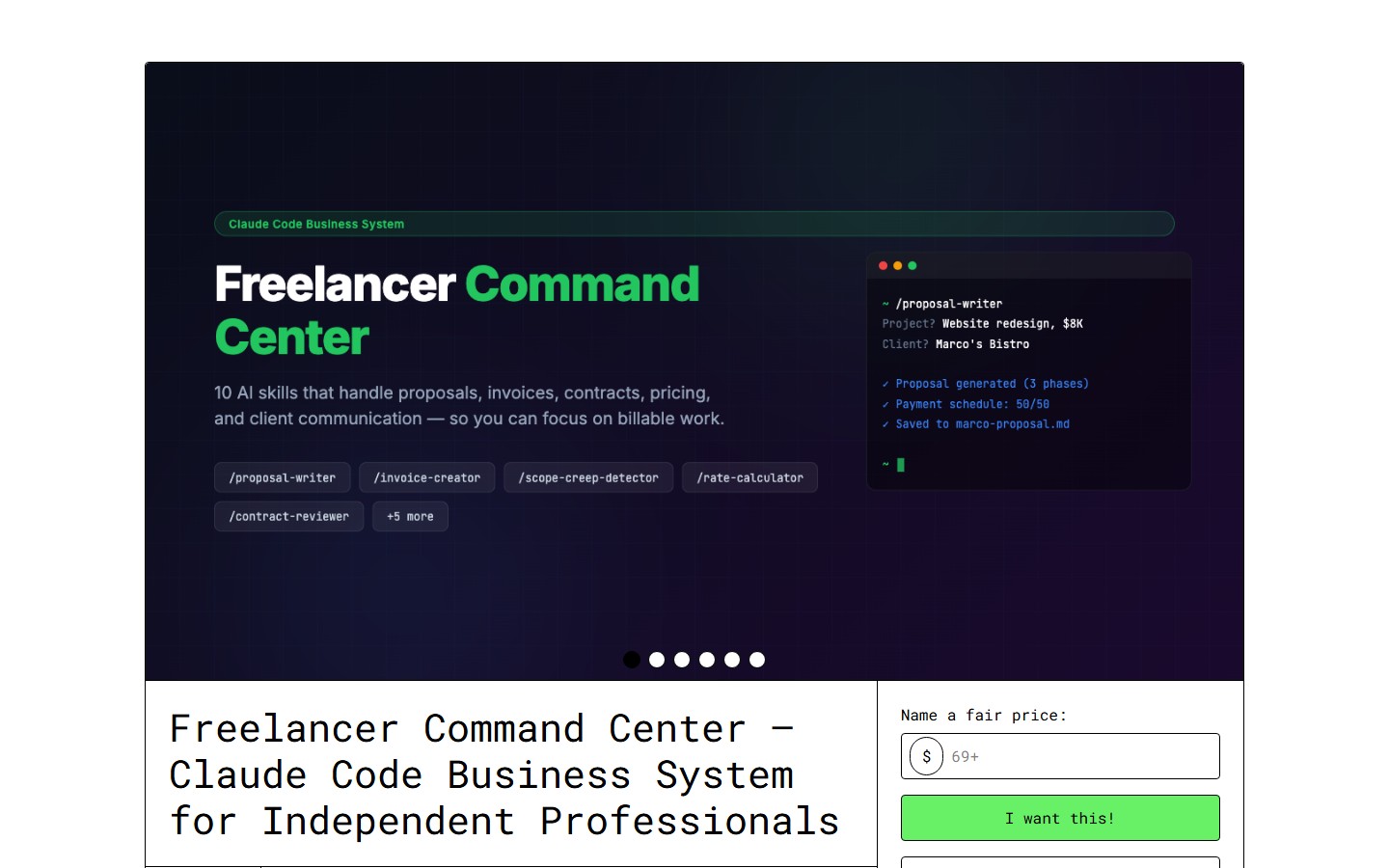
The Freelancer Command Center ($39) from the Skiln store is the fastest way I've found to stand up freelance operations. It includes project management templates, client onboarding workflows, financial tracking systems, and document templates — all pre-built for AI freelancers.
If you prefer to build from scratch, here's the minimum viable operational stack:
| Function | Free Option | Paid Upgrade |
|---|---|---|
| ---------- | ------------ | -------------- |
| Project Management | Notion (free tier) | Notion (paid) or Asana |
| Invoicing | Wave (free) | FreshBooks ($17/mo) |
| Contracts | Google Docs templates | HelloSign ($15/mo) |
| Time Tracking | Toggl (free tier) | Toggl (paid) |
| Communication | Email + Google Meet | Slack + Zoom |
| AI Tools | Claude Free + ChatGPT Free | Claude Pro ($20/mo) + ChatGPT Plus ($20/mo) |
The key insight: your operational setup signals your professionalism to clients. A freelancer with a clean onboarding process, professional contracts, and organized project management wins clients over a freelancer with better skills but chaotic operations. Every time.
If you're also serving legal clients, consider the OpenClaw Freelancer ($49) for industry-specific practice management that handles the unique requirements of legal work — confidentiality protocols, trust account management, and document automation for legal deliverables.
Step 3: Land Your First Clients {#land-clients}
This is where most freelancers stall. They build a portfolio, set up their tools, and then... wait. Waiting is not a client acquisition strategy.
Getting clients requires active outreach. Not occasionally. Daily. Here's the hierarchy of client acquisition channels ranked by effectiveness for new AI freelancers:
Tier 1: Direct Outreach (Highest Conversion)
- LinkedIn outreach — Connect with decision-makers at companies that need AI services. Share value-first content. DM with specific, personalized offers.
- Cold email — Research companies that would benefit from your services. Send personalized emails that reference specific problems you can solve.
Tier 2: Platforms (Fastest Start)
- Upwork — The largest freelance marketplace. Competition is fierce but volume is high. Optimize your profile for AI services and specialize your proposals.
- Fiverr — Better for productized services. Package your AI services into clear deliverables with fixed pricing.
Tier 3: Inbound (Highest Long-Term ROI)
- Content marketing — Blog posts, LinkedIn articles, and social content that demonstrates your expertise. Slow to build but compounds over time.
- Referrals — Happy clients refer more clients. Build referral requests into your project completion process.
The AI Client Acquisition System ($39) is purpose-built for this challenge. It includes outreach templates for all six channels listed above, a proposal generator that cuts proposal writing time by 75%, lead scoring frameworks, pricing strategies, and follow-up sequences.
I reviewed the AI Client Acquisition System in detail here. The short version: my outreach volume tripled, response rates nearly doubled, and I landed 4 clients in 30 days versus my typical 1-2.
Whether you use the system or build your own, the non-negotiable discipline is this: send outreach every single day. Five targeted outreach messages per day, five days per week. That's 100 outreach touches per month. At even a 5% close rate, that's 5 new clients monthly.
The Proposal That Wins
Here's what separates proposals that close from proposals that get ignored:
- Research the prospect first. Reference specific problems they have. "I noticed your blog hasn't been updated since October" beats "I can help with content."
- Lead with outcomes, not process. "I'll produce 8 SEO blog posts per month targeting keywords that drive organic traffic" beats "I use AI tools to write content."
- Include a case study. One example of similar work with measurable results is more persuasive than a generic portfolio.
- Price with confidence. Don't apologize for your rates. Present pricing as an investment with expected returns.
- Make the next step easy. End with a specific call-to-action: "I'm available for a 15-minute call this Thursday at 2pm — does that work?"
Step 4: Create Content That Sells {#content-strategy}
Content marketing is the most underrated client acquisition channel for AI freelancers. Why? Because your content IS your portfolio. When you publish a well-written blog post about AI automation, you're simultaneously demonstrating your expertise and generating inbound leads.
The content strategy for an AI freelancer is simple:
- Write about what you do. If you're an AI content writer, write about AI content strategy. If you're an automation consultant, write about AI workflow automation. Your content topics should match your service offerings.
- Target keywords your ideal clients search. "How to use AI for [client's industry]" keywords attract exactly the people who would hire you. "Best AI tools for real estate marketing" brings you real estate clients who need AI help.
- Publish consistently. One blog post per week, minimum. Three LinkedIn posts per week. Content compounds, but only if you maintain cadence.
- Repurpose ruthlessly. Every blog post becomes 3-5 social posts, an email newsletter section, and a LinkedIn article. The AI Content Empire Toolkit ($29) systematizes this entire process with prompt chains and editorial calendars.
I reviewed the AI Content Empire Toolkit in detail here. The prompt chains for blog post creation and the repurposing workflows are the strongest components. For a freelancer trying to maintain a content publishing cadence while also serving clients, the time savings are significant.
Content Metrics That Matter
Don't obsess over vanity metrics. Track these:
| Metric | Why It Matters | Target |
|---|---|---|
| -------- | --------------- | -------- |
| Organic traffic | Inbound lead volume | Growing month-over-month |
| Email subscribers | Owned audience | 100+ in first 3 months |
| LinkedIn engagement | Professional visibility | 50+ reactions per post |
| Inbound inquiries | Direct business impact | 2-5 per month |
| Content-to-client conversion | ROI on content time | Track which posts generate clients |
Step 5: Add Digital Products for Passive Income {#digital-products}
Here's the multiplier that transforms a freelance hustle into a business: sell what you know.
Every freelancer develops specialized knowledge through client work. Templates, workflows, prompt libraries, process documents — these are assets you can package and sell as digital products. The marginal cost of each sale is zero. You create it once and it generates revenue indefinitely.
The Digital Product Ladder
- Templates and Prompt Packs ($9-29) — Package your best prompts, templates, and workflows. Lowest barrier to entry.
- Toolkits and Systems ($29-79) — Comprehensive systems that solve a specific problem. Like the Skiln store products — each one addresses a complete workflow.
- Courses and Workshops ($97-497) — Teach your methodology in video or cohort format. Highest revenue per sale.
- Done-With-You Programs ($500-2,000) — Group coaching that blends education with implementation support.
Selling on Gumroad
Gumroad remains the fastest path to selling digital products. No technical setup, no website required, no inventory management. You upload a product, set a price, share the link. Gumroad handles payments, delivery, and even affiliate programs.
The Sell on Gumroad toolkit ($24) from the Skiln store includes everything you need: product listing templates, sales page copywriting prompts, pricing strategies, launch email sequences, and marketing workflows specifically designed for digital product launches on Gumroad.
My advice: launch your first digital product within 60 days of starting your freelance business. It doesn't need to be perfect. A $19 prompt pack based on your service niche validates the concept and starts generating passive income while you build toward larger products.
The Complete Toolkit Stack {#toolkit-stack}
After testing dozens of tools and products, here's the four-product stack I recommend for new AI freelancers:
| Product | Price | What It Covers | Skiln Store Link |
|---|---|---|---|
| --------- | ------- | ----------------- | ----------------- |
| Freelancer Command Center | $39 | Operations, project management, financial tracking | Get it → |
| AI Client Acquisition System | $39 | Outreach, proposals, lead scoring, pricing | Get it → |
| AI Content Empire Toolkit | $29 | Content marketing, prompt chains, editorial calendar | Get it → |
| Sell on Gumroad | $24 | Digital product creation, sales, and marketing | Get it → |
| Total | $131 | Complete freelance AI business infrastructure |
$131 total. One-time payment. No subscriptions. Lifetime updates on all four products.
For context, a single session with a freelance business coach costs $150-400. A comprehensive freelance course runs $500-2,000. This stack gives you the implementation tools — not just education — for less than the cost of a nice dinner out.
If you serve legal clients specifically, add the OpenClaw Freelancer ($49) for practice-area-specific templates and compliance workflows. That brings the total to $180 for a complete legal AI freelance operation.
Month-by-Month Roadmap {#roadmap}
Month 1: Foundation
- Week 1: Choose your niche. Set up AI tools (Claude Pro, ChatGPT Plus). Purchase and deploy the Freelancer Command Center.
- Week 2: Build your portfolio — create 3-5 sample projects in your niche. Set up your LinkedIn profile as a professional service page.
- Week 3: Deploy the AI Client Acquisition System. Build your first lead list of 30 prospects. Begin daily outreach (5 messages/day).
- Week 4: Submit your first proposals. Set up your content publishing system with the AI Content Empire Toolkit. Publish your first blog post.
Target: 2-3 discovery calls, 1 client, $500-1,500 revenue.
Month 2: Traction
- Week 5-6: Continue daily outreach. Refine proposals based on feedback. Deliver excellent work for first client(s). Publish 4 blog posts.
- Week 7-8: Ask first clients for testimonials. Expand outreach to additional platforms (Upwork, cold email). Begin developing your first digital product.
Target: 3-5 active clients, $2,000-4,000 revenue.
Month 3: Acceleration
- Week 9-10: Launch first digital product on Gumroad ($19-29 price point). Scale outreach to 10 messages/day across 3 platforms. Your content should be generating inbound inquiries by now.
- Week 11-12: Raise rates for new clients. Build referral pipeline from existing clients. Publish consistently — aim for 2 blog posts per week.
Target: 5-8 active clients, $4,000-8,000 revenue, first digital product sales.
Month 4-6: Scaling
- Transition from hourly/project pricing to retainers where possible
- Launch second digital product ($39-79 price point)
- Begin outsourcing lower-value tasks
- Target: $6,000-12,000/month revenue with 20-40% from digital products
Final Thoughts {#final-thoughts}
Starting a freelance AI business in 2026 is one of the highest-ROI career moves available right now. The demand is real. The barriers are low. The tools are affordable.
But — and this is important — tools and systems don't replace execution. The best toolkit in the world is worthless if you don't send the outreach, publish the content, and deliver great work for clients.
The advantage of using a structured system (whether it's the Skiln toolkit stack or your own cobbled-together setup) is that it removes friction from execution. When writing a proposal takes 30 minutes instead of 3 hours, you write more proposals. When content creation has a repeatable workflow, you publish more consistently. When operations are organized, you deliver better client work.
Remove the friction. Do the work. Build the business.
The opportunity won't wait forever. But it's here right now, and it's yours if you take it.
Frequently Asked Questions {#faqs}
How much can you earn freelancing with AI in 2026?
Earnings vary widely by niche and experience. AI content writers typically earn $50-150 per article. AI consultants charge $100-300 per hour. AI automation freelancers bill $2,000-10,000 per project. The median freelance AI professional in 2026 earns $60,000-120,000 annually, with top performers exceeding $200,000. Your actual earnings depend on niche selection, pricing strategy, and how consistently you pursue client acquisition.
What skills do you need for an AI freelance business?
Core skills include prompt engineering, understanding of AI capabilities and limitations, a domain specialty (writing, marketing, development, design, consulting), basic business skills (pricing, client management, invoicing), and the ability to translate AI outputs into professional deliverables. You don't need to be a programmer or AI researcher. The Freelancer Command Center includes skills assessment frameworks to identify where you're strong and where to focus development.
What are the best AI freelance niches in 2026?
The highest-demand niches include AI content production (blogs, social media, email), AI automation consulting (workflow automation for businesses), AI-powered design services, chatbot and AI agent development, AI-assisted data analysis, and AI training/education. Content production and automation consulting are the most accessible entry points with the fastest path to income.
How do you find clients for AI freelance services?
The most effective channels are LinkedIn outreach with thought leadership content, cold email to businesses struggling with AI adoption, Upwork and freelance platforms, content marketing, referrals from existing clients, and AI-focused community networking. The AI Client Acquisition System provides structured outreach templates for all of these channels.
Should I sell digital products alongside freelancing?
Yes. Digital products create passive income that supplements client work. Templates, prompt libraries, courses, and toolkits based on your freelance expertise sell while you sleep. Platforms like Gumroad make selling easy with minimal setup. Many successful AI freelancers earn 30-50% of their income from digital products within 6-12 months.
What tools do you need to start an AI freelance business?
Essential tools: an AI platform (Claude Pro at $20/month or ChatGPT Plus at $20/month), project management system (Notion free tier), invoicing software (Wave, free), a portfolio website (Carrd, $9/year), and professional communication tools. Specialized toolkits from the Skiln store provide ready-made frameworks for operations, client acquisition, content marketing, and digital product sales.
How long does it take to build a full-time AI freelance income?
Most freelancers take 3-6 months to replace a full-time income, assuming they freelance part-time while employed. With aggressive outreach (5+ messages daily) and a strong niche, some reach full-time income within 2-3 months. The key variables are your existing network, niche demand, and how consistently you invest in business development.
Matty Reid is the Content Strategy Editor at Skiln. He covers AI tools, freelance business strategy, and digital product creation. Read more guides on the Skiln blog.