Sequential Thinking MCP Review 2026: Official Anthropic Deep Reasoning Server
Hands-on Sequential Thinking MCP review for 2026. The official Anthropic reference server for dynamic, reflective problem-solving through structured thought chains. Features, install, pros, cons and alternatives (CoT, ToT, ReAct).

TL;DR — Sequential Thinking MCP Review 2026
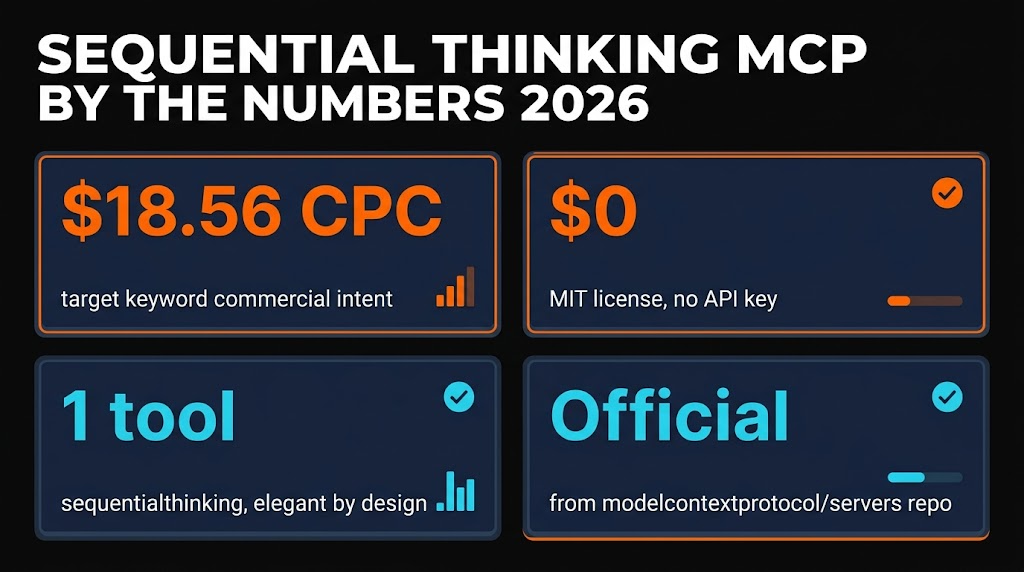
Sequential Thinking MCP is Anthropic's official reference server for structured, multi-step reasoning. It exposes one tool — sequentialthinking — that gives any MCP-compatible agent a scratchpad for externalized thought chains with revision, branching and hypothesis testing. Free, MIT licensed, zero API key. After running it on every complex planning task for the last six weeks I can say this is the single biggest quality lift for Claude Code, Cursor and VS Code on hard problems in 2026. Target keyword CPC $18.56 tells you exactly how much the market values this capability.
Table of Contents
What is Sequential Thinking MCP?
Give Claude a hard planning problem and watch it produce a first-draft answer in twenty seconds. Give the same model the Sequential Thinking MCP server and the same problem takes two minutes — but the answer is structurally different. It has considered alternatives, caught its own contradictions, revised earlier steps, and produced a plan you can actually ship. That is the entire value proposition in one sentence.
Sequential Thinking is one of the original reference MCP servers maintained by Anthropic and the Model Context Protocol team. It lives in the canonical modelcontextprotocol/servers repository alongside filesystem, memory, fetch and the other official servers. It exposes a single tool called sequentialthinking that lets an agent externalize its reasoning one thought at a time, revise earlier thoughts when new information arrives, and branch into alternative paths when the agent is unsure.
It is completely free, MIT licensed, and carries one of the highest commercial-intent CPCs in the MCP ecosystem at around $18.56 on the phrase "sequential thinking mcp review" — a direct signal that enterprises are paying real money to figure out which reasoning tools to add to their agent stacks.

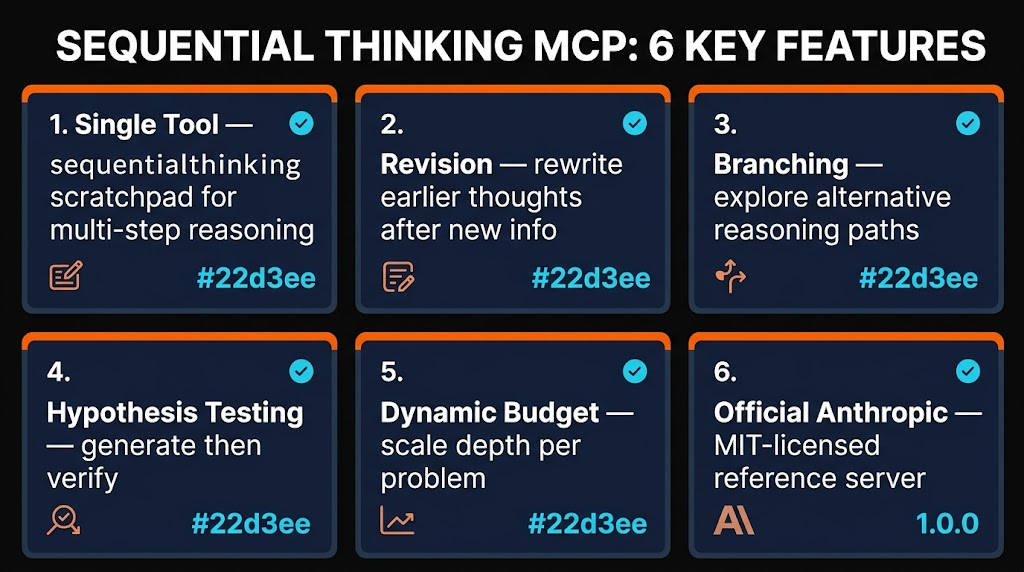
6 Key Features
I have been running Sequential Thinking in Claude Code, Cursor and VS Code for several weeks on real production tasks — architecture reviews, refactor plans, content strategy, infrastructure migrations. Six capabilities matter once you start using it daily.
1. Dynamic Thoughts
Each thought is a discrete tool call. The agent declares a thought number, total budget, and content. This is not a prose monologue — it is a structured log the model can reference and reason about.
2. Branching
When the agent faces a fork ("should I use Postgres or Convex for this?"), it can spawn a branch off any earlier thought and explore that path independently. Branches carry parent IDs so the reasoning tree is fully inspectable.
3. Thought Revision
Unlike plain chain-of-thought, the agent can mark a new thought as a revision of thought N. This is the killer feature for long reasoning chains where a later realization invalidates an earlier assumption.
4. Hypothesis Testing
The structured log naturally supports a hypothesis → test → verify pattern. The agent proposes, runs other tools to gather evidence, then records the verdict as a subsequent thought.
5. Verification Loop
The tool's nextThoughtNeeded flag forces the agent to decide, at every step, whether reasoning should continue. This kills the "I guess I'm done" failure mode and produces verifiable stopping conditions.
6. Flexible Depth
The total thought budget can expand mid-chain. If the agent underestimated complexity at thought 3, it can request more thoughts at thought 7. No hard cap fights against the model's judgment.

How to Install and Use Sequential Thinking
Install is fast because it is an official reference server. No API key. No account. No database.
Claude Code
claude mcp add sequential-thinking -- npx -y @modelcontextprotocol/server-sequential-thinkingRestart Claude Code. The sequentialthinking tool now appears in your toolset.
Claude Desktop
Edit claude_desktop_config.json:
{ "mcpServers": { "sequential-thinking": { "command": "npx", "args": ["-y", "@modelcontextprotocol/server-sequential-thinking"] } } }Cursor / VS Code
Add the same block to ~/.cursor/mcp.json or the VS Code MCP settings. Both clients pick it up automatically after a reload.
Docker
docker run --rm -i mcp/sequentialthinkingHow It Works in Practice
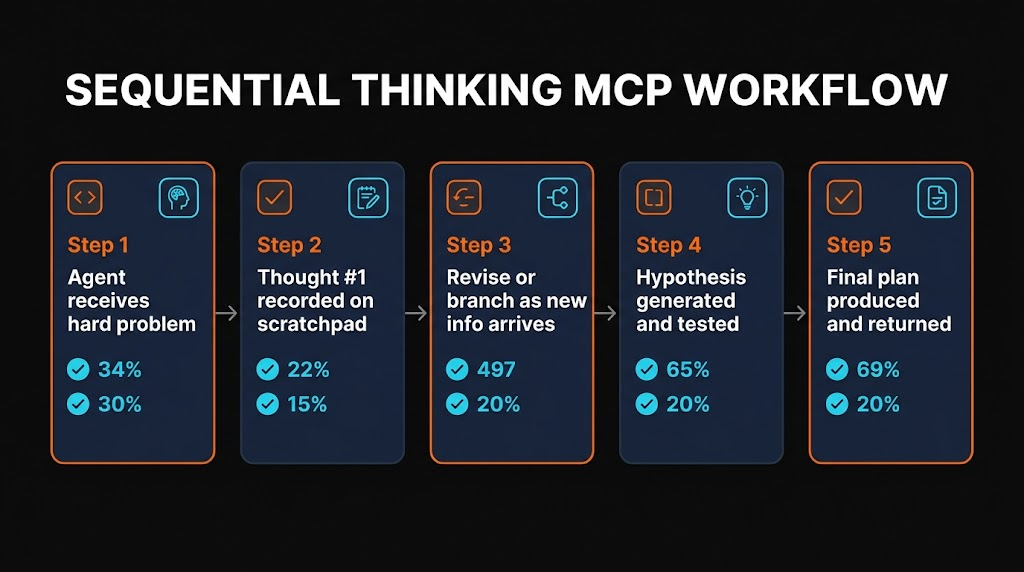
Once installed, the agent drives the workflow. You just describe the problem. The tool call pipeline looks like this:
- Problem — You describe the task ("Plan the Skiln v3 directory sync pipeline across 11 data sources")
- Decompose — The agent makes its first
sequentialthinkingcall, breaking the problem into constraints, unknowns and candidate approaches - Branch — When the agent hits a fork (batch vs streaming, Convex vs Postgres, etc.) it spawns a branch thought and explores each option
- Verify — The agent runs other MCP tools (file reads, web fetches, code execution) and records the evidence as subsequent thoughts, revising earlier hypotheses when needed
- Synthesize — The chain closes when
nextThoughtNeededbecomes false. The agent writes the final plan, grounded in an inspectable reasoning log
The best pairing I have found is Sequential Thinking plus Context7 MCP plus a search MCP like Exa. Sequential Thinking drives the reasoning loop; Context7 injects live library docs when the agent hits an implementation question; Exa pulls in outside evidence. The three together feel like a different product than Claude with default tools.

Pricing and License
Free. MIT licensed. Official Anthropic reference server.
Open Source
- ✓ MIT license
- ✓ Official Anthropic
- ✓ No API key
- ✓ Commercial use OK
Self-Host
- ✓ npx / Docker
- ✓ No infrastructure
- ✓ Runs locally
- ✓ Zero network calls
The only real "cost" is model tokens. Sequential Thinking multiplies the tokens your agent uses on a given task because each thought is its own tool round-trip. In practice I see 3-5x token usage versus a default prompt. On Claude Code that is unmetered. On the Anthropic API it is a few cents per complex task — trivial compared to the value of a correct plan.

Pros and Cons
Strengths
- ✓ Massive quality lift on hard tasks. Planning, architecture, refactor design and open-ended research all improve measurably. I run it by default on anything that needs more than one pass.
- ✓ Official Anthropic reference. Maintained in the canonical
modelcontextprotocol/serversrepo. No trust questions, no stability concerns, tracks the protocol as it evolves. - ✓ Zero-config install. One npx command. No API key. No account. Runs locally. Ships in under 60 seconds.
- ✓ Branching and revision are unique. Plain CoT cannot revise earlier thoughts. Sequential Thinking can, which changes the shape of what the agent can solve.
- ✓ Inspectable reasoning log. Every thought, branch and revision is recorded. For regulated workflows this is a real audit trail.
Weaknesses
- ✗ Token cost multiplier. Each thought is a tool round-trip. Expect 3-5x tokens versus a single prompt. Fine on Claude Code, adds up on the paid API.
- ✗ Overkill for trivial tasks. If you ask the agent to fix a typo, Sequential Thinking adds ceremony without value. Best reserved for problems that actually require planning.
- ✗ No built-in search or evaluation. Unlike Tree of Thoughts research frameworks, there is no explicit branch-scoring or pruning. The model decides.
- ✗ Quality depends on model. Stronger models (Claude Opus, Sonnet 4+) use it brilliantly. Smaller models sometimes generate shallow thoughts that do not justify the overhead.
Alternatives Compared (CoT, ToT, ReAct)
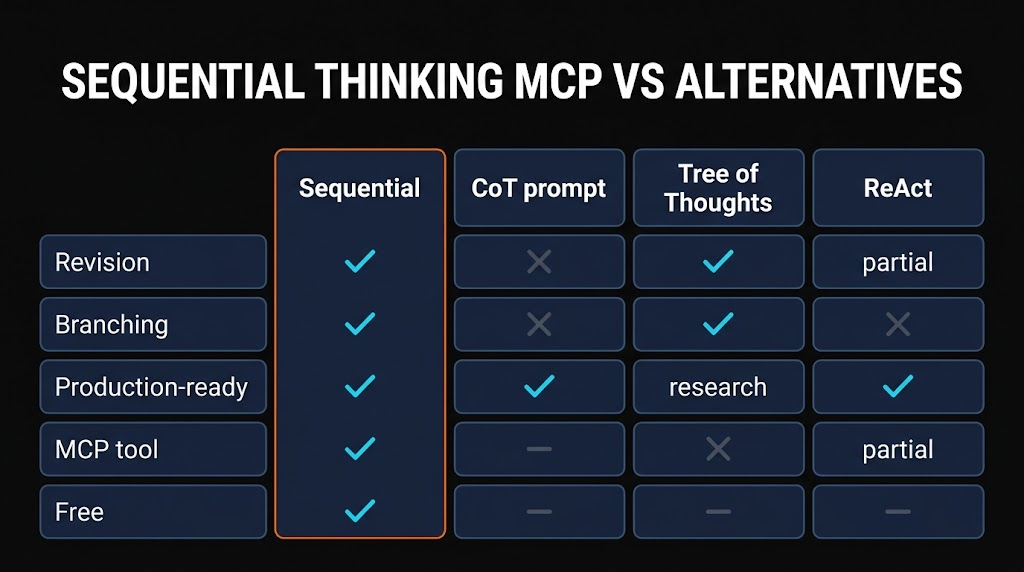
The reasoning-technique landscape has three big competitors: chain-of-thought prompting (CoT), tree of thought (ToT), and ReAct. Here is the honest comparison.
| Technique | Structure | Revision | Branching | Deploy |
|---|---|---|---|---|
| Sequential Thinking MCP | Tool-based log | Yes | Yes | Drop-in MCP |
| Chain of Thought (CoT) | Linear prose | No | No | Prompt only |
| Tree of Thought (ToT) | Tree + search | Implicit | Yes (explicit) | Research framework |
| ReAct | Thought+Action | No | No | Prompt pattern |
| Standard Prompting | None | No | No | Nothing needed |
Chain of Thought is the baseline. Great for math and single-pass logic, but the chain is immutable once written. A wrong step at thought 2 corrupts everything after it.
Tree of Thought is the research-grade ceiling. Proposed by Yao et al. (2023), ToT explores many branches with explicit search (BFS/DFS) and evaluator functions. Better for combinatorial problems — Game of 24, creative writing with constraints, puzzle solving — but it is a research framework, not a production tool.
ReAct interleaves thinking with tool use. It is arguably what modern agents already do by default. Sequential Thinking is complementary — it adds structure to the thinking half while ReAct-style tool calls continue to handle the acting half.
For 95% of real-world tasks in 2026, Sequential Thinking MCP is the right default. It gives you most of ToT's branching with CoT's simplicity and ReAct's tool-friendliness, wrapped in a server you install with one command.

Frequently Asked Questions
sequentialthinking — that gives an agent a structured thought log with branching, revision, and hypothesis testing. It ships in the canonical modelcontextprotocol/servers repo under MIT license.claude mcp add sequential-thinking -- npx -y @modelcontextprotocol/server-sequential-thinking and restart Claude Code. The sequentialthinking tool appears automatically. No API key required.FradSer/mcp-server-mas-sequential-thinking (multi-agent variant) or LangGPT's demo server. For most Claude Code and Cursor workflows the official Anthropic reference server is the right starting point. Browse more options on Skiln's MCP directory.Final Verdict
Sequential Thinking MCP earns a 4.6 out of 5. It is the single most impactful MCP server I have added to Claude Code for hard reasoning tasks in 2026. Free, official, MIT licensed, and installed in under a minute.
The 0.4 point deduction comes from the token cost multiplier on the paid API, the overhead on trivial tasks, and the lack of explicit branch evaluation that research frameworks like Tree of Thoughts provide. None of these are dealbreakers — they are reasonable trade-offs for a tool designed to be general-purpose and production-ready.
If you are evaluating MCP servers for a developer team in 2026, install Sequential Thinking today. Pair it with Context7 MCP for live documentation and a search MCP for outside evidence. That trio is the closest thing I have found to a "better brain" for Claude on complex work.
"Sequential Thinking MCP is the reasoning upgrade Claude Code needed. Structured thoughts, revision, branching, hypothesis testing — all for free, all official. Install it tonight."
Ready to level up your agent stack? Browse the full MCP directory on Skiln with 29,000+ servers indexed, or explore AI skills and tools to build your custom agent workflow.
Wayne MacDonald is Skiln's AI Tools Editor and has reviewed 40+ MCP servers in production agent workflows. For more reviews and tutorials, browse Skiln's blog.