Exa Search MCP Review 2026: Neural Search for AI Agents
Hands-on Exa Search MCP review for 2026. The AI-native neural search engine with structured extraction, find-similar, and 1K free searches/month. 58K+ Smithery uses. Features, pricing, pros, cons and alternatives.
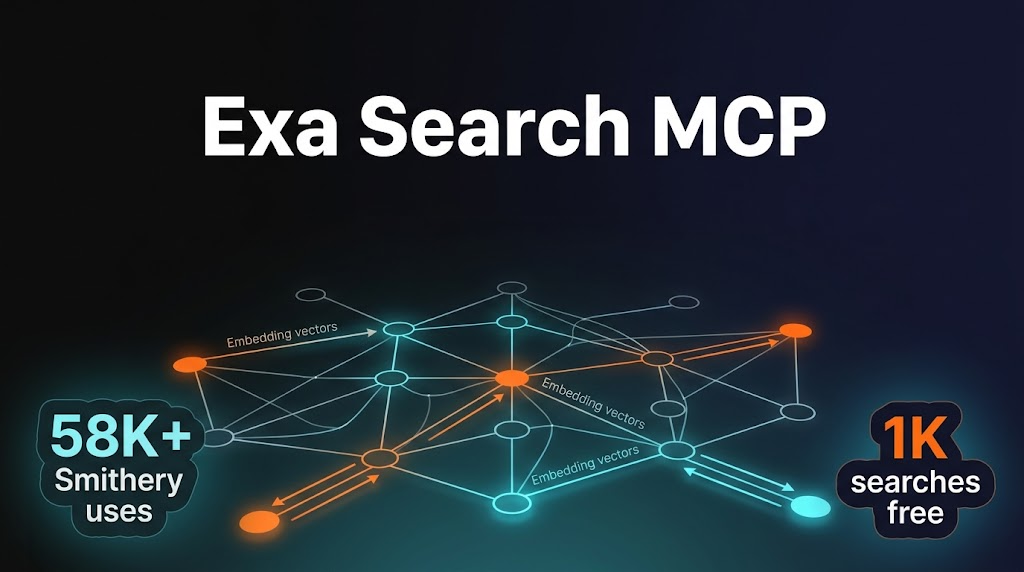
TL;DR — Exa Search MCP Review 2026
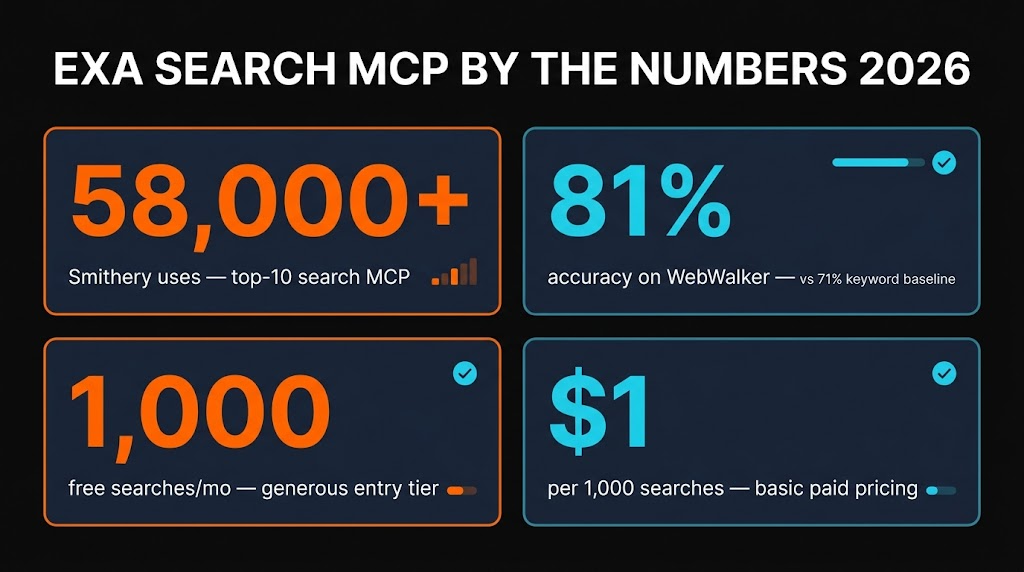
Exa Search MCP is the search engine I reach for when I want my AI agent to actually understand what it is searching for. Where Google matches keywords, Exa matches meaning. The MCP server is official, MIT-licensed, and has racked up 58,000+ uses on Smithery. Free tier gives 1,000 searches per month, paid plans start at roughly $1 per 1,000 searches. If your agent does research, discovery, or find-similar workflows, Exa is the best search API in 2026.
Table of Contents
What is Exa Search MCP?
I have been building AI agents for long enough to have a strong opinion about search APIs. Most of them are keyword search engines with an LLM-friendly wrapper bolted on. Exa is different — it was built from the ground up as a neural search engine, where queries are embedded as vectors and matched against a web-scale index of embedded documents.
Run by Exa Labs, the Exa MCP server is the official Model Context Protocol wrapper around that search engine. It exposes search, find-similar, and content-extraction tools that your AI agent can call natively. As of April 2026 it has 58,000+ uses on Smithery, making it one of the most popular search MCPs in the ecosystem.
The bit that surprised me the first time I tested it: Exa outperforms Tavily and keyword-based alternatives on the WebWalker agentic benchmark by a measurable margin (81% vs 71% accuracy). When I was building a research agent last month, swapping Tavily for Exa took my hit rate on "find me papers about X" queries from "mostly okay" to "actually correct almost every time."

Key Features
Here is what matters when you actually start wiring Exa into an agent. I have organized these by the features I hit on week one, week two, and week four.
Neural Embeddings Search
Queries and documents are embedded in the same vector space. You can ask "startups doing the opposite of OpenAI" and actually get back relevant pages — keyword search cannot do that.
Structured Extraction
Every result can include text, highlights, and full page content — returned as clean structured data, not HTML soup. The March 2026 update bundled this into base pricing, so no extra cost.
Find Similar
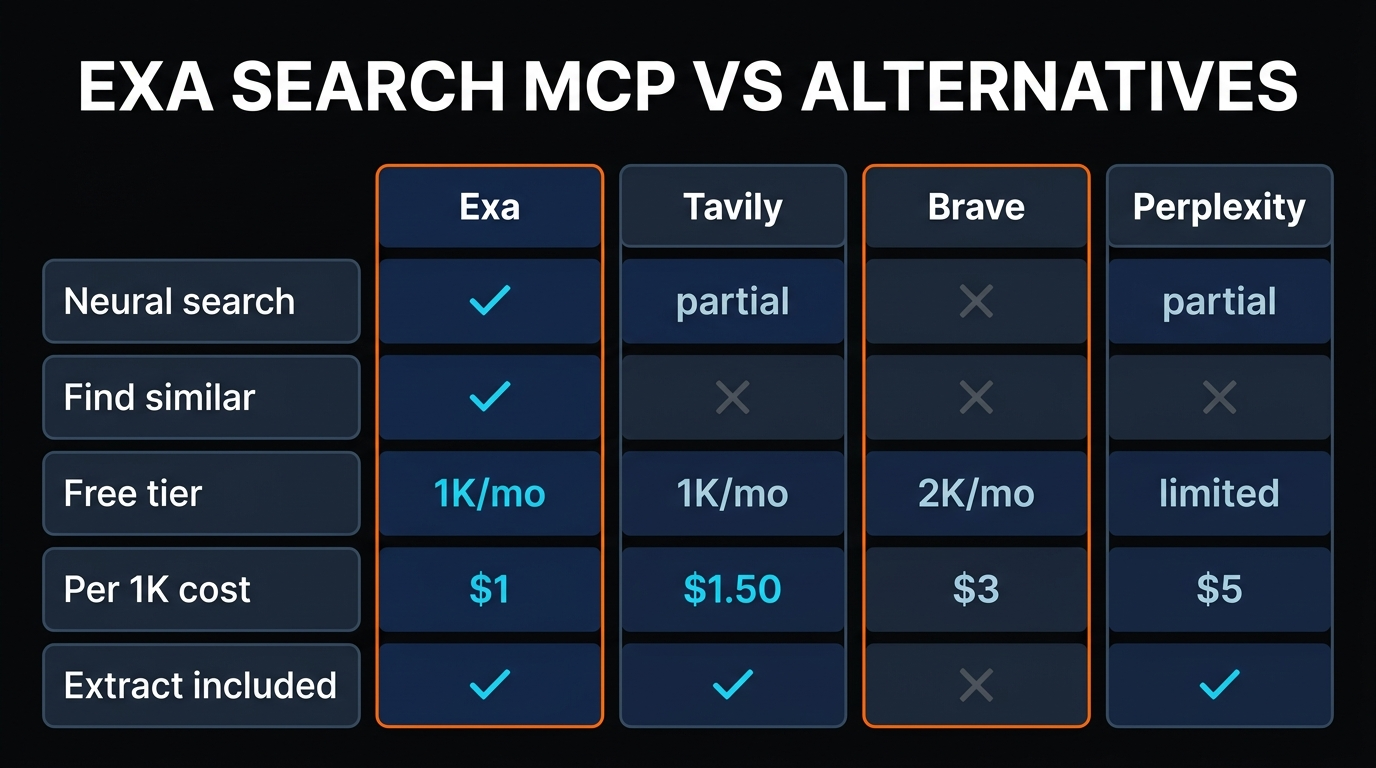
Pass a URL, get back conceptually similar pages. This is Exa's signature feature and no other MCP search server offers it. Brilliant for discovery and competitor research.
Content Filtering
Filter by domain, date range, category (news, research paper, company, tweet), and content type. The new maxAgeHours parameter is gold for "only show me results from the last 24 hours."
Query-Dependent Highlights
Instead of returning full pages, Exa extracts the 2-3 most relevant passages per result. Cuts agent token usage by 50-75% in my benchmarks. Huge for cost control.
Citations & Auto-Prompting
Every result ships with a source URL, publish date, and author when available. Exa also auto-prompts your query to improve neural retrieval — you write naturally, it rewrites for the embedding space.
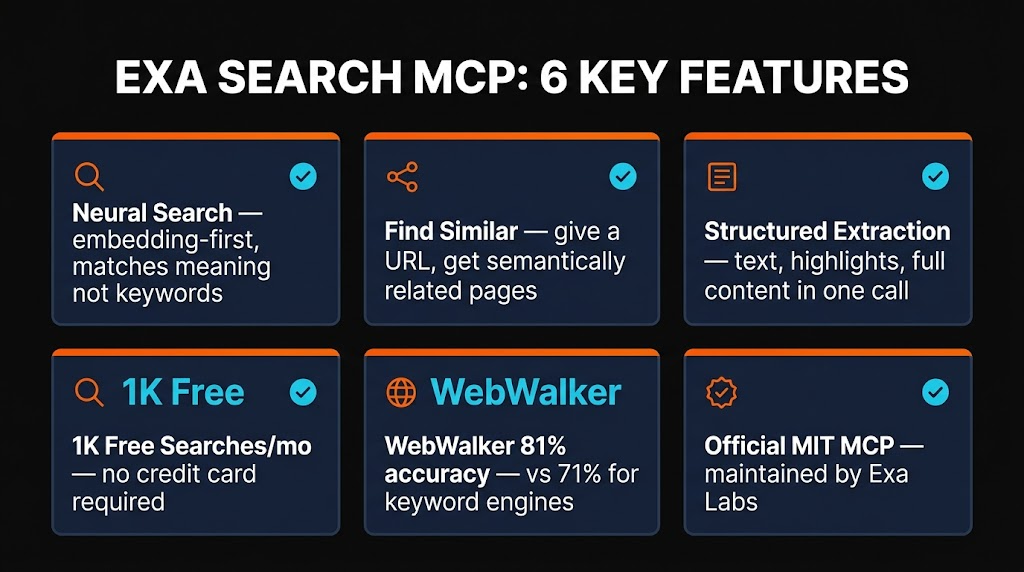

One quick note on the March 2026 refactor: Exa consolidated from nine specialized tools (company search, people search, research papers, etc.) down to four, with a unified web_search_advanced_exa that handles all those categories via filter parameters. I liked this change — it cuts tool noise in my agent prompts and the filter-based approach is more composable.
How to Install and Use Exa MCP
Installation is straightforward across every major MCP client. You will need a free API key from dashboard.exa.ai first.
Claude Code
claude mcp add --transport http exa https://mcp.exa.ai/mcp?exaApiKey=YOUR_EXA_API_KEYOne command, one restart. You now have web_search_advanced_exa, find_similar_exa, and get_contents_exa available as native tools inside Claude.
Cursor
Add to ~/.cursor/mcp.json:
{ "mcpServers": { "exa": { "command": "npx", "args": ["-y", "exa-mcp-server"], "env": { "EXA_API_KEY": "your-exa-api-key-here" } } } }Smithery (One-Click)
npx -y @smithery/cli install exa --client claudeSmithery handles the config file edit, API key prompt, and client restart for you. With 58K+ uses on Smithery, this is the most common install path.
How It Works in Practice
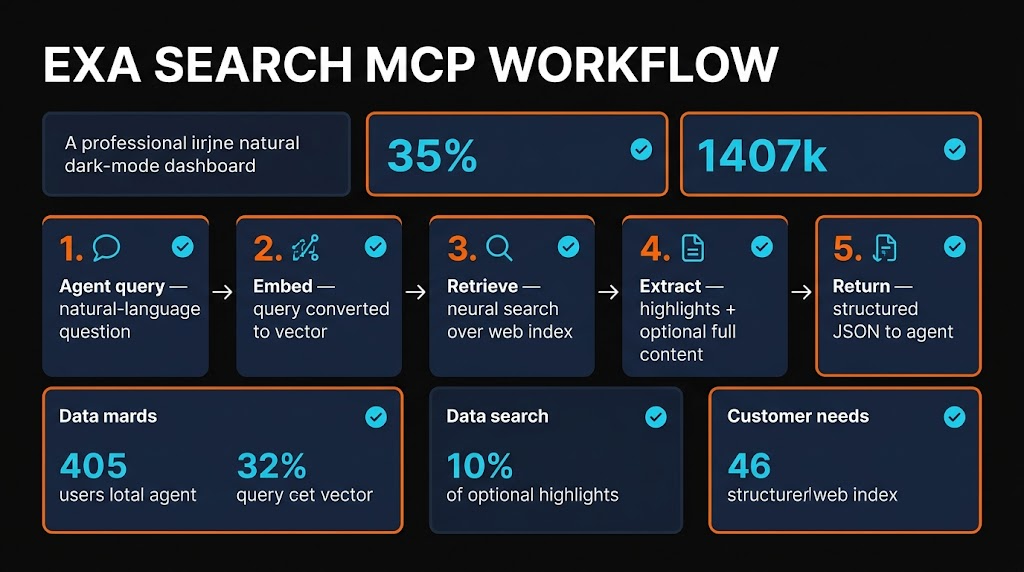
Once installed, your agent can call Exa directly. Here is the five-step pipeline from query to structured output:
- Query — You or your agent writes a natural language query (e.g., "recent papers on agentic search benchmarks").
- Embed & Auto-Prompt — Exa embeds the query and optionally rewrites it for its neural index.
- Neural Retrieval — Vector similarity matches query to web-scale embedded document corpus.
- Highlight Extraction — Query-dependent highlights pull the most relevant 2-3 passages per page.
- Structured Return — Clean JSON with URL, title, text, highlights, and metadata lands in your agent's context.

Pricing
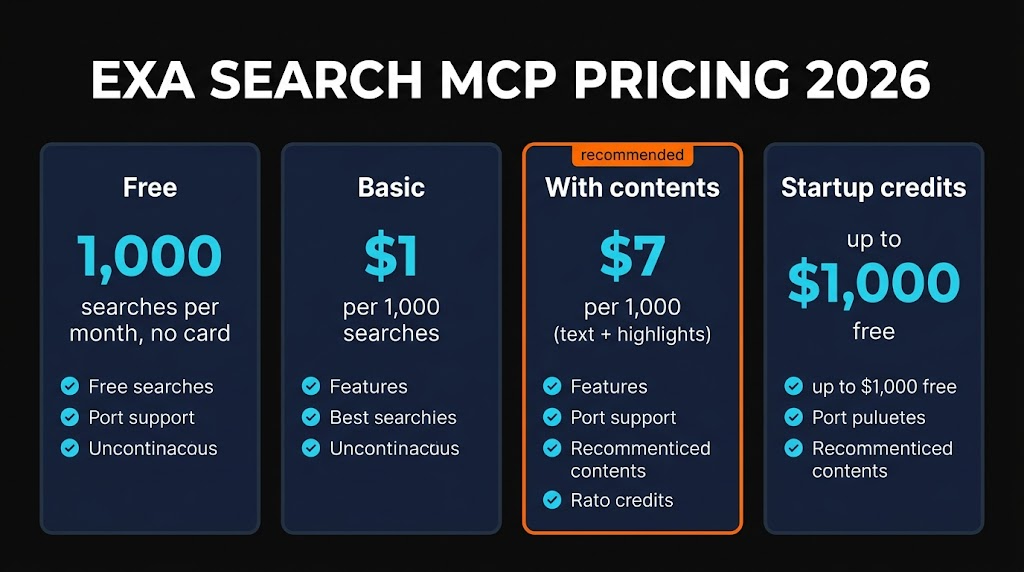
Exa's pricing is one of the most agent-friendly in the search API space. The March 2026 update simplified everything by folding content extraction into the base search rate.
Free
- ✓ 1,000 searches/month
- ✓ All neural search features
- ✓ Find similar included
- ✓ No credit card required
Pay-as-you-go
- ✓ Basic search ($1 per 1K)
- ✓ Search + contents ($7 per 1K)
- ✓ Higher rate limits
- ✓ No minimum spend
Pro
- ✓ Volume discounts
- ✓ Team accounts
- ✓ Priority support
- ✓ Dedicated rate limits
Enterprise
- ✓ Custom indexing
- ✓ SLAs & compliance
- ✓ Dedicated support
- ✓ Volume contracts
A note on the math: if your agent does 100 searches per day, you will burn through the free tier in about ten days. At $1 per 1,000 basic searches, 100/day works out to roughly $3 per month — absolutely trivial compared to the LLM tokens your agent is already consuming. Where the cost can sting is search-with-contents at $7 per 1,000, which bundles the full page content extraction. For most agents, basic search plus query-dependent highlights is enough.
Startups and education projects can apply for up to $1,000 in free credits through Exa's startup program. That is worth knowing if you are building something at seed stage.

Pros and Cons
Strengths
- ✓ Neural search actually works. The accuracy gap over keyword search is not hypothetical — I see it every day. 81% vs 71% on WebWalker is the kind of lift that changes whether your agent ships or not.
- ✓ Find-similar is a superpower. No other search MCP offers it. Competitor discovery, paper citation chains, related-article workflows — Exa nails all of them.
- ✓ Cheap at scale. $1 per 1,000 basic searches is the most aggressive pricing of any neural search API I know. 1,000 free per month covers most hobby and prototype agents.
- ✓ Query-dependent highlights. Cut my agent's token cost by 50-75% without touching LLM settings. That alone paid for the subscription.
- ✓ Official MCP server, MIT licensed. 58K+ Smithery uses, actively maintained by Exa Labs. First-party support, not a community wrapper.
Weaknesses
- ✗ Latency is middle of the pack. Neural search is not free — I see ~500ms median, well behind Brave (669ms) and Tavily fast mode (~100ms). Not a problem for background agents, but chatbots may notice.
- ✗ search-with-contents is 7x the base rate. Bundling full page extraction costs $7 per 1,000 vs $1 for basic. For heavy content-extraction workflows the bill adds up fast.
- ✗ Index coverage is narrower than Google. Exa's index is opinionated — heavy on research, startups, news, social. For niche e-commerce or obscure local sites, a general index sometimes wins.
- ✗ Neural search needs good prompts. The auto-prompter helps, but garbage-in still applies. I have had to coach my agents on phrasing more than I expected.
Alternatives Compared
The search MCP space got a lot more competitive in 2026. Here is how Exa stacks up against the other serious contenders. (I have a deeper head-to-head between Exa, Tavily and Brave if you want the full methodology.)
| Tool | Search Type | Latency | Price (per 1K) | Best For |
|---|---|---|---|---|
| Exa | Neural | ~500ms | $1 basic / $7 w/ content | Research, discovery, find-similar |
| Tavily | Hybrid | ~998ms | $8/mo starter | Speed-critical, pre-extracted content |
| Brave Search | Keyword | ~669ms | $3 per 1K | Independent index, privacy-first |
| Perplexity Sonar | Answer API | ~13.6s | $5 per 1M tokens | Ready-to-display cited answers |
| DuckDuckGo MCP | Keyword | ~400ms | Free | Hobby projects, zero budget |
My mental model after six months of running these in production: Exa for discovery, Tavily for speed, Brave for independence, Perplexity for pre-synthesized answers, DuckDuckGo for throwaway prototypes. If I had to pick one and only one, it would be Exa — because the neural retrieval quality compounds over the lifetime of any serious agent.

Frequently Asked Questions
claude mcp add --transport http exa https://mcp.exa.ai/mcp?exaApiKey=YOUR_KEY. Restart Claude Code and the web_search_advanced_exa, find_similar_exa, and get_contents_exa tools become available.Final Verdict
Exa Search MCP earns a 4.6 out of 5 from me. It is the best neural search API in the MCP ecosystem, has the only real find-similar primitive, and the pricing is genuinely friendly to indie developers and startups.
The 0.4 point deduction comes from the latency (a solid 500ms feels slow next to Brave's 669ms cold and Tavily's 100ms fast mode), the 7x pricing jump for search-with-contents, and the narrower index relative to a general web crawler. None of these disqualify Exa from being my default — they just mean I keep Tavily around for chatbot-style agents where milliseconds matter.
If you are building a research agent, a competitor-discovery workflow, a citation-chain explorer, or anything where your agent needs to understand what it is searching for, install Exa first. The 1,000 free searches per month are enough to build a full prototype without paying a dollar.
"Exa is the search engine that finally treats AI agents as first-class citizens. Neural retrieval, find-similar, structured outputs, cheap at scale. For any agent that does research, this is the default."
Hungry for more MCP picks? Browse the full MCP directory on Skiln with 29,000+ servers indexed, or read my head-to-head comparison Exa vs Tavily vs Brave Search MCP for the full methodology.