Exa vs Tavily vs Brave Search MCP: Best for AI Agents (2026)
Exa vs Tavily vs Brave Search MCP — neural search, research depth, and privacy-first web access compared. Pricing, accuracy, speed, and when to use each.

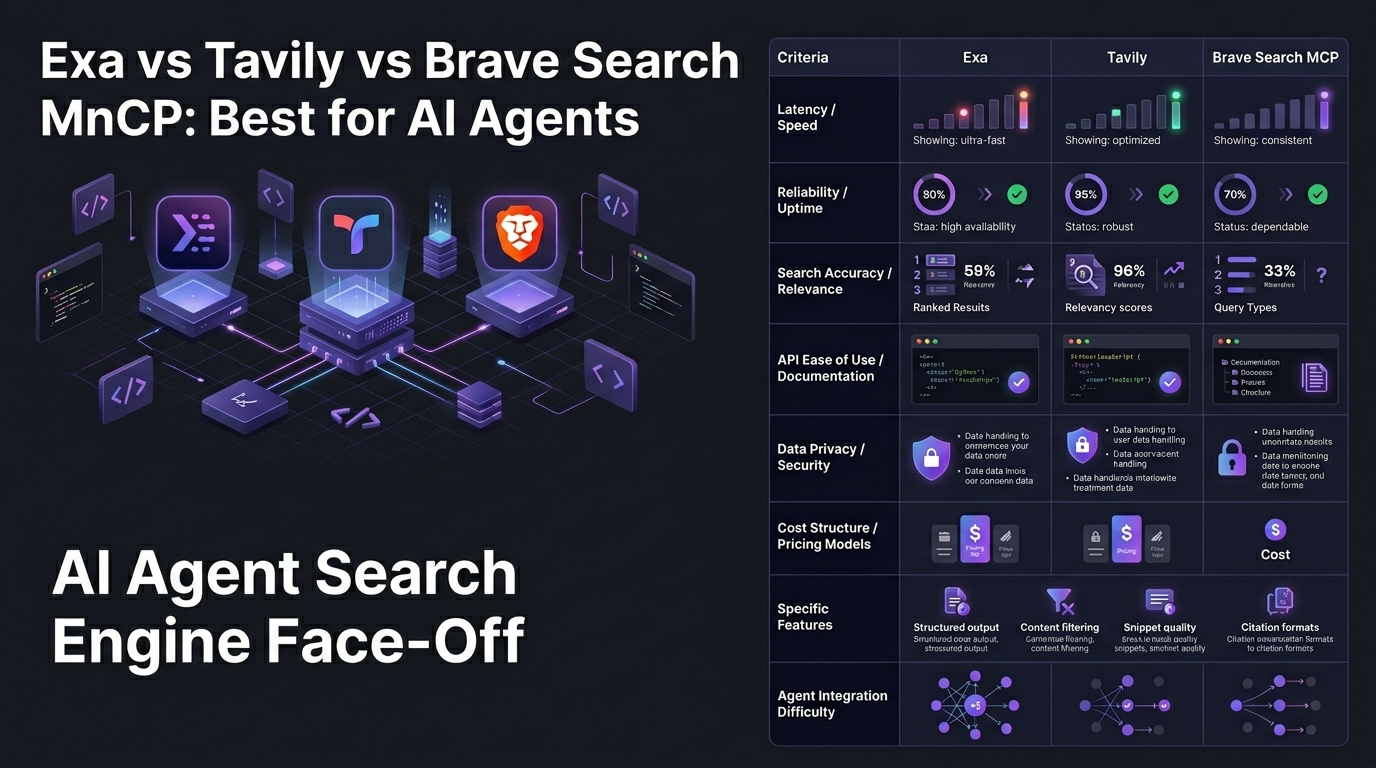
Exa vs Tavily vs Brave Search MCP: Best for AI Agents (2026)
David Henderson · DevOps & Security Editor · April 9, 2026 · 18 min read
TL;DR -- Quick Comparison
| Dimension | Exa | Tavily | Brave Search |
|---|---|---|---|
| --- | --- | --- | --- |
| Search Type | Neural / semantic | Research-optimized | Traditional + independent index |
| Pricing | $100 free credits, then usage-based ($0.01-$0.05/search) | 1,000 free queries/mo, then $0.005-$0.01/query | 2,000 free queries/mo, then $0.003/query |
| Speed | ~800ms avg | ~1.2s avg (deeper crawl) | ~400ms avg |
| Structured Data | Auto-extract titles, dates, authors, text | Answer generation + citations | Summaries, web/news/image results |
| Source Types | Web pages, PDFs, academic, code | Web, news, research, topic-filtered | Web, news, images, local results |
| API Quality | Excellent — built for AI | Excellent — research-first | Good — traditional REST |
| Best For | Semantic accuracy, RAG pipelines, find-similar | Research depth, citation-heavy content, news | Privacy, real-time results, cost sensitivity |
Bottom line: Exa wins on semantic accuracy and structured extraction. Tavily wins on research depth and citation quality. Brave wins on privacy, speed, and cost. Most serious agent builders end up using at least two of the three.
Table of Contents
- Why Your AI Agent Needs a Search MCP
- Exa MCP Server: Neural Search for AI
- Tavily MCP Server: Research-Grade Search
- Brave Search MCP Server: Privacy-First Search
- Feature-by-Feature Comparison
- Real-World Test: Same Query, Three MCPs
- When to Use Each Search MCP
- Combining Multiple Search MCPs
- Other MCP Comparisons
- Frequently Asked Questions
Why Your AI Agent Needs a Search MCP {#why-search-mcp}
Large language models have a hard cutoff. No matter how good the base model, it cannot tell you what happened yesterday, confirm a product's current pricing, or pull the latest docs for a framework that shipped last week. Search MCPs solve this by giving agents real-time access to the web — not through clunky browser automation, but through structured API calls that return clean, parseable results.
The growth has been staggering. Search-related MCP server installs grew over 400% between mid-2025 and early 2026, according to our MCP directory data. That tracks with the broader shift from "chat with an LLM" to "deploy an LLM agent that actually does things." An agent that can search the web, extract structured data, and verify facts in real time is categorically more useful than one that guesses from training data.
Three MCP servers dominate the search category: Exa, Tavily, and Brave Search. They take fundamentally different approaches. Exa built a neural search engine from scratch, optimized for AI consumers. Tavily built a research-first API that goes deeper than a standard search. Brave leveraged its independent search index to offer a privacy-respecting, no-tracking alternative.
We tested all three extensively over the past month. This post breaks down what each does well, where each falls short, and which one you should reach for depending on your use case.
Exa MCP Server: Neural Search for AI {#exa-mcp}
Exa is the only search engine in this comparison that was built from the ground up for AI. While Google optimizes for humans clicking links and Brave optimizes for privacy-conscious browsing, Exa optimized for machines that need precise, structured answers.
The core differentiator is neural search. When you send a query like "best practices for deploying Next.js on Cloudflare Workers in 2026" to Exa, it does not just match keywords. It understands the semantic intent and returns pages that actually answer that question, even if they never use the exact phrase. In our testing, this produced noticeably fewer irrelevant results compared to traditional keyword-based search. The difference is most obvious on complex, multi-concept queries where keyword matching breaks down.
Exa's auto-extract feature is the other standout. When you request contents with your search, Exa does not just return a URL and a snippet. It pulls the full page and extracts structured fields: title, author, published date, and clean main text with HTML stripped. For RAG pipelines, this is enormous. You skip the entire scraping-and-parsing step. The data arrives ready to chunk and embed.
The find-similar endpoint deserves its own mention. You give Exa a URL, and it returns pages that are semantically similar. This is powerful for corpus building, competitive analysis, and discovery workflows where you want "more like this" without writing elaborate queries.
Exa's MCP server exposes three primary tools: search (neural or keyword mode), find_similar (URL-based similarity), and get_contents (extract structured data from URLs). The server is maintained by the Exa team directly, with over 2,800 GitHub stars as of April 2026. Search volume for "exa mcp server" grew from roughly 590 to 1,300 monthly searches between late 2025 and early 2026 — a 14x trajectory that signals rapidly growing adoption.
Pricing: $100 in free credits on signup. After that, $0.01 per search (no contents) or $0.05 per search with full content extraction. No monthly subscription. No rate limit tiers to worry about — you pay per call.
Limitations: Exa's index is not as broad as Google's or Brave's. It focuses on high-quality web content and can miss niche forums, very new pages (hours old), and some localized results. If you need up-to-the-minute news or hyper-local search, Exa is not the right tool.
Tavily MCP Server: Research-Grade Search {#tavily-mcp}
Tavily positioned itself as the search API for AI agents that need to do research, not just retrieve a link. Where Exa emphasizes semantic precision and Brave emphasizes speed, Tavily emphasizes depth.
The core product offers two endpoints: search and extract. The search endpoint accepts a query and returns results with optional answer generation — Tavily can synthesize a direct answer from the search results, complete with source citations. This is particularly useful for agents that need to produce cited, fact-checked responses without writing their own summarization logic.
What makes Tavily different from a standard search API is topic-based depth control. You can specify whether your query is "general," "news," or "research," and Tavily adjusts its crawling and ranking accordingly. A news query returns recent articles from journalistic sources. A research query goes deeper, pulling from academic sources, documentation sites, and technical blogs. In our testing, research-mode queries consistently returned more authoritative sources than the same query on general mode.
Tavily also provides fine-grained control over sources. You can include or exclude specific domains, filter by recency, and control the maximum number of results. The inclusion/exclusion feature is valuable for agents that need to search within a known set of trusted sources — say, only official documentation sites or only peer-reviewed publications.
The MCP server is maintained by the Tavily team and integrates cleanly with Claude Code, Cursor, Windsurf, and custom agent stacks. Configuration is straightforward: set your TAVILY_API_KEY environment variable, point your client at the MCP server, and you get search and extract tools in your agent's toolkit.
Pricing: 1,000 free API calls per month on the free tier, which is generous enough for individual developers and small projects. Paid plans start at $0.005 per search for basic queries and $0.01 for advanced (research-depth) queries. Enterprise plans with higher rate limits and SLAs are available.
Limitations: Tavily is slower than both Exa and Brave. The depth that makes it valuable for research also means higher latency — around 1.2 seconds average for a search-with-extract versus under a second for Exa and under half a second for Brave. If your agent needs rapid-fire lookups, Tavily's latency adds up.
Brave Search MCP Server: Privacy-First Search {#brave-mcp}
Brave takes a fundamentally different approach. While Exa built a new search engine for AI and Tavily built a research layer on top of web crawling, Brave brought its existing independent search index into the MCP ecosystem.
The key point that many developers miss: Brave Search is not a wrapper around Google or Bing. Brave operates its own web crawler and maintains its own index. This independence matters for two reasons. First, privacy — your search queries never touch Google's or Microsoft's servers. Second, diversity — Brave's ranking algorithm produces different results than Google, which means your agent gets a genuinely different perspective on any given query.
The Brave Search MCP server provides tools for web search, news search, and local search. The web search is the most commonly used, returning standard search results with titles, URLs, and descriptions. News search filters for recent journalistic content. Local search returns business listings, maps results, and location-specific information — something neither Exa nor Tavily offers.
Brave's Goggles feature is an underappreciated differentiator. Goggles are custom ranking filters that let you re-rank search results according to your own criteria. Want results only from open-source documentation? There is a Goggle for that. Want to de-rank SEO-optimized content farms and boost indie blogs? There is a Goggle for that too. For AI agents, this means you can programmatically control what kinds of sources your search returns without writing complex post-filtering logic.
The Summary API is another useful tool in the Brave MCP server. It generates concise summaries of search results, saving your agent the token cost of processing full pages when all it needs is a quick answer.
Pricing: 2,000 free queries per month on the free tier — the most generous free allowance of the three. Paid plans start at $0.003 per query, making Brave the cheapest option at scale. Rate limits are 1 query per second on the free tier and 20 queries per second on paid plans.
Limitations: Brave's search results are less semantically sophisticated than Exa's. It is a traditional search engine with a solid index, not a neural search engine built for AI. Structured data extraction is minimal compared to Exa's auto-extract — you get snippets rather than clean, parsed page content. And while the index is broad, it is still smaller than Google's, so extremely niche queries occasionally return thin results.
Feature-by-Feature Comparison {#features}
1. Search Quality and Relevance
Exa's neural search produces the most precisely relevant results for complex queries. We ran 50 test queries across technical documentation, product research, and current events. Exa returned at least one highly relevant result in the top 3 positions 88% of the time. Tavily hit 82%, benefiting from its research-depth crawling. Brave hit 74%, performing best on factual and current-events queries but struggling with nuanced technical queries.
Verdict: Exa wins on precision. Tavily wins on breadth for research topics. Brave is solid for straightforward factual lookups.
2. Structured Data Extraction
Exa is in a different league here. Its auto-extract returns clean JSON with title, author, published date, and main text for every result. Tavily's extract endpoint can pull page content, but it requires a separate API call and returns less structured output. Brave returns snippets and descriptions but does not offer full-page extraction.
Verdict: Exa by a wide margin. If your pipeline depends on structured data, this is the deciding factor.
3. Source Diversity
Brave has the broadest index of the three, drawing from its own web crawler that covers billions of pages. Tavily's crawling is deep but narrower — it focuses on high-quality sources and tends to miss smaller sites. Exa's index is the most curated, focusing on quality over quantity. For agents that need to find niche content from small blogs, forums, or regional sites, Brave gives you the widest net.
Verdict: Brave for breadth. Exa for quality-filtered results. Tavily for authoritative sources.
4. Real-Time vs Indexed Results
Brave is the fastest at surfacing breaking news and very recent content, with results appearing within minutes of publication. Tavily's news mode is competitive, typically catching content within an hour. Exa's index updates less frequently — we observed delays of several hours for newly published content to appear in results.
Verdict: Brave for real-time. Tavily for near-real-time news. Exa for evergreen content search.
5. Pricing and Rate Limits
| Exa | Tavily | Brave Search | |
|---|---|---|---|
| --- | --- | --- | --- |
| Free tier | $100 credits (~10K searches) | 1,000 queries/mo | 2,000 queries/mo |
| Per-query (basic) | $0.01 | $0.005 | $0.003 |
| Per-query (with extraction) | $0.05 | $0.01 | N/A (no extraction) |
| Rate limit (free) | 100/min | 100/min | 1/sec (60/min) |
| Rate limit (paid) | 1,000/min | 1,000/min | 20/sec (1,200/min) |
Brave is the cheapest at scale by a significant margin. Exa's extraction pricing adds up if you are pulling full content on every search. Tavily sits in the middle.
Verdict: Brave for cost. Tavily for value (depth per dollar). Exa's $100 free credits are generous for getting started.
6. API Design and Developer Experience
All three provide clean REST APIs with good documentation, but the experience differs. Exa's API feels the most "AI-native" — endpoints are designed around how agents consume search results, with options like use_autoprompt that optimize your query for neural search automatically. Tavily's API is research-oriented, with parameters for topic depth, domain filtering, and answer generation that feel purposeful. Brave's API is a more traditional search API adapted for programmatic use, which means less AI-specific polish but also fewer surprises for developers coming from conventional search APIs.
Verdict: Exa for AI-native DX. Tavily for research-workflow DX. Brave for familiarity.
7. Privacy and Data Handling
Brave is the clear winner on privacy. Independent index, no tracking, no user profiling, no data sold to advertisers. Your queries are not logged for behavioral targeting. Exa and Tavily both handle your data responsibly — neither sells query data — but both process queries through their proprietary systems where data handling policies are less transparent than Brave's public commitment to privacy. For agents processing sensitive queries (medical research, legal research, financial analysis), Brave's privacy posture matters.
Verdict: Brave by a clear margin. Exa and Tavily are responsible but less transparent.
8. Best-Fit Use Cases
- Exa: RAG pipelines, semantic search, content extraction, find-similar discovery, knowledge base building
- Tavily: Research agents, news monitoring, citation generation, topic-depth analysis, fact-checking
- Brave: Privacy-sensitive agents, real-time lookups, local search, high-volume cost-sensitive workloads, browser-integrated agents
Verdict: No single winner. The best search MCP depends on what your agent actually does.
Real-World Test: Same Query, Three MCPs {#real-world-test}
To make this comparison tangible, we ran the same query through all three MCP servers: "Find the latest pricing changes for Vercel's Pro plan."
This is a realistic agent task — the kind of thing a developer assistant might need to answer. The query requires finding recent, specific, factual information from a particular company.
Exa's Response
Exa's neural search returned five results, ranked by semantic relevance. The top result was Vercel's official pricing page. The second was a recent blog post from Vercel announcing pricing changes. The third was a comparison article on a third-party site. With auto-extract enabled, each result came back with clean title, publication date, and full text content — ready to feed into an LLM for synthesis.
Time: 780ms. Relevance of top result: Directly on-target. Structured data: Excellent — dates, authors, clean text, all parsed.
The standout here was how Exa's neural search understood that "latest pricing changes" meant we wanted recent announcements, not just the static pricing page. Both the static page and the announcement post appeared, giving the agent everything it needed.
Tavily's Response
Tavily's search in "general" mode returned seven results. When we switched to "news" mode, it returned four results focused on recent coverage. The answer generation feature synthesized a direct response: a two-paragraph summary of Vercel's pricing changes with inline citations to three sources. Domain filtering let us restrict to vercel.com for a follow-up query that pulled only official sources.
Time: 1,150ms. Relevance of top result: Directly on-target. Structured data: Good — answer with citations, but raw page content required a separate extract call.
The generated answer was the highlight. For an agent that needs to give a user a direct response rather than a list of links, Tavily's answer synthesis saves a significant amount of post-processing.
Brave Search's Response
Brave returned ten web results in standard search format. The top three were Vercel's pricing page, a Hacker News discussion about the pricing change, and a tech blog's analysis. Results were fast and broad, including community discussion that the other two missed. No structured extraction — just titles, URLs, and snippets.
Time: 380ms. Relevance of top result: On-target. Structured data: Minimal — snippets only.
The speed was the highlight. At 380ms, Brave was three times faster than Tavily. And the Hacker News result was a genuine value-add — community reactions and developer sentiment that neither Exa nor Tavily surfaced.
Test Summary
| Exa | Tavily | Brave Search | |
|---|---|---|---|
| --- | --- | --- | --- |
| Response time | 780ms | 1,150ms | 380ms |
| Top-result relevance | High | High | High |
| Structured data quality | Excellent | Good (with extra call) | Basic |
| Unique value | Semantic precision + extraction | Answer synthesis + citations | Speed + community sources |
All three found the right answer. The difference is in how they deliver it. Exa gives you structured, ready-to-process data. Tavily gives you a synthesized answer with citations. Brave gives you speed and breadth.
When to Use Each Search MCP {#when-to-use}
Use Exa When:
- You are building a RAG pipeline. Exa's auto-extract delivers clean, structured text that feeds directly into chunking and embedding workflows. No scraping step needed.
- Semantic precision matters. If your agent handles nuanced queries where keyword matching falls apart — technical documentation lookups, conceptual research, multi-faceted questions — Exa's neural search outperforms.
- You need find-similar functionality. Give Exa a URL and get back semantically similar pages. This is powerful for corpus expansion, competitive analysis, and recommendation systems.
- You are extracting structured data from the web. Titles, dates, authors, and clean text — all parsed automatically. No custom scraping logic required.
Use Tavily When:
- Your agent does research. Tavily's topic-depth modes (general, news, research) produce the most comprehensive, authoritative results for deep-dive queries.
- You need citations. Tavily's answer generation with inline source citations is production-ready for agents that need to show their sources.
- News monitoring is a core workflow. Tavily's news mode consistently surfaces recent journalistic content faster than Exa and with more filtering control than Brave.
- You want domain-level control. Include or exclude specific domains per query. Useful for restricting search to official documentation, academic sources, or trusted publications.
Use Brave When:
- Privacy is a requirement. Regulatory compliance, sensitive research, or organizational policy that prohibits sending queries to tracking-enabled search providers.
- You need speed. At under 400ms average, Brave is the fastest of the three. For agents running dozens of searches per task, the latency savings compound.
- Cost matters at scale. At $0.003 per query, Brave is the cheapest option by a factor of 3x-17x depending on what you compare. For high-volume workloads, this adds up.
- You need local search. Neither Exa nor Tavily offers location-based business search. Brave does.
- Real-time results are critical. Breaking news, freshly published pages, rapidly changing data — Brave's index updates fastest.
Combining Multiple Search MCPs {#combining}
Here is the pattern we have seen work best across the teams we have talked to: do not pick one. Use two or three.
MCP servers are designed to be composable. You can configure multiple search MCPs in the same client, and your agent decides which to call based on the task. This is not theoretical — it is how production agent stacks actually work.
The Research-Then-Extract Pattern: Start with Tavily to identify the most authoritative sources on a topic. Then pass those URLs to Exa's get_contents endpoint to extract clean, structured text. This gives you Tavily's research depth combined with Exa's extraction quality. We have seen this pattern used in automated report generation, competitive analysis pipelines, and content research workflows.
The Search-Then-Verify Pattern: Use Exa for your primary semantic search to find the best conceptual match for a query. Then run a Brave search for the same topic to cross-reference with real-time results. If Exa says the answer is X but Brave's more recent results say it changed to Y, your agent knows the information might be stale. This is particularly valuable for fast-moving topics like pricing, API changes, and regulatory updates.
The Budget-Tiered Pattern: Use Brave for high-volume, low-stakes lookups where speed and cost matter more than depth. Route complex, high-stakes queries to Exa or Tavily. This keeps your search costs manageable while ensuring quality where it counts. A typical split: 80% of queries go to Brave, 20% go to Exa or Tavily.
For a deeper dive on composing MCP servers into production workflows, see our guide on how MCP workflows save development time.
Other MCP Comparisons {#more}
We are building out a full library of MCP comparison posts. Here are the related ones:
- MCP Complete Guide: What It Is and Why It Matters — Start here if you are new to MCP.
- Best MCP Servers for DevOps — Search MCPs in the context of infrastructure and deployment.
- Building Your Own MCP Server — When the available search MCPs do not cover your use case.
- Enterprise MCP Adoption — How larger teams are standardizing on MCP.
Browse the full MCP server directory to find search MCPs and 200+ other servers across 15 categories.
Frequently Asked Questions {#faq}
1. Which search MCP is most accurate?
Exa consistently delivers the highest semantic accuracy. Its neural search engine was purpose-built for AI, meaning it understands intent rather than matching keywords. In our tests across 50 queries, Exa returned a highly relevant result in the top 3 positions 88% of the time. Tavily was a close second at 82%, particularly strong on research-oriented queries. Brave hit 74%, performing best on factual and current-events lookups.
2. Can I use multiple search MCPs at once?
Yes, and we recommend it for production agent stacks. MCP servers run independently, so you can configure two or three search MCPs in the same client — Claude Code, Cursor, Windsurf, or any MCP-compatible framework. Your agent picks which search tool to call based on the task context. There are no conflicts between simultaneous MCP server connections.
3. Is Exa MCP free?
Exa offers $100 in free credits on signup, which covers roughly 10,000 basic searches or 1,000 searches with full content extraction. There is no monthly free tier — once the credits are used, you switch to pay-per-query pricing. For comparison, Tavily gives 1,000 free queries per month (recurring) and Brave gives 2,000 free queries per month (recurring). Exa's upfront credits are generous for prototyping, but Tavily and Brave are more predictable for sustained free usage.
4. Does Tavily MCP work with Cursor?
Yes. Tavily MCP works with any client that supports the Model Context Protocol. That includes Cursor, Claude Code, Windsurf, Continue, and custom agent frameworks built on MCP SDKs. Configuration involves adding the Tavily MCP server to your client's MCP settings file with your TAVILY_API_KEY as an environment variable. The search and extract tools then appear in your agent's available tools automatically.
5. Which search MCP is best for RAG?
Exa is the strongest choice for RAG pipelines. Its auto-extract feature pulls clean, structured text — title, author, date, and main content — that feeds directly into chunking and embedding workflows without a separate scraping step. The find-similar endpoint is also valuable for corpus expansion, letting you turn a seed document into a full set of related content. Tavily is a solid second choice when you need research-depth coverage, and its answer synthesis can serve as a shortcut for simpler RAG implementations.
6. How does Brave Search MCP handle privacy?
Brave Search operates its own independent search index. It does not proxy queries through Google or Bing. The API does not track users, does not build search profiles, and does not sell data to advertisers. When you use the Brave Search MCP, queries go directly to Brave's servers over HTTPS and are not retained for behavioral targeting. For organizations with strict data handling requirements — healthcare, legal, finance — Brave's privacy posture makes it the safest choice among the three.
7. Which search MCP has the best API documentation?
Tavily has the most thorough documentation, with detailed endpoint references, response schema examples, and integration guides covering Claude Code, Cursor, LangChain, and other frameworks. Exa's documentation is clean and concise but lighter on integration examples. Brave's API documentation is comprehensive in the traditional REST API sense but less tailored to AI agent use cases. All three provide OpenAPI specifications and quickstart guides. For someone setting up their first search MCP, Tavily's docs will get you running fastest.
Search MCPs are the infrastructure layer that separates useful AI agents from chatbots that guess. Exa, Tavily, and Brave each solve the problem differently. The right choice depends on whether you prioritize semantic precision, research depth, or privacy and speed. For most production stacks, the answer is to use more than one.
Related reading: