Why Every Developer Needs a Skills Stack in 2026
Individual skills are powerful, but curated skill combinations unlock exponential productivity. Learn why Skill Packs and config generators are becoming essential developer tools in 2026.
Beyond Individual Skills
Here is a pattern I see constantly: a developer discovers Claude Skills, installs a few that look useful, and sees an immediate productivity bump. A week later, the novelty fades. The skills help with isolated tasks, but the overall workflow still feels disjointed. Something is missing.
That something is composition. Individual skills are like individual tools in a workshop — useful on their own, but transformative when organized into a coherent system. A hammer, saw, measuring tape, and level become far more powerful when arranged on a workbench designed for furniture building versus scattered around a garage.
This is the argument for building a skills stack: a deliberately curated, intentionally layered collection of skills that work together to support your specific development workflow.
What Is a Skills Stack?
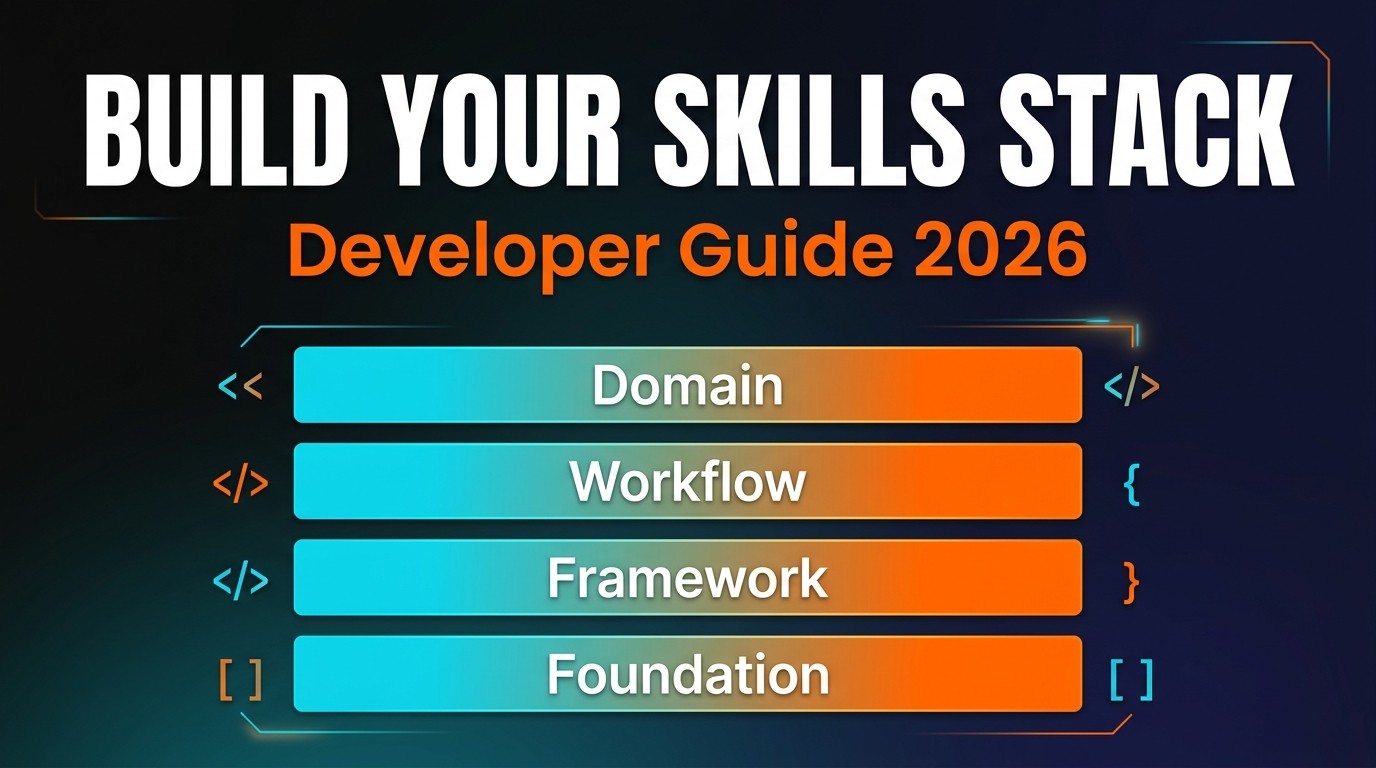
A skills stack is more than a list of installed skills. It is a layered architecture:
Layer 1 — Foundation: Universal preferences that apply to everything. Your coding style, language preferences, documentation standards, and error handling conventions.
Layer 2 — Framework: Skills specific to your tech stack. React patterns, Next.js conventions, your ORM's query style, your testing framework's best practices.
Layer 3 — Workflow: Skills that match how you work. PR description generators, commit message formatters, code review checklists, deployment validators.
Layer 4 — Domain: Industry or project-specific skills. Healthcare compliance checkers, financial calculation validators, e-commerce catalog managers.
Each layer builds on the ones below it. Your framework skills assume the foundation layer's coding style. Your workflow skills generate output that matches your framework conventions. The result is an AI assistant that does not just help with tasks — it helps with your tasks, in your way.
The Rise of Skill Packs
Manually assembling a skills stack from thousands of individual options is time-consuming. That is why Skill Packs have emerged as one of the fastest-growing categories in the ecosystem.
A Skill Pack bundles complementary skills into a single installable package. Explore pre-built Skill Packs to see what is available:
- Next.js Full Stack Pack: Components, API routes, database queries, server actions, middleware, and deployment — 12 skills that cover the entire Next.js development lifecycle.
- Python Data Science Pack: Jupyter workflows, pandas operations, visualization generation, model training, and experiment tracking.
- DevOps Essentials Pack: Docker, CI/CD, monitoring, logging, and incident response.
- API Development Pack: REST design, OpenAPI spec generation, authentication, rate limiting, and testing.
The advantage of packs over individual skills is that the authors have already solved the composition problem. Skills within a pack are tested together and designed to produce consistent output across related tasks.
Building Your Stack
If you prefer to build your own stack rather than using pre-built packs, here is the process I recommend:
Step 1: Audit your workflow Spend a day noting every task where you think "Claude could help with this." Group similar tasks together. Common groups include: scaffolding, testing, debugging, documentation, deployment, and code review.
Step 2: Find skills for each group Search Skiln for skills matching each task group. Read community reviews and check the "works" vote percentage before installing.
Step 3: Layer intentionally Install foundation skills first. Test them for a few days before adding framework skills. This incremental approach makes it easy to identify which skill is causing issues if something goes wrong.
Step 4: Test interactions Sometimes two skills give conflicting instructions. Run through common workflows and check that the output is consistent. If two skills disagree on error handling patterns, either remove one or explicitly set priority in your configuration.
Step 5: Export and version Once your stack is stable, export the configuration and commit it to your project repository. This makes it reproducible across machines and shareable with teammates.
Config Generators Save Hours
Manually editing JSON configuration files is tedious and error-prone. Generate your config with the Skiln Config Generator, which lets you select skills from a visual interface and outputs a ready-to-use configuration file.
The generator handles:
- Correct file paths for global vs project skills
- MCP server configuration with proper authentication placeholders
- Dependency ordering (some skills depend on others)
- Conflict detection between incompatible skills
What used to take an hour of reading documentation and editing JSON now takes two minutes of clicking checkboxes.
Team Stacks vs Personal Stacks
There is an important distinction between stacks you build for yourself and stacks you build for a team.
Personal stacks can be opinionated. You prefer tabs over spaces? Functional over class components? Single-line imports? Your stack, your rules.
Team stacks need consensus. The foundation layer should reflect agreed-upon standards — your team's style guide, architecture decisions, and review criteria. Individual developers can add personal layers on top, but the shared base ensures consistency across the codebase.
The best teams I have seen maintain a .claude/skills/ directory in their repo with team-approved skills, while individual developers add personal preferences to their global ~/.claude/skills/ directory. This separation keeps team standards enforced without limiting personal productivity.
The Bundling Trend Beyond Development
The skills stack pattern is not unique to development. Across industries, the trend toward curated bundles of AI capabilities is accelerating.
Businesses protecting their online reputation use Flaggd alongside development tools to manage their digital presence as a unified strategy rather than separate concerns. AI-powered analysis tools like Sentimyne show the same bundling trend in business intelligence — combining review monitoring, sentiment analysis, and SWOT reporting into a single workflow rather than juggling separate tools.
The underlying principle is the same: composed tools that work together outperform isolated tools used independently. Whether you are managing code, reputation, or business intelligence, the stack approach wins.
Getting Started Today
If you take one action after reading this, make it this: write down the five tasks you repeat most often in your development workflow. Then find one skill for each. Install them, test them for a week, and iterate.
You do not need the perfect stack on day one. The developers with the most effective setups built them incrementally over weeks, adding and removing skills based on real experience rather than theoretical utility.
The tools to build your stack are available now. Browse skills, install packs, generate configs — the infrastructure exists. The only variable is whether you invest the time to build a system that compounds your productivity or continue using ad-hoc tools that help with isolated tasks.
The compounding approach wins. Every time.